


Arm Holdings Has $2 Billion in Orders It Cannot Fill Yet — Is ARM Stock a Buy at $257?
TradingKey - Arm FY2026: $4.92B revenue (+20% YoY), data centre royalties doubled, $0.60 EPS record. $2B in orders but only half can be filled. Bernstein Outperform, TD Cowen $265 target. ARM at $257.
On May 6, Arm Holdings (NASDAQ: ARM) reported what it called record results for the fiscal year 2026: $4.92 billion for the entire year, 20% or better year-over-year growth for the third straight year, and data centre royalty revenues that more than doubled from a year ago. The shares have had a big run so far this year. The conundrum creating today’s volatility is one almost any company would prefer: Arm has around $2 billion worth of committed orders for its next-generation AGI CPU chips but because of limited manufacturing capacity, it can only satisfy about half at the moment.
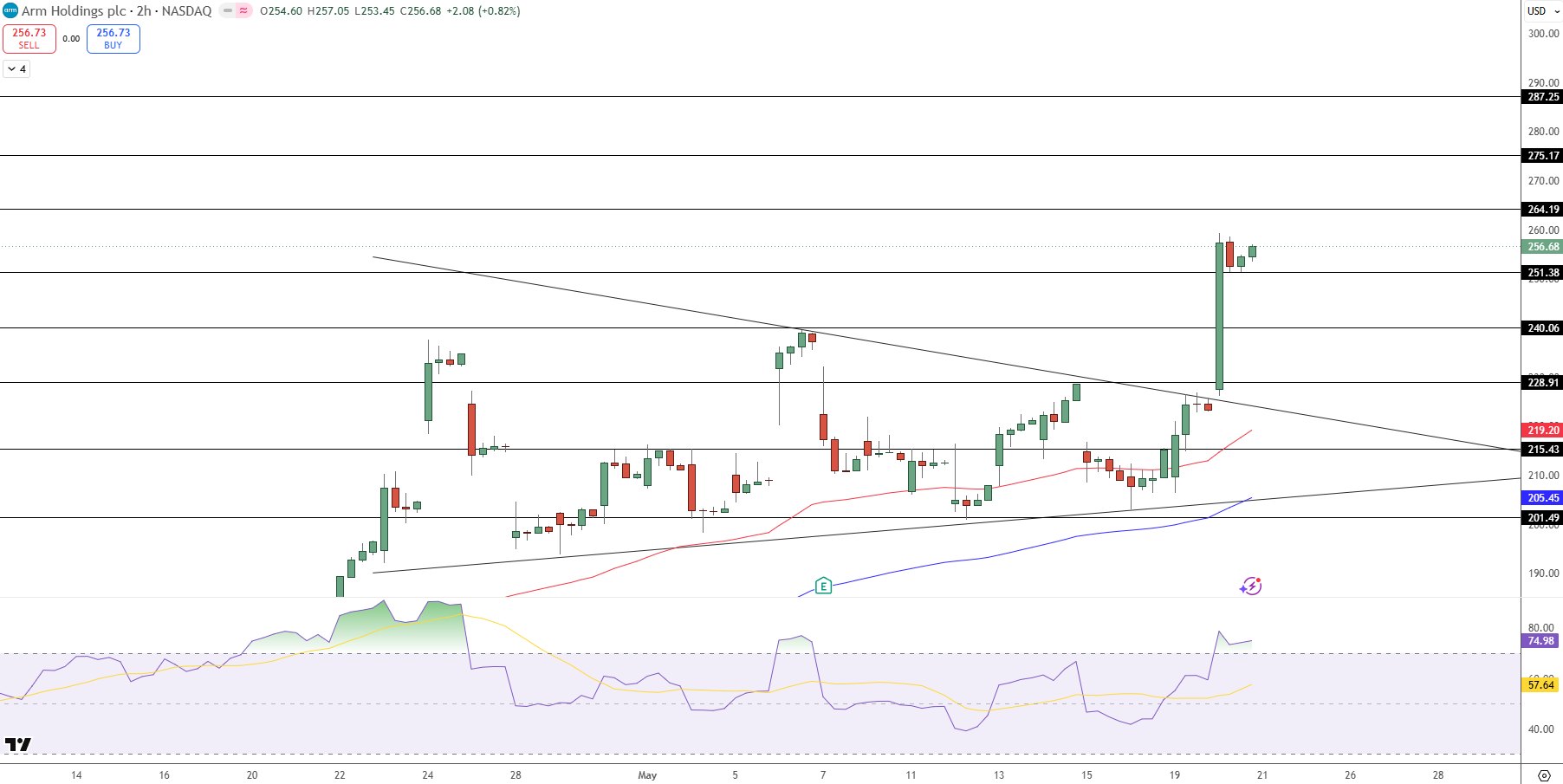
Too much demand is not a negative view on the company but it does bring some execution risk and uncertainty as to when the supply constraints are going to ease. At $256.68, ARM shares are testing again the descending trendline from May’s highs of $264 to $275 with the RSI at 74 to 75 and a bullish hammer on its chart.
FY2026 Results, Data Centre Royalties Doubled and Licensing Revenue Was Record
The full year FY2026 results were another data point supporting the idea of a business model transition in progress. Full-year 2026 revenue of $4.92 billion grew over 20% for a third consecutive year as the company has matured in the wake of its 2023 IPO. Royalty revenues grew 11% to $671 million due to the increasing take rate of the new Armv9 architecture as more products move into higher-royalty Compute Subsystems. Licensing revenue grew 29% to $819 million, as the backlog of new customers looking to design their own custom silicon on Arm chips continues to swell. Non-GAAP EPS hit a record $0.60, beating estimates. For the fourth quarter of 2026, revenue hit a record $1.49 billion, a 20% increase year-over-year.
The most important figure in the earnings report wasn’t the headline revenue figure but the data centre royalty revenue which more than doubled year-over-year. This figure is a measure of how far the Neoverse platform of data centre chips has made inroads with hyperscalers for their new AI infrastructure. Chips such as AWS Graviton, Google Axion, and Microsoft Cobalt are all Arm-based server chips that are going into hyperscaler AI data centres.
It’s not just the marketing that Arm’s chips offer better power efficiency for these data centres, it’s a fact that hyperscaler operators need in order to meet their power-density challenges for the new AI data centre infrastructure which has the GPU clusters of a few years ago nearing their limit of physical space and power capacity. The CEO, Rene Haas, has been talking for years about the power advantage of Arm architecture being its structural advantage in AI and the doubling of data centre royalty revenues bears this out.
The $2 Billion Order Gap: Why the Lack of Production Capacity Isn’t a Usual Problem
While the earnings numbers overall are strong, the volatility today is the result of a single detail: the company has $2 billion in committed orders for next-generation AGI chips which its manufacturing partners can currently deliver in an amount roughly equivalent to $1 billion. This is a demand problem masquerading as an execution problem. Customers want the product, have put in the money, and are waiting for supplies.
This is different in nature than a problem involving a company trying to ramp up production and uncertain about the demand. The issue is a timing problem. It’s possible that if the supply issues continue long enough some customers may be tempted to look at other architectures or make plans to design chips based on their current designs rather than the ones with limited production.
On a day when the earnings were good, Bernstein Securities initiated coverage of ARM with an Outperform rating because of the role it is set to play in next-generation data centres. TD Cowen raised its price target to $265 and Deutsche Bank moved to $205. Overall, the consensus remains bullish as the long-term thesis remains unchanged.
The business model that was first devised by the company 35 years ago, whereby it does not compete with its own customers by supplying its IP in a licensing format, its developer ecosystem of 22 million and its applications in everything from data centres to smartphones, to cars and edge AI, mean there is a multi-decade duration to the revenues Arm will generate from it. The production constraints are a problem for the 2026 calendar while the overall size of the total market the company is selling to is a story for the rest of this decade and the decade beyond.
ARM Technical Analysis: Re-Testing the Descending Trendline Around $257 with an RSI of 74
The ARM shares have fallen from the highs in May around $264 to $275 on the two-quarter NASDAQ 2H chart. The stock is now re-testing a black line trendline and the chart now shows a bullish hammer at the support point of the red moving average. The RSI has climbed into the bullish area around 74 to 75 with positive divergence on its past dips but is not yet at extreme overbought levels.
ARM Price Chart - Source: Tradingview
The moving average in the chart in blue supports the ARM shares at around $201 to $205. Above the descending line the key resistance is at $264.19 to $275.17, and then $287.25. The immediate support points are at $251.38 to $240.06, then $228.91. If the ARM shares stay above $258 the next targets are at the past high in May and beyond.
ARM share price trade plan
Entry: Long positions in shares above $258 when the descending trendline is breached as shown on the chart.
First target: $264.19 to $275.17 where resistance from past highs is likely to stop any further moves in share prices.
Second target: $287.25 at the next level of resistance.
Stop loss: Daily close below $251.00 when the trendline support in the chart is broken and invalidated.
What Were Arm Holdings FY2026 Numbers?
Arm Holdings announced that full-year revenue for FY2026 was $4.92 billion, up more than 20% from the previous year, marking the third year in a row with double-digit revenue growth. Royalty revenue was $671 million for the year, up 11%, while licensing revenue increased 29% to $819 million. Non-GAAP EPS was a record $0.60. Year-over-year data centre royalty revenue more than doubled on the back of continued Neoverse platform adoption at AWS, Google, and Microsoft.
Fourth quarter revenue came in at a record $1.49 billion. The company said it had nearly $2 billion in committed orders for next-generation AGI CPU chips from customers, but that it only has the capacity right now to ship roughly half of that volume because manufacturing is constrained.
Why Is Arm Holdings Stock Volatile Following a Strong Earnings Report?
Arm stock got choppy after the company disclosed that around $2 billion of committed orders for next-generation AGI CPU chips are constrained by manufacturing capacity and only half the volume will be fulfilled in this timeframe.
The volume shortfall represents extraordinary demand but leaves some execution and timing uncertainty around when the revenue gets recognized. Another headwind was a temporary pullback in smartphone revenue because the company’s memory chips for smartphone customers became constrained by the demand for chips for AI infrastructure, diverting semiconductor manufacturing away from consumer electronics. That volatility has mostly to do with timing in the near term, not any weakness in demand, as seen with royalty revenues from data centres more than doubling year over year.
Is Arm Stock a Buy at $257 in May 2026?
The technical setup is constructive. ARM is retesting the downtrendline since May at a red MA support zone where it formed a hammer candle with an RSI at 74 to 75 in bullish territory. A long above $258 looks to test $264.19 to $275.17 and $287.25, with a stop below $251.
Fundamentals are strong with data centre royalties more than doubling, $4.92 billion in FY2026 revenue, and nearly $2 billion in committed orders. Bernstein has an Outperform rating on the stock, as well as TD Cowen which raised its year-end target to $265. The biggest risk for investors is how the ramp-up in manufacturing capacity will proceed and the timeline for fulfilling this massive $2 billion order backlog.
The Bottom Line
Arm has about $2 billion in orders but can ship only $1 billion in volume right now. That represents a demand story, but not a fundamental failure; the upside simply takes longer to show up in revenue recognition. Data centre royalties doubling, $4.92 billion in FY2026 revenue, and the 22 million-developer ecosystem make a compelling case for the long-term opportunity here.
At $257, ARM is retesting a downtrendline after the hammer and RSI reading in bullish territory. The trade above $258 targets $264 to $275. The investment case should play out once manufacturing capacity gets ramped up to meet the $2 billion order backlog, with the next quarterly update happening in Q2 FY2027 in August.
Recommended Articles


