


What a Kevin Warsh-Led Fed Could Mean for the Big Bank Stocks
Key Points
Kevin Warsh was recently sworn in as chairman of the Federal Reserve.
He wants to shrink the Fed's balance sheet, which could be a headwind to bank earnings.
Lower regulations for banks may be a nice profit boost for the likes of JPMorgan Chase.
- 10 stocks we like better than JPMorgan Chase ›
After eight years, a new leader of the Federal Reserve has taken the reins from Jerome Powell. On May 15, Kevin Warsh stepped into the role leading the largest central bank in the world amid promises to bring changes to its philosophy, greasing the wheels of the financial system.
But what will that mean for big banks like JPMorgan Chase (NYSE: JPM), Bank of America (NYSE: BAC), and Wells Fargo (NYSE: WFC)? The answer lies in Warsh's philosophy toward banking regulations.
Will AI create the world's first trillionaire? Our team just released a report on the one little-known company, called an "Indispensable Monopoly" providing the critical technology Nvidia and Intel both need. Continue »
Low interest rates matter less than quantitative tightening
The first thing investors think about regarding the Federal Reserve is interest rates. The federal funds rate set by the Fed seeps through to the rest of the economy, affecting how much big banks can earn from loans. If JPMorgan Chase's cost of loans rises, it will be forced to lend at much higher rates to maintain profitability, reducing demand.
The Fed's interest rate policy is generally dictated by inflation. Low inflation means low interest rates, while high inflation means rising interest rates to cool the economy and halt price increases for consumers and businesses. His stated interest rate policy is not much different from Jerome Powell's or other Fed leaders, and managing prices and rates has been one of the core mandates of the Fed since it was established in 1913.
Where Warsh may hurt the big banks is his philosophy on the Fed's balance sheet. He is opposed to the central bank holding on to assets such as short-term Treasury securities and mortgage loans, which add liquidity to the banking system and make it easier for big banks to pay customers less on deposits. If Warsh starts offloading the Fed's balance sheet, it could pull liquidity out of the financial system. That could increase the interest big banks are forced to pay customers, which is a good thing for individuals but a headwind to banking profitability.

Image source: Getty Images.
Reducing regulations to fuel credit growth
On the positive side, Kevin Warsh wishes to reduce regulations that have burdened big banks since the 2007-2009 financial crisis, believing they have restricted the financial system's growth. He wants to slash compliance costs and lower capital requirements for banking balance sheets.
Both could boost banking profitability by lowering overhead costs and expanding the big banks' ability to lend to customers or return capital to shareholders through buybacks and dividends. At the end of the day, a bank makes more money if it can lend out more of the capital it holds on its balance sheet. This could enable the big banks to take advantage of the artificial intelligence (AI) revolution, which has been mainly fueled by rising loan volumes in private credit markets beyond the heavily regulated big banks.
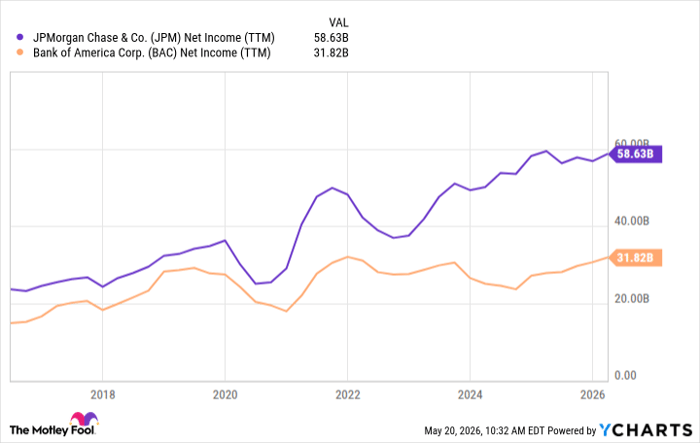
JPM Net Income (TTM) data by YCharts
What Kevin Warsh means for big bank stocks
On the whole, I believe Kevin Warsh's philosophy for managing the Federal Reserve could be a net positive for big banks like Wells Fargo. Although quantitative tightening may create a slight funding headwind by pushing up the rates bank must pay depositors, there is much more upside if banks are freed up to become more aggressive with loan generation.
We are currently in the middle of a funding boom in the U.S. economy, including in manufacturing, artificial intelligence (AI) infrastructure, and the space economy. Until now, most lending in this revolution has come outside the banking system, such as the aforementioned private credit institutions.
JPMorgan Chase's net income just hit a record of $58 billion, while Bank of America earned $32 billion. This earnings power depends to a great extent on the health of the U.S. economy, but because the economy tends to expand, so will bank earnings as long long as they can make profitable loans. At reasonable prices today, the big bank stocks look like sturdy long-term bets for an investor in the age of a Kevin Warsh Federal Reserve.
Should you buy stock in JPMorgan Chase right now?
Before you buy stock in JPMorgan Chase, consider this:
The Motley Fool Stock Advisor analyst team just identified what they believe are the 10 best stocks for investors to buy now… and JPMorgan Chase wasn’t one of them. The 10 stocks that made the cut could produce monster returns in the coming years.
Consider when Netflix made this list on December 17, 2004... if you invested $1,000 at the time of our recommendation, you’d have $481,750!* Or when Nvidia made this list on April 15, 2005... if you invested $1,000 at the time of our recommendation, you’d have $1,352,457!*
Now, it’s worth noting Stock Advisor’s total average return is 990% — a market-crushing outperformance compared to 206% for the S&P 500. Don't miss the latest top 10 list, available with Stock Advisor, and join an investing community built by individual investors for individual investors.
See the 10 stocks »
*Stock Advisor returns as of May 21, 2026.
JPMorgan Chase is an advertising partner of Motley Fool Money. Bank of America is an advertising partner of Motley Fool Money. Wells Fargo is an advertising partner of Motley Fool Money. Brett Schafer has no position in any of the stocks mentioned. The Motley Fool has positions in and recommends JPMorgan Chase. The Motley Fool has a disclosure policy.
Recommended Articles


