


Brent Crude Returns to $100 Mark. US-Iran Conflict Heats Up Again, JPMorgan Sees Oil Prices Remaining High This Year
Tradingkey - On May 26, ET, the conflict in Iran escalated once again, leading both major crude oil futures to pare losses. WTI crude futures are currently down 3% at $93.70; Brent crude futures returned to the $100 mark, still down 3.41% currently.
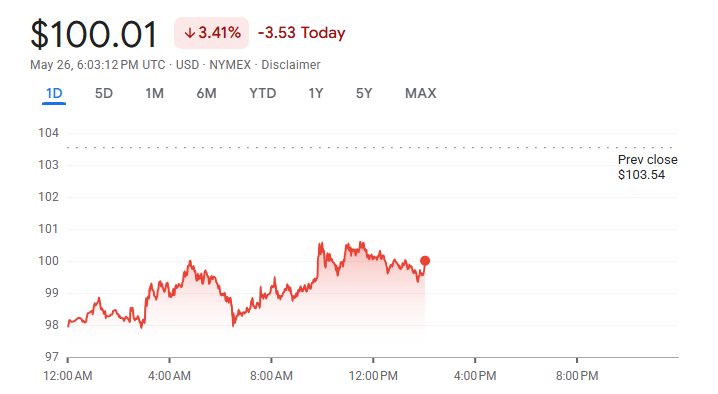
The core catalyst for the rapid rebound in international oil prices is the sudden escalation of geopolitical tensions in the Strait of Hormuz: the U.S. military recently launched strikes in the strait area, and Iran responded with tough countermeasures, directly causing market optimism for "restoring navigation through negotiations" to cool significantly.
According to official statements from U.S. Central Command, the U.S. strike targets included missile launch sites near the port of Bandar Abbas in southern Iran and two Iranian vessels attempting to lay mines in the Strait of Hormuz; the U.S. described the action as being of a "defensive nature." The Islamic Revolutionary Guard Corps responded in a statement on the 26th, claiming it shot down a U.S. MQ-9 "Reaper" drone in Iranian airspace over the Persian Gulf, marking a significant escalation in the military standoff between the two sides.
On the negotiation front, according to a report by Iran's Fars News Agency on the 26th, the core disagreement in Iran-U.S. negotiations remains focused on the unfreezing of $24 billion in overseas assets. Sources close to the Iranian negotiating team revealed that the U.S. has recently "backtracked" on fulfilling its commitment to unfreeze funds, while the Iranian side maintains a bottom-line position that "no agreement is possible until the agreed funds are received in full."
Meanwhile, Israel has signaled a tougher stance: it will intensify strikes against Hezbollah in Lebanon. Iran, for its part, has clearly stated that any peace agreement must include the "cessation of all hostilities in Lebanon" as a precondition, reflecting a trend of multi-point linkage in regional conflicts.
The essence of this conflict is the irreconcilable differences over core interests. Iran insists that the U.S. first unfreeze $24 billion in overseas assets as a "litmus test" of sincerity; whereas the U.S. demands that Iran first open the Strait of Hormuz and clear mines before gradually fulfilling its commitments. This "chicken or the egg" deadlock has become even more difficult to resolve following the U.S. military strikes.
For the crude oil market, this means the previous pricing logic based on a "peace agreement" has become invalid. The Strait of Hormuz accounts for 30% of global seaborne crude oil volume, and any sign of trouble will trigger sharp fluctuations in oil prices.
Phillip Nova analyst Priyanka Sachdeva noted in a report that although the market is occasionally supported briefly by peace prospects, traders overall still do not believe the situation has stabilized.
JPMorgan released the market's most targeted crude oil price outlook report. The bank pointed out that even if geopolitical conflicts ease and the Strait of Hormuz can fully resume navigation in June, the average annual price of Brent crude in 2026 will still remain high at $96 per barrel. On a quarterly basis, oil prices will show a "rise then fall" trend: the average price in the second quarter will be $103/barrel, climbing slightly to an annual peak of $104/barrel in the third quarter, and falling back to $98/barrel in the fourth quarter.
Recommended Articles


