


Why Is Oracle Stock Down for Five Straight Days? OpenAI Reliance and $88 Billion Net Debt Prompt Revaluation
TradingKey - Recent debates in the AI industry surrounding the pace of advanced model development have intensified, putting Oracle (ORCL) under renewed market scrutiny. As Oracle aggressively expands its cloud infrastructure and maintains close business ties with AI clients such as OpenAI, the market is growing concerned that if frontier AI labs slow down model R&D or cut related spending, it could further impact demand for cloud computing and AI compute power.
This concern has already been reflected in its stock price. On September 15, Oracle shares dropped 3.07%, declining for a fifth consecutive trading session and bringing its cumulative loss over the past five trading days to 13.6%. Notably, while some chip stocks have rebounded during the same period, Oracle remains under pressure.
Why OpenAI News Is Affecting Oracle's Stock Price
Oracle is transitioning from a traditional database software company into an AI infrastructure provider, and OpenAI is one of the most critical customers in this transformation. The closer their relationship becomes, the more pronounced the impact of changes in OpenAI's fundraising, model development, and compute spending will be on Oracle's valuation.
Anthropic CEO Dario Amodei called on the industry to appropriately slow the development pace of frontier models to buy more time for safety evaluations and governance measures. OpenAI CEO Sam Altman subsequently voiced concerns over AI safety issues and stated that, out of safety considerations, the company will not pursue an initial public offering in 2026.
These statements do not mean that OpenAI has reduced its infrastructure spending; however, the market fears that discussions surrounding the pace of AI development could prompt frontier laboratories to reassess their capital expenditures. If governments further tighten regulation, progress on model training, product launches, and data center construction could also be impacted.
Patrick Walravens, head of technology research at Citizens, believes that investors are growing concerned that frontier AI laboratories such as OpenAI and Anthropic may adopt a more cautious spending strategy. Because Oracle needs to invest massive capital upfront to build out cloud computing capacity, its stock price is particularly sensitive to changes in such expectations.
OpenAI's delayed IPO also adds uncertainty. A public listing was originally expected to provide the company with a new capital-raising channel; if the IPO timeline is pushed back, investors may focus more on whether OpenAI can rely on existing cash flows and private funding to sustain massive computing contracts over the long term.
$664 Billion in Orders Contrasts With High Leverage
Based on operational data, Oracle's AI cloud business continues to expand rapidly. In the first quarter of fiscal 2027, the company's revenue reached $19.34 billion, up 30% year-over-year, while cloud infrastructure revenue grew 121% to $7.4 billion. The company also signed over $30 billion in new AI cloud contracts during the quarter, pushing its remaining performance obligations to $664 billion. Oracle's official financial report shows that the massive order backlog provides high visibility for future revenue.
However, orders do not equal cash revenue. Remaining performance obligations reflect contract amounts that have been signed but not yet recognized as revenue, which typically must be recognized gradually as data centers are completed, computing power is delivered, and customers actually use the services. Oracle must first commit capital to purchase chips, build facilities, and upgrade power and networking infrastructure before it can convert orders into revenue and cash flow.
The company expects capital expenditures to reach $90 billion to $95 billion in fiscal 2027. Meanwhile, FactSet data shows that Oracle's net debt stands at approximately $88 billion. The simultaneous rise in order volume and balance sheet pressure presents the company with a unique risk profile.
Gil Luria, an analyst at D.A. Davidson, noted that Oracle possesses an order backlog comparable to that of traditional hyperscalers, alongside the high capital expenditure and high leverage characteristics of new-generation AI cloud companies. Compared with cloud giants that are financially stronger and able to use cash flow from mature businesses to support data center construction, Oracle relies more heavily on debt financing and a small number of large AI clients.
If demand for AI computing power continues to grow, Oracle can use operating leverage to rapidly expand revenue and gradually improve free cash flow. However, if customers delay deployment or reduce purchases, the company must still bear fixed costs such as data center construction, interest expenses, and equipment depreciation. This asymmetric risk is a major reason why Oracle remains under pressure while other AI stocks rebound.
Oracle Stock Technical Analysis
Source: TradingView
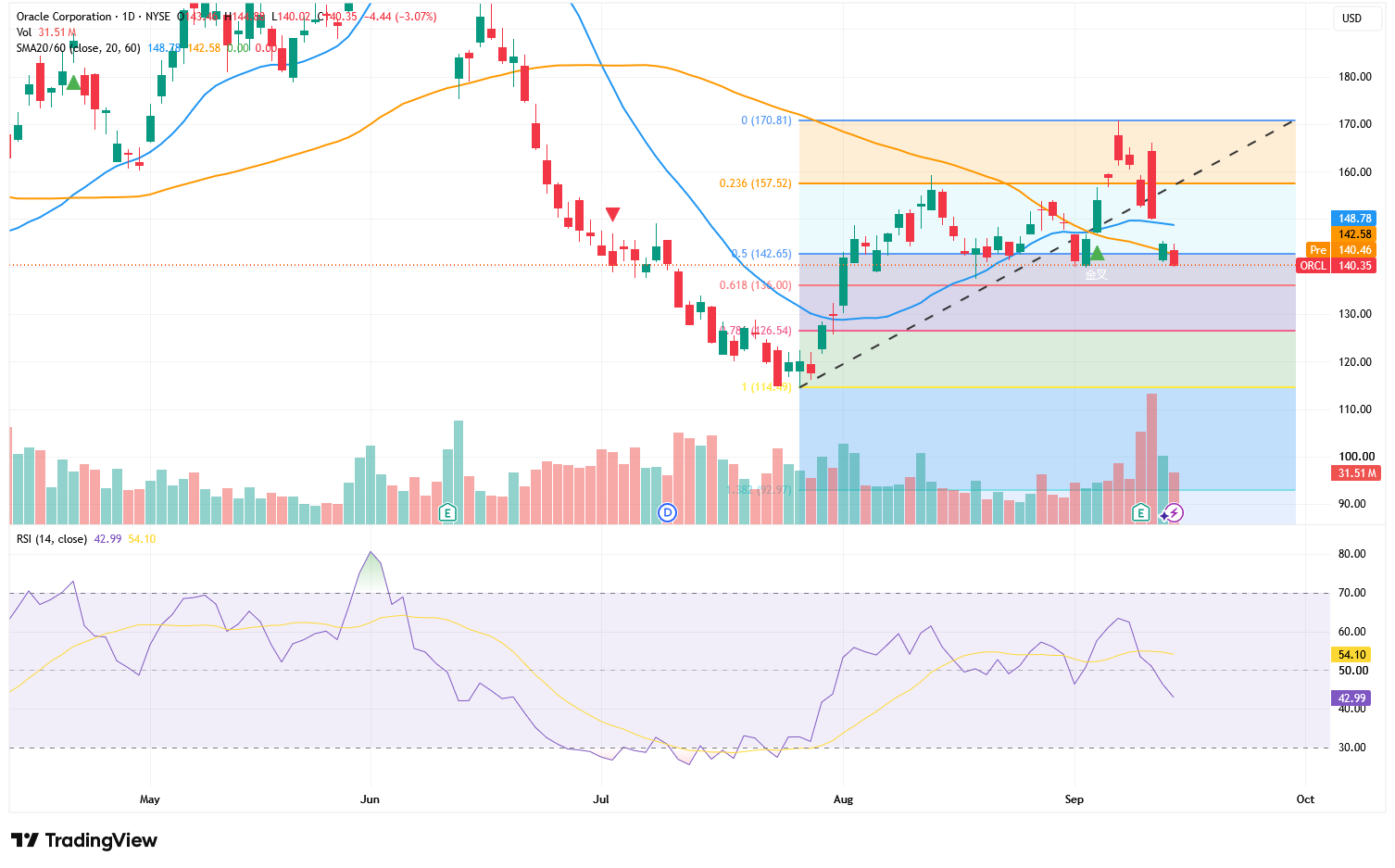
Oracle last closed at $140.35, with its stock price pulling back for five consecutive trading days. The stock had previously rebounded to around $168 but failed to break above its previous high of $170.81, before rapidly falling below the upward trendline, indicating noticeable profit-taking and capital outflow pressure near the peak.
Currently, the stock price has fallen below the 20-day moving average of $148.78 and is slightly below the 60-day moving average of $142.58. The 0.5 Fibonacci retracement level sits at $142.65, forming a key resistance zone alongside the 60-day moving average. If the stock cannot quickly reclaim $142.6–$149, any rebound may remain suppressed by the moving averages.
In terms of momentum, the 14-day RSI has dropped to 42.99, significantly below the signal line of 54.10 and crossing below the 50 threshold, indicating that bearish momentum continues to build. Since the RSI has not yet entered the oversold territory below 30, it cannot be confirmed that the stock price has bottomed out.
To the downside, focus first on the 0.618 Fibonacci retracement level at $136. If the stock price can stabilize in the $136–$140 range, a technical rebound could emerge to retest $142.65 and $148.78; if it breaks below $136 on heavy daily volume, the next support will shift down to $126.54, with a further potential retest of the interim low of $114.49.
To the upside, Oracle must firmly regain $149 to initially ease the pressure from its five-day losing streak; it then needs to break above $157.52 for the rebound structure to improve significantly. $170.81 remains a strong medium-term resistance, and only reclaiming this level will confirm a new uptrend.
Recommended Articles


