


3 Company Earnings to Watch This Week (April 13-17)
Key Points
Investors can glean key insights into the economy from JPMorgan Chase's earnings report.
Taiwan Semiconductor can provide clues about AI demand.
Netflix just raised prices and has an ambitious content budget for 2026.
- 10 stocks we like better than Netflix ›
Earnings season for the first quarter of 2026 has officially kicked off, and while the bulk of the season will last for at least the next several weeks, analysts will get to see some key reports over the next few days (April 13-17).
Earnings reports provide a three-month snapshot into a company's performance. Management teams also typically use the reports as an opportunity to set up a conference call with Wall Street analysts to provide an update on the business and take questions.
Will AI create the world's first trillionaire? Our team just released a report on the one little-known company, called an "Indispensable Monopoly" providing the critical technology Nvidia and Intel both need. Continue »
The technical part of earnings season is the numbers themselves. Analysts who cover a stock all have their own projections for earnings and revenue, among many other line items. These estimates are averaged together to create a consensus. If a company reports numbers better than consensus, that's often a good sign; the reverse is true if results are below estimates.
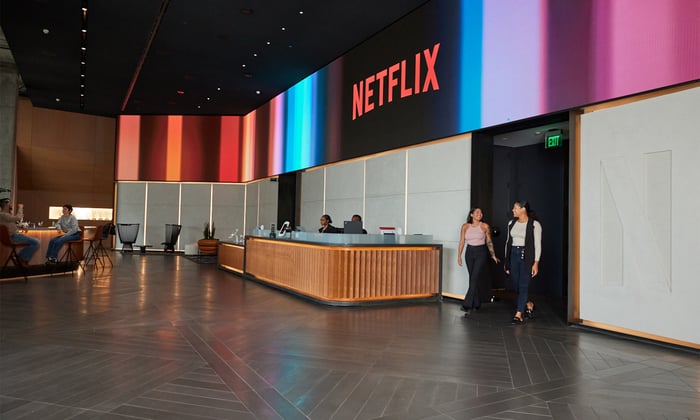
Image source: Netflix.
Some management teams will also provide more near-term guidance, which is also weighed against consensus estimates. The conference calls provide investors with an opportunity to gauge sentiment and gain more insight into big company initiatives or projects.
While well over 100 companies will report earnings this week, here are three big ones to watch.
From banking to artificial intelligence to streaming
JPMorgan Chase (NYSE: JPM), the largest U.S. bank by assets, will report tomorrow before the market opens.
While the numbers are somewhat interesting here, at least if there is a big beat or miss on a certain line item, I think investors will be more focused on full-year guidance and broader insights into the economy.
JPMorgan reports full-year guidance for net interest income, expenses, and projected losses in the credit card portfolio. Any changes from last quarter could move the stock.
However, given concerns about the broader economy, investors will be equally interested in how the consumer is holding up and other segments of the economy.
On Thursday, April 16, both Taiwan Semiconductor (NYSE: TSM) and Netflix (NASDAQ: NFLX) will report.
Because Taiwan Semiconductor reports monthly revenue numbers, we already know that the chip manufacturer posted $35.6 billion in revenue, above Wall Street forecasts and a 35% year-over-year increase.
However, as the primary manufacture for Nvidia's most advanced semiconductor chips, investors in artificial intelligence stocks will be curious about overall demand, a key topic in the sector. Taiwan Semiconductor provides guidance for the following quarter's net revenue and gross and operating margins, so investors will certainly be interested in that, as well as any other comments touching on demand.
Netflix is coming off a tumultuous few months, during which it ultimately decided to back out of an intense bidding war over the company Warner Bros. That means the streaming giant is back to focusing on organic growth.
Netflix just raised subscription prices on all of its plans, so investors will likely be interested to see what subscriber growth has been like and whether management increases its 2026 revenue guidance range of $50.7 billion to $51.7 billion.
Netflix is also trying to hit a $20 billion content budget in 2026, so I'm sure investors will want more details on this plan, as well as other initiatives at the company.
Should you buy stock in Netflix right now?
Before you buy stock in Netflix, consider this:
The Motley Fool Stock Advisor analyst team just identified what they believe are the 10 best stocks for investors to buy now… and Netflix wasn’t one of them. The 10 stocks that made the cut could produce monster returns in the coming years.
Consider when Netflix made this list on December 17, 2004... if you invested $1,000 at the time of our recommendation, you’d have $555,526!* Or when Nvidia made this list on April 15, 2005... if you invested $1,000 at the time of our recommendation, you’d have $1,156,403!*
Now, it’s worth noting Stock Advisor’s total average return is 968% — a market-crushing outperformance compared to 191% for the S&P 500. Don't miss the latest top 10 list, available with Stock Advisor, and join an investing community built by individual investors for individual investors.
See the 10 stocks »
*Stock Advisor returns as of April 13, 2026.
JPMorgan Chase is an advertising partner of Motley Fool Money. Bram Berkowitz has no position in any of the stocks mentioned. The Motley Fool has positions in and recommends JPMorgan Chase, Netflix, Nvidia, Taiwan Semiconductor Manufacturing, and Warner Bros. Discovery. The Motley Fool has a disclosure policy.
Recommended Articles


