


Stanley Druckenmiller Says Stablecoins Will Dominate Global Payments Within 15 Years. Are Visa and Mastercard Stock in Trouble?
Key Points
Stablecoins are digital assets pegged to a commodity or currency.
Druckenmiller believes more of the global payments system will soon gravitate toward stablecoins due to their efficiency and low cost.
The big question is what this means for payment giants Visa and Mastercard.
- 10 stocks we like better than Visa ›
Stablecoins have made a big splash in payments. The tokens leverage the same blockchain technology as cryptocurrencies, but without the inherent volatility. Stablecoins are often pegged to fiat currencies like the U.S. dollar, meaning they try to track the currency's price at all times.
While increasingly viewed as an innovative payment method, stablecoins just got a ringing endorsement from one of the best investors of all time. Billionaire Stanley Druckenmiller recently said he thinks the global payments system will largely run on stablecoins within the next 10 to 15 years.
Will AI create the world's first trillionaire? Our team just released a report on the one little-known company, called an "Indispensable Monopoly" providing the critical technology Nvidia and Intel both need. Continue »
Does this pose a major threat to the two global payment giants, Visa (NYSE: V) and Mastercard (NYSE: MA)? Are these stocks in trouble?
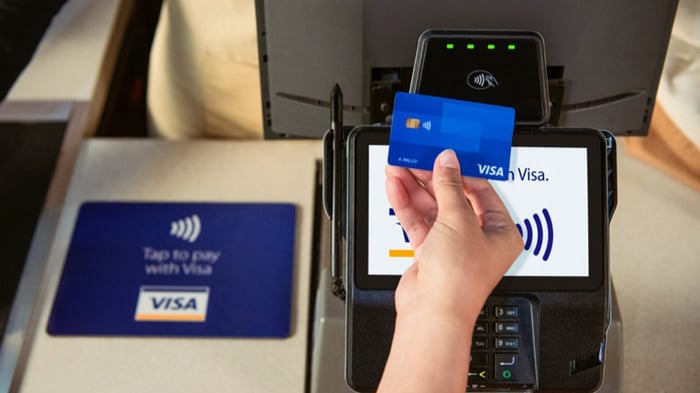
Image source: Visa.
Why stablecoins pose disruption
As mentioned, stablecoins are digital assets that run on blockchain networks, but without the volatility that most tokens pose. The core use case for all digital assets is that they can move money between any two parties with internet access, bypassing the need for a bank account and the other traditional payment rails that currently power most global payments.
If you don't need the traditional rails, then you may not need all of the middlemen that currently power traditional payment transactions, each of which takes a cut of the small fee charged for each transaction. The blockchain also powers payments to be transmitted and settled instantly, at all hours of the day and on any day of the year, which makes it easy to see why people are bullish on stablecoins.
Not only is Druckenmiller one of the best at spotting future trends, but he's not historically been a huge bull on crypto. Still, he views stablecoins becoming dominant because they are "efficient, quicker, and cheaper" and "incredibly useful in terms of productivity." Stablecoins are also flexible because they can be converted into other cryptocurrencies or fiat currencies.
The largest stablecoins are currently Tether and USDC, with market caps of roughly $184 billion and nearly $78 billion, respectively. Both track the U.S. dollar.
Stablecoin usage also continues to surge. In 2025, global stablecoin transaction value totaled $33 trillion, according to Bloomberg, a 72% increase from 2024. Bloomberg Intelligence also predicts that stablecoin payment flows will hit $56 trillion by 2030.
Are Visa and Mastercard in trouble?
Visa and Mastercard run the two largest payment networks in the world. For the 12 months ending Sept. 30, Visa saw $16.7 trillion in total volume flow through its network. Both networks have long had impenetrable moats, enabling many investors to view these companies as set-it-and-forget-it stocks. Many challengers have tried and failed to disrupt Visa and Mastercard.
Visa and Mastercard have long been aware of cryptocurrencies and have begun to embed them into their businesses. In presentations last July, Mastercard executives downplayed the threat of stablecoins and said they view them as an opportunity. At the time, Mastercard chief product officer Jorn Lambert said that about 90% of stablecoin volume was still used to trade other cryptocurrencies, so the technology is not yet being used for traditional payments.
Still, Mastercard has offered stablecoins for certain uses and partnered with companies seeking to use them. Three use cases Mastercard foresees for stablecoins are issuing cards for buying and selling stablecoins, helping financial institutions offer stablecoins, and providing digital wallets for business-to-business and cross-border transactions.
Last year, Visa CEO Ryan McInerney said that the company would offer access to stablecoins and help them scale if it sees demand for the technology.
While executives at the payment giants have brushed off the risk of stablecoins, they are certainly real to an extent. If you are in any business, why would you want to pay a fee on each merchant transaction if you didn't have to, or if it could cost less? It is possible that the percentage of Visa and Mastercard transactions erodes over time or that the networks lose volume.
Still, Visa appears to be focused on interoperability across various crypto networks and traditional payment rails, while also adding value-added services, such as payment technologies and fraud capabilities. After all, if payments can be made instantly, catching fraud before it happens becomes critical.
Ultimately, stablecoins could force Visa and Mastercard to seek new sources of revenue or change their business models, but I don't believe they will make the payment giants irrelevant, and I haven't seen enough evidence to suggest they will significantly hurt their market positions.
Should you buy stock in Visa right now?
Before you buy stock in Visa, consider this:
The Motley Fool Stock Advisor analyst team just identified what they believe are the 10 best stocks for investors to buy now… and Visa wasn’t one of them. The 10 stocks that made the cut could produce monster returns in the coming years.
Consider when Netflix made this list on December 17, 2004... if you invested $1,000 at the time of our recommendation, you’d have $550,348!* Or when Nvidia made this list on April 15, 2005... if you invested $1,000 at the time of our recommendation, you’d have $1,127,467!*
Now, it’s worth noting Stock Advisor’s total average return is 959% — a market-crushing outperformance compared to 191% for the S&P 500. Don't miss the latest top 10 list, available with Stock Advisor, and join an investing community built by individual investors for individual investors.
See the 10 stocks »
*Stock Advisor returns as of April 10, 2026.
Bram Berkowitz has no position in any of the stocks mentioned. The Motley Fool has positions in and recommends Mastercard and Visa. The Motley Fool has a disclosure policy.
Recommended Articles


