

2 Recession Resistant Dividend Stocks to Buy Now While They're Still Cheap

Source The Motley Fool

Key Points

  • CVS Health and Bristol Myers Squibb are built to handle the toughest recessions.

  • Both companies have maintained or increased their dividends through downturns over the past two decades.

  • Their shares look attractive right now.

  • 10 stocks we like better than CVS Health ›

When a recession hits, investors tend to take their money out of speculative, high-risk stocks and put it into safer companies, those with businesses built to perform relatively well across the entire economic cycle. Now might be a good time to at least explore doing so. We aren't sure that a recession will hit soon, but it now seems more likely than it was even three months ago, given rising oil prices and geopolitical tensions. Let's consider two stocks that could be safe havens during a recession, and that also happen to be attractively valued: CVS Health (NYSE: CVS) and Bristol Myers Squibb (NYSE: BMY).

Pharmacist talking to patient.

Image source: Getty Images.

Will AI create the world's first trillionaire? Our team just released a report on the one little-known company, called an "Indispensable Monopoly" providing the critical technology Nvidia and Intel both need. Continue »

1. CVS Health

For investors worried about a recession, CVS Health is worth serious consideration. The company's business -- featuring a vast network of pharmacies across the U.S., a large insurance business, and small but growing footprints in primary care -- is built to perform relatively well during recessions. CVS Health's dividend program is another thing to consider. Regular payouts can help smooth out market losses during downturns.

Over the past 20 years -- which includes the 2008 financial crisis, the pandemic-related disruption, and many other shocks to the economy and broader equity markets -- CVS has maintained its dividend program without resorting to payout cuts.
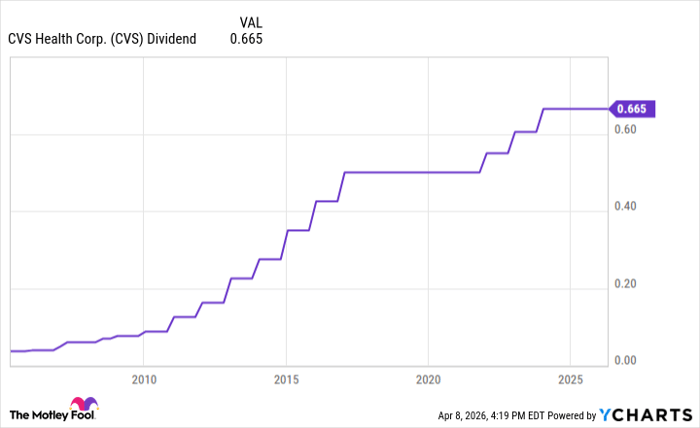
CVS Dividend Chart

CVS Dividend data by YCharts

CVS Health could also be a great long-term stock, as the company should benefit from increased demand for medical care driven by an aging population. Meanwhile, the stock looks reasonably valued, trading at 10.3x forward earnings, compared to the healthcare sector average of 16.8x.

CVS Health is well equipped to address various challenges, as it has before, and continues to perform well in the long run. That's why the stock is a buy today.

2. Bristol Myers Squibb

Bristol Myers' shares look particularly cheap right now. The company is trading at 9.5x forward earnings. While it is true that it has encountered patent cliffs in recent years -- and will face more in the next few -- Bristol Myers has also launched plenty of new products that should help it bounce back once the effect of older, off-patent medicines fades.

The company even launched a new, subcutaneous version of its oncology medicine, Opdivo, that has been a major growth driver for years. Opdivo will soon run out of patent exclusivity, too, but the new formulation won't and should contribute to Bristol Myers' top line for years.

The drugmaker's vast portfolio of medicines across multiple therapeutic areas can also help it navigate recessions. No one wants to stop taking drugs that treat severe, chronic, or lifesaving conditions, regardless of what the economy is doing. Lastly, Bristol Myers also has a solid dividend program and has not suspended or reduced its dividend in the past two decades, further evidence that it can navigate downturns.
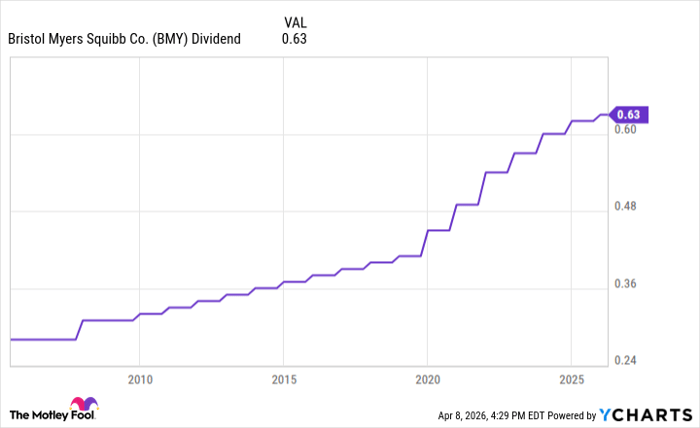
BMY Dividend Chart

BMY Dividend data by YCharts

Bristol Myers is a top pick for income seekers preparing their portfolios for a recession.

Should you buy stock in CVS Health right now?

Before you buy stock in CVS Health, consider this:

The Motley Fool Stock Advisor analyst team just identified what they believe are the 10 best stocks for investors to buy now… and CVS Health wasn’t one of them. The 10 stocks that made the cut could produce monster returns in the coming years.

Consider when Netflix made this list on December 17, 2004... if you invested $1,000 at the time of our recommendation, you’d have $536,003!* Or when Nvidia made this list on April 15, 2005... if you invested $1,000 at the time of our recommendation, you’d have $1,116,248!*

Now, it’s worth noting Stock Advisor’s total average return is 946% — a market-crushing outperformance compared to 190% for the S&P 500. Don't miss the latest top 10 list, available with Stock Advisor, and join an investing community built by individual investors for individual investors.

See the 10 stocks »

*Stock Advisor returns as of April 10, 2026.

Prosper Junior Bakiny has no position in any of the stocks mentioned. The Motley Fool has positions in and recommends Bristol Myers Squibb. The Motley Fool recommends CVS Health. The Motley Fool has a disclosure policy.

Disclaimer: For information purposes only. Past performance is not indicative of future results.
placeholder
Bitcoin CME gaps at $35,000, $27,000 and $21,000, which one gets filled first?Prioritize filling the $27,000 gap and even try higher.
Author  FXStreet
Aug 22, 2023
Prioritize filling the $27,000 gap and even try higher.
placeholder
Pinduoduo Earnings Incoming: Morgan Stanley Sees Long-Term Profit Potential​Insights – On November 21, Chinese e-commerce giant Pinduoduo (PDD) will release its Q3 2024 earnings.
Author  Mitrade
Nov 20, 2024
​Insights – On November 21, Chinese e-commerce giant Pinduoduo (PDD) will release its Q3 2024 earnings.
placeholder
Elon Musk’s xAI and Neuralink Launch New Funding Rounds​Billionaire Elon Musk recently raised funds for his two high-profile tech companies, xAI and Neuralink.
Author  Insights
Jun 03, 2025
​Billionaire Elon Musk recently raised funds for his two high-profile tech companies, xAI and Neuralink.
placeholder
Bitcoin briefly loses 2025 gains as crypto plunges over the weekend.Bitcoin experienced a sharp decline this weekend, briefly erasing its 2025 gains and dipping below its year-opening value of $93,507. The cryptocurrency fell to a low of $93,029 on Sunday, representing a 25% drop from its all-time high in October. Although it has rebounded slightly to around $94,209, the pressures on the market remain significant. The downturn occurred despite the reopening of the U.S. government on Thursday, which many had hoped would provide essential support for crypto markets. This year initially appeared promising for cryptocurrencies, particularly after the inauguration of President Donald Trump, who has established the most pro-crypto administration thus far. However, ongoing political tensions—including Trump's tariff strategies and the recent government shutdown, lasting a historic 43 days—have contributed to several rapid price pullbacks for Bitcoin throughout the year. Market dynamics are also being influenced by Bitcoin whales—investors holding large amounts of Bitcoin—who have been offloading portions of their assets, consequently stalling price rallies even as positive regulatory developments emerge. Despite these sell-offs, analysts from Glassnode argue that this behavior aligns with typical patterns seen among long-term investors during the concluding stages of bull markets, suggesting it is not indicative of a mass exodus. Notably, Bitcoin is not alone in its struggles, as Ethereum and Solana have also recorded declines of 7.95% and 28.3%, respectively, since the start of the year, while numerous altcoins have faced even steeper losses. Looking ahead, questions linger regarding the viability of the four-year cycle thesis, particularly given the increasing institutional support and regulatory frameworks now in place in the crypto landscape. Matt Hougan, chief investment officer at Bitwise, remains optimistic, suggesting a potential Bitcoin resurgence in 2026 driven by the “debasement trade” thesis and a broader trend toward increased adoption of stablecoins, tokenization, and decentralized finance. Hougan emphasized the soundness of the underlying fundamentals, pointing to a positive outlook for the sector in the longer term.
Author  Mitrade
Nov 17, 2025
Bitcoin experienced a sharp decline this weekend, briefly erasing its 2025 gains and dipping below its year-opening value of $93,507. The cryptocurrency fell to a low of $93,029 on Sunday, representing a 25% drop from its all-time high in October. Although it has rebounded slightly to around $94,209, the pressures on the market remain significant. The downturn occurred despite the reopening of the U.S. government on Thursday, which many had hoped would provide essential support for crypto markets. This year initially appeared promising for cryptocurrencies, particularly after the inauguration of President Donald Trump, who has established the most pro-crypto administration thus far. However, ongoing political tensions—including Trump's tariff strategies and the recent government shutdown, lasting a historic 43 days—have contributed to several rapid price pullbacks for Bitcoin throughout the year. Market dynamics are also being influenced by Bitcoin whales—investors holding large amounts of Bitcoin—who have been offloading portions of their assets, consequently stalling price rallies even as positive regulatory developments emerge. Despite these sell-offs, analysts from Glassnode argue that this behavior aligns with typical patterns seen among long-term investors during the concluding stages of bull markets, suggesting it is not indicative of a mass exodus. Notably, Bitcoin is not alone in its struggles, as Ethereum and Solana have also recorded declines of 7.95% and 28.3%, respectively, since the start of the year, while numerous altcoins have faced even steeper losses. Looking ahead, questions linger regarding the viability of the four-year cycle thesis, particularly given the increasing institutional support and regulatory frameworks now in place in the crypto landscape. Matt Hougan, chief investment officer at Bitwise, remains optimistic, suggesting a potential Bitcoin resurgence in 2026 driven by the “debasement trade” thesis and a broader trend toward increased adoption of stablecoins, tokenization, and decentralized finance. Hougan emphasized the soundness of the underlying fundamentals, pointing to a positive outlook for the sector in the longer term.
placeholder
Gold edges lower below $4,750 amid fragile Middle East ceasefire Gold price (XAU/USD) trades in negative territory around $4,705 during the early Asian session on Thursday. The precious metal edges lower amid a temporary two-week ceasefire between the US and Iran.   
Author  FXStreet
Yesterday 09: 04
Gold price (XAU/USD) trades in negative territory around $4,705 during the early Asian session on Thursday. The precious metal edges lower amid a temporary two-week ceasefire between the US and Iran.   
goTop
quote