


Will the S&P 500 Crash in 2026? History Offers a Clear Answer
Key Points
Earlier this year, the S&P 500 was down as much as 9% from its all-time high.
Given recent and forecast earnings growth rates, this correction is typical of what we've seen in the past under similar conditions.
Deeper bear markets of 20% or more generally require a significant earnings contraction or recession.
- 10 stocks we like better than S&P 500 Index ›
The markets have experienced a lot of volatility over the past month due primarily to the war in Iran. At one point in late March, the S&P 500 (SNPINDEX: ^GSPC) closed about 9% below its all-time high. That doesn't yet meet the generally accepted definition of a correction, but it sure feels like one to many.
Naturally, it raises the question of whether there are worse times ahead. History does offer some guidance on this front. While there are no guarantees, investors might like what they find.
Will AI create the world's first trillionaire? Our team just released a report on the one little-known company, called an "Indispensable Monopoly" providing the critical technology Nvidia and Intel both need. Continue »
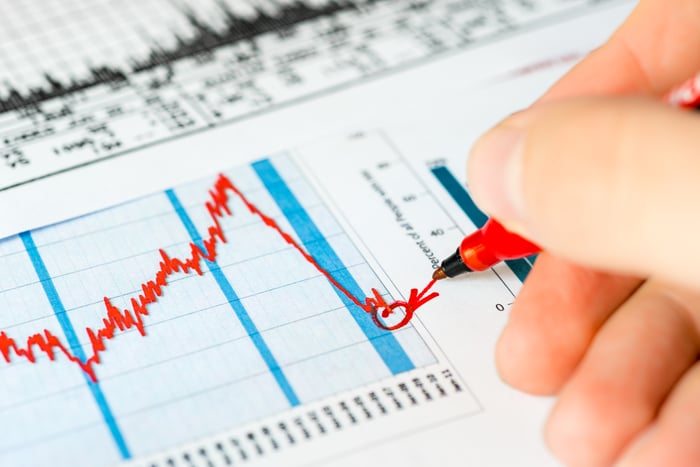
Image source: Getty Images.
Key takeaways
- Corrections of 10% typically occur about once a year. U.S. stocks enter a 20%-plus bear market drop on average about every six years.
- Corrections often occur during both good and bad economic conditions. Bear markets more typically occur only when there's a recession, an earnings contraction, or another major event.
- Strong earnings growth tends to insulate against steeper stock market declines.
- S&P 500 earnings growth percentage is expected to be in the double digits over the next two years.
History suggests a low risk of a bear market when earnings growth is strong
In the short term, stocks can move for many reasons. Over the long term, stock market performance is driven by earnings growth. If corporate earnings are growing steadily, it's likely to limit the downside that might be experienced.
Let's take a look at recent corrections in which stocks fell, but earnings continued to grow.
| Year | S&P 500 EPS Growth | Market Event |
|---|---|---|
| 1994 | +39.8% | 9% pullback in the first half of the year |
| 1997 | +2.6% | 10% correction late in the year |
| 1999 | +27.7% | 12% correction in the second half of the year |
| 2004 | +20.1% | 8% pullback in mid-year |
| 2011 | +12.4% | 19% correction; near-bear market |
| 2018 | +20.5% | 20% correction in the fourth quarter |
Data source: Multiple
History shows that positive earnings growth for the S&P 500 doesn't necessarily preclude stocks from approaching a bear market. In the cases of 2011 and 2018, however, most of the losses were recovered in relatively short order.
- 2011: Bottom in October, new all-time high in February 2012.
- 2018: Bottom in December, new all-time high in April 2019.
If history is any guide, it teaches us this. When earnings are growing, corrections are possible, but generally contained. Even in deeper corrections, rebounds tend to come relatively quickly.
But how about those deeper bear markets?
| Year | Event | Result |
|---|---|---|
| 2000-2002 | Tech bubble | Earnings fell 51% in 2001; the S&P 500 dropped 49% |
| 2007-2009 | Housing crisis | Earnings fell 19% in '07 and 77% in '08; S&P 500 down 51% |
| 2020 | COVID-19 pandemic | Earnings fell 32%; S&P 500 down 32% |
| 2022 | Inflation spike | Earnings fell 13%; S&P 500 down 24% |
Data source: Multiple
In short, if earnings break down and/or a recession hits, a deep bear market in stocks is more than likely.
Will the S&P 500 crash in 2026?
FactSet estimates currently call for S&P 500 earnings growth of 17% in 2026 and another 17% in 2027.
If those estimates prove true, it would strongly support the idea that there will be no stock market crash in 2026.
If there's anything that the war in Iran has taught us this year, however, it's that conditions can change quickly. If anything happens to cause earnings estimates to fall, though, it'd be time to get cautious.
Should you buy stock in S&P 500 Index right now?
Before you buy stock in S&P 500 Index, consider this:
The Motley Fool Stock Advisor analyst team just identified what they believe are the 10 best stocks for investors to buy now… and S&P 500 Index wasn’t one of them. The 10 stocks that made the cut could produce monster returns in the coming years.
Consider when Netflix made this list on December 17, 2004... if you invested $1,000 at the time of our recommendation, you’d have $532,066!* Or when Nvidia made this list on April 15, 2005... if you invested $1,000 at the time of our recommendation, you’d have $1,087,496!*
Now, it’s worth noting Stock Advisor’s total average return is 926% — a market-crushing outperformance compared to 185% for the S&P 500. Don't miss the latest top 10 list, available with Stock Advisor, and join an investing community built by individual investors for individual investors.
See the 10 stocks »
*Stock Advisor returns as of April 5, 2026.
David Dierking has no position in any of the stocks mentioned. The Motley Fool has positions in and recommends FactSet Research Systems. The Motley Fool has a disclosure policy.
Recommended Articles


