


Wondering What AGNC Investment Is Worth? The REIT Tells You Every Quarter.
Key Points
AGNC Investment is a mortgage real estate investment trust.
Most investors are awed by the massive 14% yield, but its tangible book value per share could be more important.
- 10 stocks we like better than AGNC Investment Corp. ›
Dividend investors often place too much emphasis on a stock's dividend yield. While that's understandable to some degree, it can lead you into troubling waters if you aren't careful. AGNC Investment's (NASDAQ: AGNC) 14% yield is an example of the issue. Here's what you need to know, including the company's regular reporting of what the business is really worth.
What does AGNC Investment do?
AGNC Investment is a mortgage real estate investment trust (REIT). It oversees a portfolio of bond-like securities that are created by pooling individual mortgages. In this way, it operates a bit like a mutual fund. Which is interesting because mutual funds report the value of their portfolio, known as net asset value (NAV), on a daily basis. AGNC Investment reports its tangible net book value every quarter, which is roughly similar to NAV.
Will AI create the world's first trillionaire? Our team just released a report on the one little-known company, called an "Indispensable Monopoly" providing the critical technology Nvidia and Intel both need. Continue »

Image source: Getty Images.
Effectively, AGNC Investment is telling you what it is worth. At the end of 2025, its tangible net book value was $8.88 per share. That is up from $8.41 at the end of 2024, but down materially from $22.59 at the end of 2015. And this is where the problem with the massive 14% yield comes in.
AGNC's dividend has been falling for years
AGNC Investment passes most of its taxable earnings on to shareholders in the form of dividends, just like all REITs. However, because mortgage payments are self-amortizing, investors are effectively getting back capital. Over time, that has led to a shrinking tangible net book value. And, as the chart below highlights, a steadily declining dividend. The yield is only as high as it is because the stock price has fallen in line with the dividend.
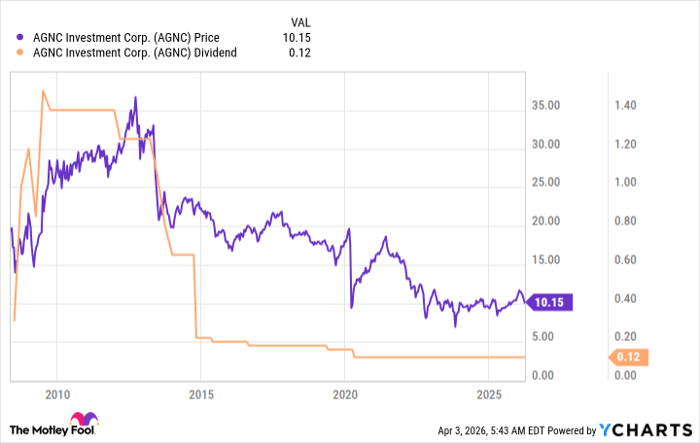
AGNC data by YCharts
AGNC Investment is not a reliable dividend investment if you are trying to create an income stream you can live off of. The quarterly update on its tangible net book value is a key part of the equation. However, that doesn't mean it is a bad investment. In fact, if you look at total return, which requires dividend reinvestment, the stock has actually outperformed the S&P 500 index (SNPINDEX: ^GSPC) over time. But you can't spend the dividends if you are reinvesting them.
Is it worth buying AGNC Investment?
Given that AGNC Investment tells you what it is worth every quarter, you can pretty easily assess if the stock is a bargain or not. Anything notably above its tangible net book value suggests you are overpaying. However, the longer-term decline in tangible net book value also highlights why dividend investors should tread with caution when considering this REIT. The yield is huge, but it comes at a very high cost if you spend the dividends you receive.
Should you buy stock in AGNC Investment Corp. right now?
Before you buy stock in AGNC Investment Corp., consider this:
The Motley Fool Stock Advisor analyst team just identified what they believe are the 10 best stocks for investors to buy now… and AGNC Investment Corp. wasn’t one of them. The 10 stocks that made the cut could produce monster returns in the coming years.
Consider when Netflix made this list on December 17, 2004... if you invested $1,000 at the time of our recommendation, you’d have $532,066!* Or when Nvidia made this list on April 15, 2005... if you invested $1,000 at the time of our recommendation, you’d have $1,087,496!*
Now, it’s worth noting Stock Advisor’s total average return is 926% — a market-crushing outperformance compared to 185% for the S&P 500. Don't miss the latest top 10 list, available with Stock Advisor, and join an investing community built by individual investors for individual investors.
See the 10 stocks »
*Stock Advisor returns as of April 4, 2026.
Reuben Gregg Brewer has no position in any of the stocks mentioned. The Motley Fool has no position in any of the stocks mentioned. The Motley Fool has a disclosure policy.
Recommended Articles


