

The Top AI Semiconductor Stocks to Buy Right Now

Source The Motley Fool

Key Points

  • Micron and Taiwan Semiconductor are capitalizing on multi-year growth trends.

  • Nvidia and Broadcom are both seeing huge demand for their cutting-edge chips.

  • 10 stocks we like better than Taiwan Semiconductor Manufacturing ›

Semiconductor stocks are the top way to play the AI arms race, in my opinion. Nobody knows what fully profitable generative AI businesses will look like, and many of these companies are private, so investors don't have access to current financials. However, one incredibly obvious thing is the amount of money these companies are spending on computing equipment.

This vaults semiconductor stocks into the leadership role on how to invest in this space. The best part is, these companies are making a boatload of money right now, making them far less risky than some other ways to invest in AI. I think these four stocks are among the best ways to invest.

Will AI create the world's first trillionaire? Our team just released a report on the one little-known company, called an "Indispensable Monopoly" providing the critical technology Nvidia and Intel both need. Continue »
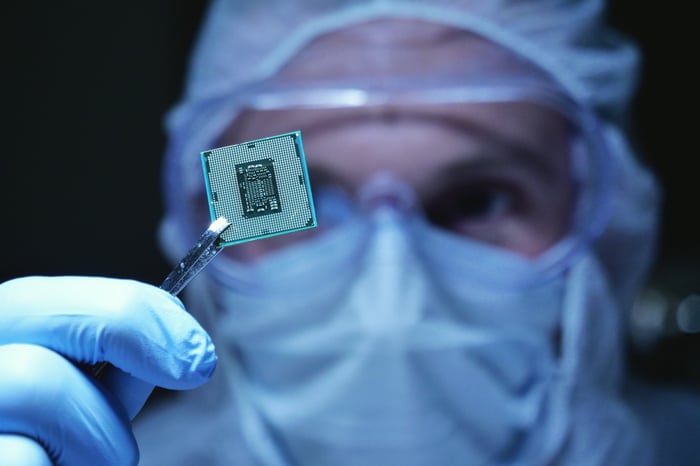
Inspector holding up an AI semiconductor.

Image source: Getty Images.

Taiwan Semiconductor Manufacturing

Starting with the most neutral way to invest in AI semiconductor stocks, Taiwan Semiconductor Manufacturing (NYSE: TSM) should be an easy pick for nearly every investor in this space. Taiwan Semiconductor is the world's leading chip fabrication company, providing logic chips to nearly every company competing in the AI arms race. Because it's positioned as a neutral provider, it has deep ties with several companies that would be considered competitors.

TSMC, as it's also known, expects the AI chip market to continue booming, and has guided for a mid- to high-50% compound annual growth rate (CAGR) between 2024 and 2029. To meet that demand, the company is spending between $52 billion and $56 billion on capital expenditures this year. That should give investors some confidence that the AI buildout is far from over, and Taiwan Semiconductor will be a leader along the way.

Micron

Micron Technology (NASDAQ: MU) is similar to Taiwan Semiconductor, except it makes memory chips. Memory chips for AI computing units have been in a massive demand crunch, and this has caused prices for them to skyrocket. While those prices have cooled off a bit thanks to Google's TurboQuant algorithm that reduces memory needs, the reality is that the high-bandwidth memory (HBM) bottleneck will still be there, as AI developers will find other ways to use that memory.

From 2025 to 2028, Micron expects the HBM market to expand from $35 billion to $100 billion. That's a huge multiyear growth trajectory, and makes Micron a strong buy, especially after the market realizes that memory chips will still be in huge demand over the next few years.

Broadcom

Moving to the next type of company, Broadcom (NASDAQ: AVGO) is another genius AI semiconductor play. While Broadcom doesn't manufacture semiconductors, it designs the devices that utilize them. One of the biggest innovations to land in the AI sector is the rise of custom AI chips, which are specifically designed for a certain workload. These chips can produce better results than a more broad-purpose computing unit, such as those made by Nvidia (NASDAQ: NVDA).

The popularity of these chips is spiking, and Broadcom is going to benefit massively as a result. By the end of 2027, these chips could produce more than $100 billion annually. With Broadcom generating $68 billion over the past 12 months companywide, that indicates huge growth ahead.

Nvidia

Nvidia and Broadcom are similar investment types, as they are both chip designers that turn the manufacturing capabilities of Micron and Taiwan Semiconductor into usable products. Nvidia's GPUs are the industry standard in the computing world, and nothing looks to change that, especially with the massive growth expected for this year.

The average Wall Street analyst estimates Nvidia's revenue will rise 71% this year and 30% next year. Despite that, Nvidia's stock trades for a mere 20.2 times forward earnings. For reference, the S&P 500 trades for 20.4 times forward earnings.

This is a rare buying opportunity to scoop up a generational growth stock for cheap, and investors would be foolish to let this opportunity slip away.

Should you buy stock in Taiwan Semiconductor Manufacturing right now?

Before you buy stock in Taiwan Semiconductor Manufacturing, consider this:

The Motley Fool Stock Advisor analyst team just identified what they believe are the 10 best stocks for investors to buy now… and Taiwan Semiconductor Manufacturing wasn’t one of them. The 10 stocks that made the cut could produce monster returns in the coming years.

Consider when Netflix made this list on December 17, 2004... if you invested $1,000 at the time of our recommendation, you’d have $532,066!* Or when Nvidia made this list on April 15, 2005... if you invested $1,000 at the time of our recommendation, you’d have $1,087,496!*

Now, it’s worth noting Stock Advisor’s total average return is 926% — a market-crushing outperformance compared to 185% for the S&P 500. Don't miss the latest top 10 list, available with Stock Advisor, and join an investing community built by individual investors for individual investors.

See the 10 stocks »

*Stock Advisor returns as of April 3, 2026.

Keithen Drury has positions in Alphabet, Broadcom, Nvidia, and Taiwan Semiconductor Manufacturing. The Motley Fool has positions in and recommends Alphabet, Micron Technology, Nvidia, and Taiwan Semiconductor Manufacturing. The Motley Fool recommends Broadcom. The Motley Fool has a disclosure policy.

Disclaimer: For information purposes only. Past performance is not indicative of future results.
placeholder
Elon Musk’s xAI and Neuralink Launch New Funding Rounds​Billionaire Elon Musk recently raised funds for his two high-profile tech companies, xAI and Neuralink.
Author  Insights
Jun 03, 2025
​Billionaire Elon Musk recently raised funds for his two high-profile tech companies, xAI and Neuralink.
placeholder
Bitcoin briefly loses 2025 gains as crypto plunges over the weekend.Bitcoin experienced a sharp decline this weekend, briefly erasing its 2025 gains and dipping below its year-opening value of $93,507. The cryptocurrency fell to a low of $93,029 on Sunday, representing a 25% drop from its all-time high in October. Although it has rebounded slightly to around $94,209, the pressures on the market remain significant. The downturn occurred despite the reopening of the U.S. government on Thursday, which many had hoped would provide essential support for crypto markets. This year initially appeared promising for cryptocurrencies, particularly after the inauguration of President Donald Trump, who has established the most pro-crypto administration thus far. However, ongoing political tensions—including Trump's tariff strategies and the recent government shutdown, lasting a historic 43 days—have contributed to several rapid price pullbacks for Bitcoin throughout the year. Market dynamics are also being influenced by Bitcoin whales—investors holding large amounts of Bitcoin—who have been offloading portions of their assets, consequently stalling price rallies even as positive regulatory developments emerge. Despite these sell-offs, analysts from Glassnode argue that this behavior aligns with typical patterns seen among long-term investors during the concluding stages of bull markets, suggesting it is not indicative of a mass exodus. Notably, Bitcoin is not alone in its struggles, as Ethereum and Solana have also recorded declines of 7.95% and 28.3%, respectively, since the start of the year, while numerous altcoins have faced even steeper losses. Looking ahead, questions linger regarding the viability of the four-year cycle thesis, particularly given the increasing institutional support and regulatory frameworks now in place in the crypto landscape. Matt Hougan, chief investment officer at Bitwise, remains optimistic, suggesting a potential Bitcoin resurgence in 2026 driven by the “debasement trade” thesis and a broader trend toward increased adoption of stablecoins, tokenization, and decentralized finance. Hougan emphasized the soundness of the underlying fundamentals, pointing to a positive outlook for the sector in the longer term.
Author  Mitrade
Nov 17, 2025
Bitcoin experienced a sharp decline this weekend, briefly erasing its 2025 gains and dipping below its year-opening value of $93,507. The cryptocurrency fell to a low of $93,029 on Sunday, representing a 25% drop from its all-time high in October. Although it has rebounded slightly to around $94,209, the pressures on the market remain significant. The downturn occurred despite the reopening of the U.S. government on Thursday, which many had hoped would provide essential support for crypto markets. This year initially appeared promising for cryptocurrencies, particularly after the inauguration of President Donald Trump, who has established the most pro-crypto administration thus far. However, ongoing political tensions—including Trump's tariff strategies and the recent government shutdown, lasting a historic 43 days—have contributed to several rapid price pullbacks for Bitcoin throughout the year. Market dynamics are also being influenced by Bitcoin whales—investors holding large amounts of Bitcoin—who have been offloading portions of their assets, consequently stalling price rallies even as positive regulatory developments emerge. Despite these sell-offs, analysts from Glassnode argue that this behavior aligns with typical patterns seen among long-term investors during the concluding stages of bull markets, suggesting it is not indicative of a mass exodus. Notably, Bitcoin is not alone in its struggles, as Ethereum and Solana have also recorded declines of 7.95% and 28.3%, respectively, since the start of the year, while numerous altcoins have faced even steeper losses. Looking ahead, questions linger regarding the viability of the four-year cycle thesis, particularly given the increasing institutional support and regulatory frameworks now in place in the crypto landscape. Matt Hougan, chief investment officer at Bitwise, remains optimistic, suggesting a potential Bitcoin resurgence in 2026 driven by the “debasement trade” thesis and a broader trend toward increased adoption of stablecoins, tokenization, and decentralized finance. Hougan emphasized the soundness of the underlying fundamentals, pointing to a positive outlook for the sector in the longer term.
placeholder
Gold Price Forecast: XAU/USD opens lower around $4,450 on fears of widening Iran conflictsGold price (XAU/USD) opens over 1% lower to near $4,445.00 on Monday, as oil prices have rallied further on fears of further widening of conflicts in the Middle East. WTI Oil price is up almost 3% above $102.50 in the opening trade, increasing fears of higher inflation expectations globally.
Author  FXStreet
Mar 30, Mon
Gold price (XAU/USD) opens over 1% lower to near $4,445.00 on Monday, as oil prices have rallied further on fears of further widening of conflicts in the Middle East. WTI Oil price is up almost 3% above $102.50 in the opening trade, increasing fears of higher inflation expectations globally.
placeholder
Silver Price Forecast: XAG/USD falls to near $72.00 amid fading safe-haven demandSilver price (XAG/USD) continues to lose ground after registering tiny losses in the previous day, trading around $72.90 during the Asian hours on Thursday. The safe-haven demand for the precious metal fades amid rising optimism over Middle East peace.
Author  FXStreet
Yesterday 08: 19
Silver price (XAG/USD) continues to lose ground after registering tiny losses in the previous day, trading around $72.90 during the Asian hours on Thursday. The safe-haven demand for the precious metal fades amid rising optimism over Middle East peace.
placeholder
Gold retreats sharply from two-week top/$4,800 as Trump’s Iran comments boost USDGold (XAU/USD) witnessed an intraday turnaround from the $4,800 mark, or a fresh two-week high set earlier this Thursday, and for now, seems to have snapped a four-day winning streak amid resurgent US Dollar (USD) demand.
Author  FXStreet
Yesterday 07: 03
Gold (XAU/USD) witnessed an intraday turnaround from the $4,800 mark, or a fresh two-week high set earlier this Thursday, and for now, seems to have snapped a four-day winning streak amid resurgent US Dollar (USD) demand.
goTop
quote