


Americans Are Warming Up to Robotaxis -- and That's Big News for Alphabet and Tesla
Key Points
A recent survey revealed that Americans are becoming more comfortable with autonomous ride-hailing services.
This bodes well for Alphabet's Waymo unit, which currently leads the robotaxi market.
Tesla is also poised to become a big winner with its potential to scale operations quickly.
- 10 stocks we like better than Alphabet ›
Would you feel anxious if a car with no driver showed up to take you to your destination? If so, you're not alone. A recent survey conducted by legal firm Murphy & Prachthauser found that 7 in 10 Americans would be at least somewhat apprehensive about riding in an autonomous rideshare vehicle.
However, the numbers look much better with people who have actually ridden in a self-driving vehicle. Although 85% said they were nervous initially, 64% felt comfortable during their most recent experience.
Will AI create the world's first trillionaire? Our team just released a report on the one little-known company, called an "Indispensable Monopoly" providing the critical technology Nvidia and Intel both need. Continue »
The bottom line of this survey is that Americans appear to be warming up to robotaxis. And that's big news for two of the biggest self-driving car stocks -- Alphabet (NASDAQ: GOOG) (NASDAQ: GOOGL) and Tesla (NASDAQ: TSLA).
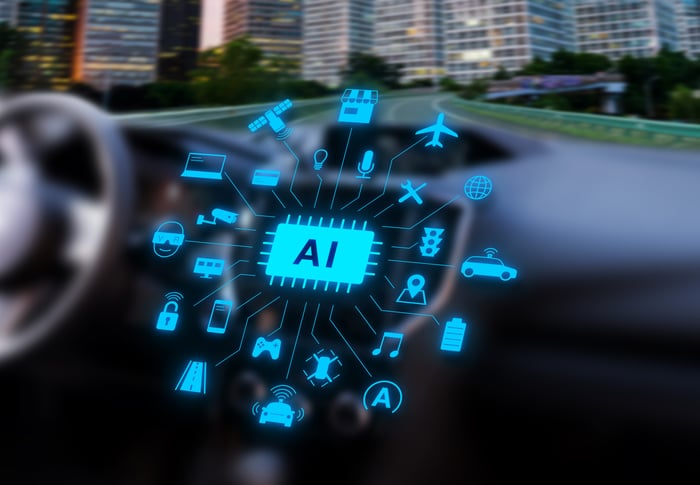
Image source: Getty Images.
Alphabet's Waymo: The autonomous ride-hailing juggernaut
Alphabet's Waymo unit describes its technology as "the world's most experienced driver." The claim is based on the fact that the company's autonomous vehicles have logged over 20 million rides so far. This impressive number reflects Waymo's status as the world's first autonomous ride-hailing service.
Waymo's management probably isn't surprised by the results of the Murphy & Prachthauser survey, which show that Americans are more receptive to robotaxis than they've been in the past. Waymo boasts a 93% customer satisfaction rate.
The unit's safety record is even more impressive. Waymo's autonomous vehicles have 92% fewer serious injuries or worse crashes and 92% fewer pedestrian crashes with injuries than average human drivers over the same distance in the cities where the company operates. Insurance giant Swiss Re determined that Waymo is a significantly safer alternative than human drivers.
A recent funding round valued Waymo at $126 billion. That's only a fraction of Alphabet's market cap, which is roughly $3.5 trillion. However, the potential upside for Waymo is massive.
Tesla: Ready to scale
Tesla has targeted the robotaxi market for years, but has so far lagged behind Waymo. That could be about to change. The company now offers autonomous ride-hailing services in Austin, Texas, and plans to expand into more cities.
Lars Moravy, Vice President of Vehicle Engineering at Tesla, expressed his view in the quarterly conference call in January that Tesla is "the only company capable of scaling at the rate that is needed for the tsunami of autonomy that has come." Whether or not he's right, it's fair to say that Tesla's biggest advantage in the robotaxi market is its potential to scale.
Millions of Tesla vehicles equipped with its FSD (full self-driving) technology are already on the road. In theory, any of these cars could be used for autonomous ride-hailing. Tesla CEO Elon Musk said in his company's quarterly conference call in January.
There will also be an opportunity, something we have talked about for a long time, for existing owners of Teslas to add or subtract their cars to the fleet, kind of like how Airbnb (NASDAQ: ABNB) works, where you can add or subtract your house to the Airbnb inventory.
However, there's one factor that could be a two-edged sword for Tesla in its quest to dominate the robotaxi market. The company's technology relies solely on computer vision, whereas Waymo uses LiDAR sensors. A vision-only AI approach significantly lowers Tesla's costs. But the trade-off could be lower safety levels.
A new frontier
In the early days of the automobile, an expression became popular: "Get a horse!" The phrase underscored Americans' skepticism about the first cars. With nearly 300 million cars registered in the U.S. today, that view has obviously gone by the wayside.
We could be at a new frontier now with autonomous ride-hailing services. Look for Americans to become increasingly more comfortable with the technology. While the robotaxi era is in its infancy, it's here already.
Alphabet isn't just a search engine stock or cloud stock. Tesla is no longer just an electric car stock. They're poised to be the biggest winners in a new market that could make forward-thinking investors a boatload of money over time.
Should you buy stock in Alphabet right now?
Before you buy stock in Alphabet, consider this:
The Motley Fool Stock Advisor analyst team just identified what they believe are the 10 best stocks for investors to buy now… and Alphabet wasn’t one of them. The 10 stocks that made the cut could produce monster returns in the coming years.
Consider when Netflix made this list on December 17, 2004... if you invested $1,000 at the time of our recommendation, you’d have $501,381!* Or when Nvidia made this list on April 15, 2005... if you invested $1,000 at the time of our recommendation, you’d have $1,012,581!*
Now, it’s worth noting Stock Advisor’s total average return is 880% — a market-crushing outperformance compared to 178% for the S&P 500. Don't miss the latest top 10 list, available with Stock Advisor, and join an investing community built by individual investors for individual investors.
See the 10 stocks »
*Stock Advisor returns as of April 1, 2026.
Keith Speights has positions in Alphabet. The Motley Fool has positions in and recommends Airbnb, Alphabet, and Tesla. The Motley Fool has a disclosure policy.
Recommended Articles


