


Forget Tariffs: The Iran War Is the Biggest Threat to Your Portfolio Right Now
Key Points
Despite doomsday fears over new tariff policies, major stock market indexes have held up strongly over the last year.
The real threat to economic growth right now involves geopolitical tensions between the United States and Iran.
The Iran War has sent oil prices surging -- posing disruption that could ripple through every major industry.
- 10 stocks we like better than S&P 500 Index ›
Ever since President Donald Trump declared "Liberation Day" last April, investors have obsessed over his tariff plans -- convinced that higher import duties will fuel inflation, disrupt supply chains, and erode corporate profit margins.
These trepidations are understandable. Tariffs raise input costs on raw materials, which subsequently invites retaliation from trading partners -- posing a threat to global economic growth. These worries have been dramatically overstated, however.
Will AI create the world's first trillionaire? Our team just released a report on the one little-known company, called an "Indispensable Monopoly" providing the critical technology Nvidia and Intel both need. Continue »
Since Liberation Day (April 2, 2025), the S&P 500 (SNPINDEX: ^GSPC), Nasdaq Composite (NASDAQINDEX: ^IXIC), and Dow Jones Industrial Average (DJINDICES: ^DJI) have risen 12%, 19%, and 7%, respectively.
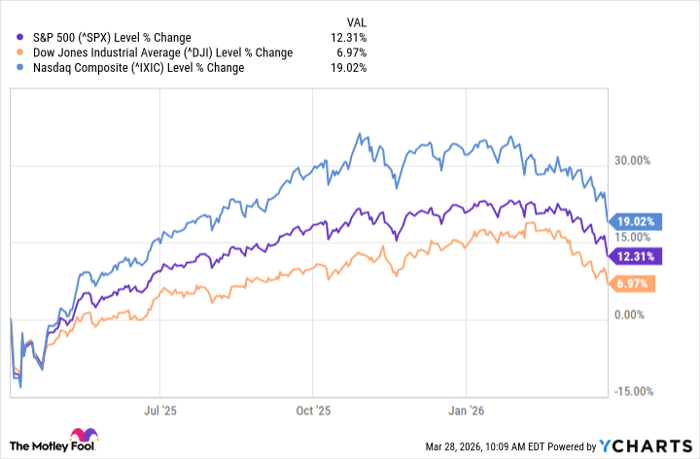
^SPX data by YCharts
These returns suggest that investors have already priced in bearish scenarios. While Trump's tariff rhetoric is great for clickbait, it's ultimately a manageable policy risk. The real portfolio-shaking event is currently unfolding halfway around the world as the U.S. wages its war against Iran.
Tariff hysteria is distracting investors from a bigger risk
As investors continue to fixate on tariffs under a microscope, they've become blind to a greater threat: Rapid escalations with Iran. What started as proxy skirmishes over the summer has now mutated into a direct confrontation with Iranian military forces.
Perhaps the most fluid dynamic of the conflict touches key shipping lanes and energy infrastructure. In particular, the Strait of Hormuz -- which processes roughly 20% of global oil supply flows -- has become a major chokepoint. Sustained disruption at this port sent crude oil prices soaring.
While energy producers will likely witness windfall revenues in the near term, the broader market will experience quite the opposite. Airlines, trucking, and logistics businesses are now staring at fuel cost explosions that weigh on profit margins. Manufacturers that rely on chemicals, plastics, and metals are watching their input costs rise by the day. Furthermore, the retail sector is forced to absorb these higher transportation costs and ultimately pass them on to consumers, fueling inflation and recession narratives.

Image source: White House photo by Daniel Torok.
How geopolitics rattles the stock market
When it comes to the stock market, investors loathe uncertainty more than just about anything. That said, wars do not affect all stocks equally at once. Instead, geopolitics gradually reshapes risk environments as the situation unfolds.
As a result, investors generally sell stocks first and ask questions later, fueling outsize volatility surges and disconnected correlations among asset classes. As capital increasingly rotates from stocks to safe havens like Treasuries or gold, central banks are forced to walk a tightrope because inflation from energy shocks clashes with a need to support economic growth. This usually means maintaining higher interest rates for longer than expected durations.
Historical episodes of Middle East energy conflict have seen initial drops of 8% to 15% across major indexes, followed by sharp rebounds that reward patient investors.
How should you structure your portfolio during periods of conflict?
Below are some steps you can take to proactively mitigate downside risk amid the Iran war:
- Reduce exposure to speculative opportunities and highly volatile growth stocks.
- Buy energy producers and commodity-related equities to hedge against inflation.
- Build a defensive shield featuring utilities, healthcare, and consumer staples.
- Complementing stocks with cash will provide necessary financial flexibility to buy the dip on inevitable oversold opportunities in quality names.
Smart investors understand that during periods of uncertainty, the best response is to avoid panic selling. Rather, use geopolitical chaos to deliberately reposition your portfolio.
Should you buy stock in S&P 500 Index right now?
Before you buy stock in S&P 500 Index, consider this:
The Motley Fool Stock Advisor analyst team just identified what they believe are the 10 best stocks for investors to buy now… and S&P 500 Index wasn’t one of them. The 10 stocks that made the cut could produce monster returns in the coming years.
Consider when Netflix made this list on December 17, 2004... if you invested $1,000 at the time of our recommendation, you’d have $503,861!* Or when Nvidia made this list on April 15, 2005... if you invested $1,000 at the time of our recommendation, you’d have $1,026,987!*
Now, it’s worth noting Stock Advisor’s total average return is 884% — a market-crushing outperformance compared to 179% for the S&P 500. Don't miss the latest top 10 list, available with Stock Advisor, and join an investing community built by individual investors for individual investors.
See the 10 stocks »
*Stock Advisor returns as of March 29, 2026.
Adam Spatacco has no position in any of the stocks mentioned. The Motley Fool has no position in any of the stocks mentioned. The Motley Fool has a disclosure policy.
Recommended Articles


