


Nvidia May be Back in Business in China. Here's What That Means for Revenue.
Key Points
Nvidia has been absent from China’s AI chip market for about a year, due to U.S. export controls.
The U.S. recently gave Nvidia the green light to resume sales to China.
- 10 stocks we like better than Nvidia ›
Nvidia (NASDAQ: NVDA) has conquered much of the world with its graphics processing units (GPUs) for artificial intelligence. These powerful AI chips drive the most crucial of tasks, such as the pouring of information into large language models -- and later, the models' process of problem solving.
The sooner AI customers develop their platforms, the sooner they can monetize them. And that's why they've rushed to get in on the fastest chips on the market -- those of Nvidia. All of this has generated record growth and revenue levels for the chip giant. For example, in the latest full year, revenue soared 65% to more than $215 billion.
Will AI create the world's first trillionaire? Our team just released a report on the one little-known company, called an "Indispensable Monopoly" providing the critical technology Nvidia and Intel both need. Continue »
But one key customer has been absent over the past year. And that's the Chinese customer. This is due to U.S. export controls on these high-performance chips, keeping Nvidia out of China.
In recent months, though, the situation has brightened. The U.S. gave the nod for exports of one particular chip, and Nvidia recently said it's revving up manufacturing. Nvidia may be back in business in China -- now, here's what that means for the company's revenue.
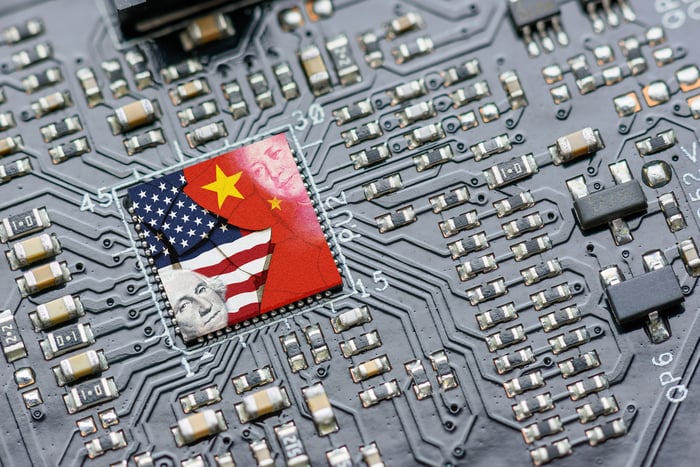
Image source: Getty Images.
The U.S. blocks exports
First, though, let's take a quick look at the China story so far. Initial action on exports began back in 2022, with the U.S. blocking exports of the most powerful chips to the country for security reasons. In response, Nvidia developed the H20 chip specifically to meet export control guidelines, and with this chip, was able to remain in China.
But, early last year, the U.S. tightened restrictions, saying companies couldn't export their chips to China without a specific license. This halted sales of the H20, and Nvidia took a $4.5 billion charge on inventory that it couldn't sell. For several months, Nvidia chief Jensen Huang spoke publicly and to President Donald Trump about the importance of a return to China -- to ensure U.S. leadership in the global AI race.
Finally, in December, Trump gave Nvidia the OK to proceed with chip sales in China, this time allowing the export of the H200, a chip that's more powerful than the H20 but less powerful than Nvidia's latest Blackwell and Blackwell Ultra products. In return, Trump is requiring Nvidia to share 25% of its sales in China with the U.S.
Nvidia couldn't immediately begin exports as it was unclear whether China would accept these imported products, and the company also had to jump-start production of these systems. All of this meant that, following Trump's decision, there was reason for Nvidia shareholders to cheer -- but any potential sales from China remained far off and a bit uncertain.
Three key announcements at GTC
In recent days, though, Nvidia's Huang has offered us important information. He said the following key things during Nvidia's GTC conference this month:
- Nvidia's H200 has been licensed for "many customers" in China.
- The company has received orders from these customers.
- Nvidia is launching manufacturing to meet this demand.
Huang, in an interview with Punchbowl News during GTC, said the H200s may enter the market in China in a matter of weeks -- and Huang also said that early next year he would aim to gain approval for the export of Blackwell chips to China. By that time, the U.S. market would have access to the newest Nvidia platform, Vera Rubin.
A multi-billion-dollar opportunity
Now, let's get back to our question: What does this mean for Nvidia's revenue? Sales in China represented 13% of Nvidia's total sales back in the 2025 fiscal year. If we apply that percentage to Nvidia's revenue last year, China could represent nearly $28 billion in annual revenue. Meanwhile, Huang told CNBC in October that the China market opportunity may be "a couple of 100 billion dollars by the end of the decade."
Of course, it's important to keep in mind that Nvidia has to restart H200 production and the entire process of exporting to China -- so sales may not soar overnight. And Chinese companies, during Nvidia's absence, have had time to introduce their chips to local customers and win them over. This could weigh on demand for Nvidia's H200. It will be key to watch the levels of revenue from China once production and exports are on track.
Still, the demand Nvidia has seen so far from China offers us reason to be optimistic. China may represent an important growth driver for Nvidia, and one that could supercharge revenue in the quarters to come. That's one more reason to be optimistic about this AI giant as the AI story reaches its next chapters.
Should you buy stock in Nvidia right now?
Before you buy stock in Nvidia, consider this:
The Motley Fool Stock Advisor analyst team just identified what they believe are the 10 best stocks for investors to buy now… and Nvidia wasn’t one of them. The 10 stocks that made the cut could produce monster returns in the coming years.
Consider when Netflix made this list on December 17, 2004... if you invested $1,000 at the time of our recommendation, you’d have $503,268!* Or when Nvidia made this list on April 15, 2005... if you invested $1,000 at the time of our recommendation, you’d have $1,049,793!*
Now, it’s worth noting Stock Advisor’s total average return is 898% — a market-crushing outperformance compared to 182% for the S&P 500. Don't miss the latest top 10 list, available with Stock Advisor, and join an investing community built by individual investors for individual investors.
See the 10 stocks »
*Stock Advisor returns as of March 28, 2026.
Adria Cimino has no position in any of the stocks mentioned. The Motley Fool has positions in and recommends Nvidia. The Motley Fool has a disclosure policy.
Recommended Articles


