


Here's Why The Vanguard S&P 500 Growth ETF Could Be Your Ticket to Beating the Market Over the Long Term
Key Points
The S&P 500 is an index of 500 American stocks from 11 different sectors of the economy, so it's highly diversified.
The S&P 500 Growth index invests in 139 of the best-performing growth stocks from the S&P 500 and disregards its other 361 stocks.
The Vanguard S&P 500 Growth ETF tracks the performance of the Growth index, and it has beaten the market for the last 16 years.
- 10 stocks we like better than Vanguard Admiral Funds - Vanguard S&P 500 Growth ETF ›
The S&P 500 (SNPINDEX: ^GSPC) is a highly diversified American stock market index featuring 500 companies from 11 different sectors of the economy, and it's coming off a strong year in 2025 with a return of 16.4%. However, had you invested in the S&P 500 Growth index instead, you would have earned an even higher return of 21.4% last year.
The Growth index exclusively invests in 139 of the best-performing growth stocks from the regular S&P 500. Therefore, it holds large positions in powerhouses like Nvidia and Microsoft while maintaining very low exposure to defensive stocks that tend to grow more slowly.
Will AI create the world's first trillionaire? Our team just released a report on the one little-known company, called an "Indispensable Monopoly" providing the critical technology Nvidia and Intel both need. Continue »
The Vanguard S&P 500 Growth ETF (NYSEMKT: VOOG) is an exchange-traded fund (ETF) that tracks the performance of the Growth index by holding the same stocks and maintaining similar weightings. It was established in 2010, and it has beaten the S&P 500 every year since. Here's why its run of outperformance is likely to continue.

Image source: Getty Images.
A growth-focused portfolio
The S&P 500 Growth index selects its holdings based on factors like their momentum and the sales growth of the underlying companies. It rebalances once per quarter by eliminating the stocks that no longer meet its criteria and replacing them with more suitable candidates.
Information technology is the largest sector in the Vanguard S&P 500 Growth ETF by weight, representing a whopping 47% of the value of its portfolio. The companies in this sector operate at the cutting edge of industries like cloud computing and artificial intelligence (AI), so they tend to grow much faster than the rest of the market.
In fact, information technology is home to more trillion-dollar giants than any other sector:
- Nvidia: $4.3 trillion.
- Apple: $3.7 trillion.
- Microsoft: $2.8 trillion.
- Taiwan Semiconductor Manufacturing: $1.8 trillion.
- Broadcom: $1.5 trillion.
Those companies are among the top holdings in the Vanguard S&P 500 Growth ETF, except for Taiwan Semiconductor Manufacturing, because it isn't American, so it doesn't qualify for inclusion in the S&P 500 Growth index or the S&P 500.
For some perspective, the information technology sector represents just 32.4% of the regular S&P 500. Therefore, since Nvidia, Apple, Microsoft, and Broadcom have delivered a median return of 1,400% over the last decade, it makes sense that the Vanguard ETF -- which assigns them much higher weightings -- has outperformed.
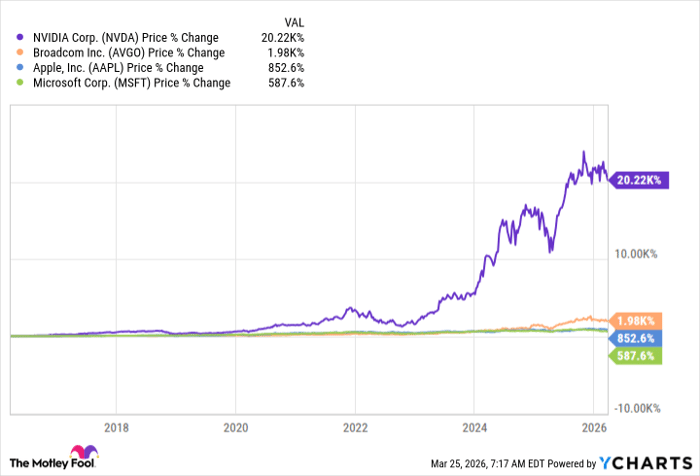
NVDA data by YCharts
But many stocks also consistently underperform the S&P 500, including those in defensive sectors like financials, utilities, and real estate. The Vanguard ETF tends to invest less aggressively in those sectors, which is another reason it regularly beats the index:
|
Sector |
Vanguard ETF Weighting |
S&P 500 Weighting |
|---|---|---|
|
Financials |
9.7% |
12.5% |
|
Real estate |
0.6% |
2% |
|
Utilities |
0.5% |
2.5% |
Data source: Vanguard. Sector weightings are accurate as of Feb. 28, 2026, and are subject to change.
The Vanguard ETF has beaten the market for 16 years
The Vanguard S&P 500 Growth ETF has delivered a compound annual return of 16.3% since its inception in September 2010, handily beating the S&P 500, which returned an average of 14% per year over the same period. While the 2.3-percentage-point difference in annual returns might not sound like much, it made a huge impact in dollar terms over the last 16 years:
|
Starting Balance (Sept. 2010) |
Compound Annual Return |
Balance In March 2026 |
|---|---|---|
|
$100,000 |
16.3% (Vanguard ETF) |
$1,038,689 |
|
$100,000 |
14% (S&P 500) |
$762,123 |
Calculations by author.
With that said, the Vanguard ETF is actually down 7.1% so far in 2026, whereas the S&P 500 has declined by a lesser 4.4%. Ongoing geopolitical tensions in the Middle East have sent oil prices soaring, stoking fears of higher inflation and weaker economic activity in the future. Growth stocks sometimes underperform during periods of turmoil in the broader market, as investors cash in some of their gains and reduce risk.
Simply put, elevated volatility is the price of admission for an opportunity to earn market-beating returns over the long run. Throughout history, investors who bought market dips have done exceptionally well, and I think technology and AI stocks are likely to continue producing the strongest returns when sentiment eventually turns positive once again.
As a result, now might be a great time to buy the Vanguard S&P 500 Growth ETF, especially for investors who are willing to hold on for a long-term period of five years or more.
Should you buy stock in Vanguard Admiral Funds - Vanguard S&P 500 Growth ETF right now?
Before you buy stock in Vanguard Admiral Funds - Vanguard S&P 500 Growth ETF, consider this:
The Motley Fool Stock Advisor analyst team just identified what they believe are the 10 best stocks for investors to buy now… and Vanguard Admiral Funds - Vanguard S&P 500 Growth ETF wasn’t one of them. The 10 stocks that made the cut could produce monster returns in the coming years.
Consider when Netflix made this list on December 17, 2004... if you invested $1,000 at the time of our recommendation, you’d have $503,268!* Or when Nvidia made this list on April 15, 2005... if you invested $1,000 at the time of our recommendation, you’d have $1,049,793!*
Now, it’s worth noting Stock Advisor’s total average return is 898% — a market-crushing outperformance compared to 182% for the S&P 500. Don't miss the latest top 10 list, available with Stock Advisor, and join an investing community built by individual investors for individual investors.
See the 10 stocks »
*Stock Advisor returns as of March 28, 2026.
Anthony Di Pizio has no position in any of the stocks mentioned. The Motley Fool has positions in and recommends Alphabet, Apple, Microsoft, Nvidia, and Taiwan Semiconductor Manufacturing and is short shares of Apple. The Motley Fool recommends Broadcom. The Motley Fool has a disclosure policy.
Recommended Articles


