


Have Tech Stocks Finally Run Out of Road? Here's What the Data Actually Says.
Key Points
The frothy valuations that were daunting just a few months ago have already been dialed back quite a bit.
Even so, most of the tech sector's stocks are in a holding pattern somewhere between being reasonably priced and unusually expensive.
Whether or not the market is willing to push technology stocks any higher depends on how much return the AI industry achieves on its recent capex.
- These 10 stocks could mint the next wave of millionaires ›
The concern isn't an unmerited one. The gains that most artificial intelligence (AI)-related stocks have made since 2023 have obviously stretched at least some valuations far too thin. Nvidia (NASDAQ: NVDA) shares, for instance, are priced at more than 35 times their trailing profits. Amazon (NASDAQ: AMZN) is trading at nearly 30 times its earnings for the past four reported quarters. And these tickers' closest technology cousins have been taken along for the same wild ride, inflating their valuations as well.
Before coming to any sweeping long-term conclusions about the entire technology sector, though, it's smart to simply take a step back and look at what the data says. You might be a bit surprised at where this sector as a whole currently stands.
Will AI create the world's first trillionaire? Our team just released a report on the one little-known company, called an "Indispensable Monopoly" providing the critical technology Nvidia and Intel both need. Continue »

Image source: Getty Images.
The numbers, in pictures
I'm using the S&P 500 Information Technology Sector Index as my proxy, partially because this cap-weighted index includes all of the S&P 500's (SNPINDEX: ^GSPC) technology names, but also just because a great deal of fundamental information exists for this index, including revenue as well as past and projected per-share earnings.
And it's this last bit of data that I'm more interested in. Not only can you use it to come up with some backward-looking and forward-looking valuations, but you can also gain an understanding of how these companies' bottom lines have been trending, and what (if anything) is likely to change in the foreseeable future.
The graphic below illustrates a great deal of what investors should know about what's supposed to be a risky tech sector right now. As you can see, the S&P 500 Information Technology Sector Index is currently priced at a somewhat palatable 29.8 times its trailing-12-month per-share earnings that are expected to continue soaring through the end of this year. In fact, based on analysts' 2026 impressive earnings projections -- up 38% from last year's profits -- these stocks are priced at a forward-looking price-to-earnings ratio of just under 24.
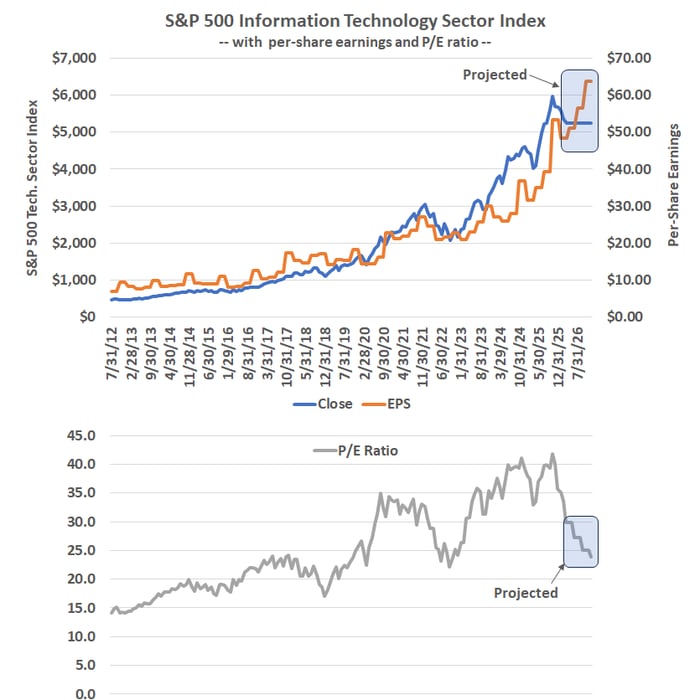
Data sources: Yahoo Finance, Standard & Poor's. P/E calculations by author.
Both figures are still above their respective long-term norms, to be clear, although not uncomfortably so. The technology sector's trailing P/E eclipsed 40 during the dot-com craze of the late 1990s, according to data from World PE Ratio, when Yardeni Research says these ticker's forward-looking projected price-to-earnings ratios approached a weighted average near 25.
Still, there's no denying many (perhaps too many) of these stocks are valued well beyond their historical norms, pricing in an earnings explosion that's expected to take shape this year, but certainly isn't guaranteed to do so. If the conflict in the Middle East escalates or lingers -- or if a bunch of tech companies just don't turn their sizable investments in AI into real profits soon -- the sector could easily end up falling well short of these lofty sectorwide earnings growth projections.
It's become an all-or-nothing proposition
There's the rub that's haunting investors, and largely responsible for the technology sector's recent weakness.
After their recent pullbacks, technology stocks like Microsoft (NASDAQ: MSFT) and Nvidia should be able to hold their current levels as the world waits to see if these companies will do as well as expected. Indeed, Nvidia shares are a relative bargain given their forward-looking price-to-earnings ratio of less than 16. Microsoft shares are also arguably cheap at less than 20 times next fiscal year's projected earnings of $19.01. Broadcom's (NASDAQ: AVGO) only trading at about 18 times next year's expected bottom line as well, which should be up more than 50% from this year's likely profits on another round of massive revenue growth. These seemingly steep valuations actually make a lot of sense given what investors believe is coming.
But most of the market's most popular artificial intelligence stocks are also priced with no room for disappointing earnings growth. If a few too many of these names are unable to meet their lofty expectations, it's likely to take an exaggerated toll on most of the sector's names, as well as the cap-weighted funds dominated by a small handful of enormous tech companies like Nvidia, Amazon, and Microsoft.
That's too bad, too, since many off-the-radar technology stocks that aren't AI mainstays are actually priced pretty reasonably. And they'll likely peel back just for being in the wrong industry at the wrong time.
Bottom line? Tech stocks as a whole haven't run out of road just yet, particularly after their pullback from October's highs. There's plenty of room to climb before re-inflating to their previous, frothy valuations.
That almost entirely hinges on another massive year of growth for the artificial intelligence revolution, though. Anything less than greatness from all of the movement's leading names could easily convince investors to dial back sectorwide valuations to the longer-term average of around 20 times its trailing earnings, as was the case for several years following the dot-com crash of 2000... even though many of today's tech giants were already starting to grow in earnest then.
Just tread lightly. You certainly can't afford to blindly buy and hold any and every name in the sector like you could a couple of years ago. Pick and choose carefully.
Where to invest $1,000 right now
When our analyst team has a stock tip, it can pay to listen. After all, Stock Advisor’s total average return is 912%* — a market-crushing outperformance compared to 185% for the S&P 500.
They just revealed what they believe are the 10 best stocks for investors to buy right now, available when you join Stock Advisor.
See the stocks »
*Stock Advisor returns as of March 27, 2026.
James Brumley has no position in any of the stocks mentioned. The Motley Fool has positions in and recommends Amazon, Microsoft, and Nvidia. The Motley Fool recommends Broadcom. The Motley Fool has a disclosure policy.
Recommended Articles


