


These 3 High-Yield Dividend ETFs Are Crushing the S&P 500. Here's the Best Buy for April.
Key Points
Notable differences exist among some popular high-yield exchange-traded funds (ETFs).
Energy stocks are driving big gains in two high-yield ETFs run by Schwab and iShares.
The Vanguard High Dividend Yield ETF prioritizes dividend quality over quantity.
- 10 stocks we like better than Vanguard High Dividend Yield ETF ›
The technology, financial, communication, and consumer discretionary sectors account for about 65% of the S&P 500. And all four sectors are down between 4.9% and 10.8% year to date. Exchange-traded funds (ETFs) with outsize exposure to value stocks are crushing the S&P 500 this year. Especially ETFs with significant energy stock holdings.
Here are three ETFs that stand out as buys in April, and how you can decide which one aligns with your risk tolerance and investment objectives.
Will AI create the world's first trillionaire? Our team just released a report on the one little-known company, called an "Indispensable Monopoly" providing the critical technology Nvidia and Intel both need. Continue »

Image source: Getty Images.
1. Schwab U.S. Dividend Equity ETF
The Schwab U.S. Dividend Equity ETF (NYSEMKT: SCHD) is heavily concentrated in the energy, consumer staples, and healthcare sectors because many companies in these sectors use dividends to return capital to shareholders.
Betting big on value sectors helps the ETF achieve a sizable 3.3% yield. Over the long term, these lower-growth sectors tend to underperform the S&P 500. But these sectors shine during market sell-offs, when investors look for lower-risk value stocks.
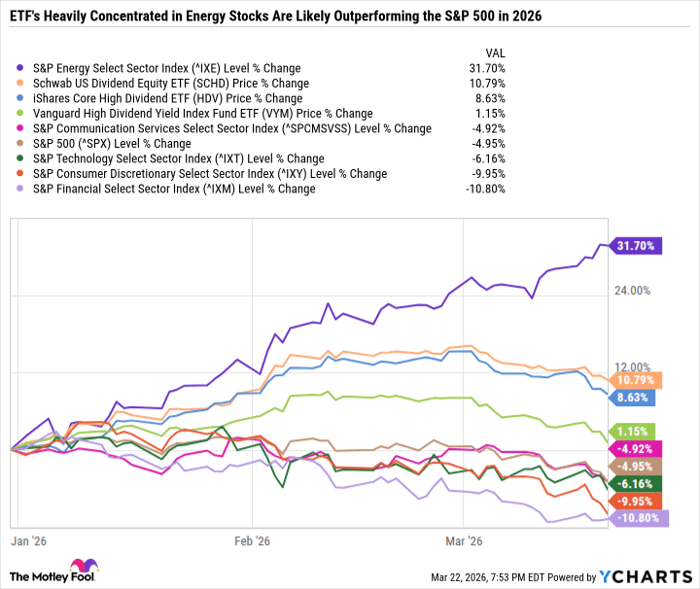
^IXE data by YCharts
As you can see in the chart, the Schwab U.S. Dividend Equity ETF is up over 10% year to date -- largely thanks to its 19.9% weighing in the red-hot energy sector. By comparison, the S&P 500 is down 5% year to date, while the consumer discretionary and financial sectors are down double digits.
2. iShares Core High Dividend ETF
Like the Schwab U.S. Dividend Equity ETF, the largest sector weighting in the iShares Core High Dividend ETF (NYSEMKT: HDV) is energy. But a key difference is that the Schwab U.S. Dividend Equity ETF is more spread out among oil major Chevron, several exploration and production companies, and refiners. The vast majority of the iShares Core High Dividend ETF's energy sector weighting, on the other hand, is in ExxonMobil, Chevron, and ConocoPhillips -- which together make up 18.3% of the entire fund.
|
Sector |
Schwab U.S. Dividend Equity ETF |
iShares Core High Dividend ETF |
Vanguard High Dividend Yield ETF |
|---|---|---|---|
|
Energy |
19.9% |
23.3% |
9.6% |
|
Consumer staples |
18.5% |
24% |
9.4% |
|
Healthcare |
16.2% |
17.3% |
12.9% |
|
Industrials |
12.1% |
2% |
13.8% |
|
Financials |
9.7% |
10.7% |
19.4% |
|
Consumer discretionary |
8.5% |
6% |
10.1% |
|
Technology/ communications |
12.5% |
6.1% |
16% |
|
Materials |
2.7% |
1.1% |
2.3% |
|
Utilities |
0% |
9.2% |
6.5% |
Data sources: Charles Schwab, BlackRock, Vanguard.
Similarly, consumer staples stocks Procter & Gamble, Philip Morris, Coca-Cola, PepsiCo, and Altria dominate the iShares Core High Dividend ETF's consumer staples exposure -- accounting for a combined 19.6% of the ETF. And Johnson & Johnson, AbbVie, and Merck make up a combined 15.6% of the ETF, which is essentially the entire healthcare position.
In this vein, the iShares Core High Dividend ETF is a great buy for investors who want exposure to a handful of industry-leading dividend-paying value stocks rather than allocating toward a larger number of stocks. The iShares Core High Dividend ETF yields 2.8%, which is still high, but lower than the Schwab U.S. Dividend Equity ETF.
3. Vanguard High Dividend Yield ETF
The Vanguard High Dividend Yield ETF (NYSEMKT: VYM) has the lowest expense ratio of the ETFs in this list at just 0.04% compared to 0.06% for the Schwab U.S. Dividend Equity ETF and 0.08% for the iShares Core High Dividend ETF. But it also has the lowest yield of 2.3%.
The major difference is the sector allocation -- with the Vanguard High Dividend Yield ETF having far less exposure to energy and consumer staples -- preferring to unlock passive income from high-quality tech stocks like Broadcom or financial powerhouses like JPMorgan Chase.
But financials and tech have been under pressure in 2026, so it's unsurprising that the fund is barely up year to date. Even with this year's muted gains and a lower yield, the Vanguard High Dividend Yield ETF is still in a virtual tie with the iShares Core High Dividend ETF in five-year total return (capital gains plus dividends), with both funds outperforming the Schwab U.S. Dividend Equity ETF.
All told, the Vanguard High Dividend Yield ETF is a great buy for investors who value diversification from quality dividend-paying blue chip stocks.
Should you buy stock in Vanguard High Dividend Yield ETF right now?
Before you buy stock in Vanguard High Dividend Yield ETF, consider this:
The Motley Fool Stock Advisor analyst team just identified what they believe are the 10 best stocks for investors to buy now… and Vanguard High Dividend Yield ETF wasn’t one of them. The 10 stocks that made the cut could produce monster returns in the coming years.
Consider when Netflix made this list on December 17, 2004... if you invested $1,000 at the time of our recommendation, you’d have $490,325!* Or when Nvidia made this list on April 15, 2005... if you invested $1,000 at the time of our recommendation, you’d have $1,074,070!*
Now, it’s worth noting Stock Advisor’s total average return is 900% — a market-crushing outperformance compared to 184% for the S&P 500. Don't miss the latest top 10 list, available with Stock Advisor, and join an investing community built by individual investors for individual investors.
See the 10 stocks »
*Stock Advisor returns as of March 26, 2026.
Charles Schwab is an advertising partner of Motley Fool Money. JPMorgan Chase is an advertising partner of Motley Fool Money. Daniel Foelber has positions in Procter & Gamble and Schwab U.S. Dividend Equity ETF and has the following options: short May 2026 $150 calls on Procter & Gamble and short May 2026 $160 calls on Procter & Gamble. The Motley Fool has positions in and recommends AbbVie, Chevron, JPMorgan Chase, Merck, and Vanguard High Dividend Yield ETF. The Motley Fool recommends BlackRock, Broadcom, Charles Schwab, ConocoPhillips, Johnson & Johnson, and Philip Morris International and recommends the following options: short March 2026 $100 calls on Charles Schwab. The Motley Fool has a disclosure policy.
Recommended Articles


