


The Stock Market Flashed a Warning Sign for the First Time Since the Dot-Com Bubble. History Offers a Remarkably Clear Idea of What's Next for the S&P 500.
Key Points
The S&P 500 soared 78% over the past three years amid excitement about the artificial intelligence opportunity.
In recent times, though, the index has fluctuated, swinging from gains to losses.
- 10 stocks we like better than S&P 500 Index ›
The S&P 500 has had its ups and downs over the past three years, but its general trend was in one direction: upward. The famous benchmark soared as investors favored growth stocks, particularly those operating in the area of artificial intelligence (AI). This field is seen as incredibly promising, as it may help companies become more profitable -- AI can do this by helping them streamline operations or more easily innovate, to name two examples.
In recent times, though, the S&P 500 and many of the stocks that have led the increase have lost much of this positive momentum. They haven't taken a clear direction, and instead have fluctuated between gains and losses. Investors have worried about the impact of geopolitical troubles and the economy on the market, and uncertainty about the AI revenue opportunity has also circulated.
Will AI create the world's first trillionaire? Our team just released a report on the one little-known company, called an "Indispensable Monopoly" providing the critical technology Nvidia and Intel both need. Continue »
Against this backdrop, investors are keen to know what may be next for the S&P 500. The stock market might offer us a clue: It's flashed a warning sign for the first time since the dot-com bubble, and history offers us a remarkably clear idea of what could lie ahead.

Image source: Getty Images.
Gains in the bull market
First, it's important to talk about the S&P 500's gain over the past few years, climbing 78% as the bull market charged on. Investors saw AI as the next game-changing opportunity in the world of technology, even comparing it to the internet or earlier advancements like the telephone. Excitement was building because AI could be applied throughout industries and even in our daily lives -- and many of its uses could help companies maximize profitability.
The first companies to benefit have been those developing or selling AI products and services, from AI chip designer Nvidia and cloud services provider Amazon to AI-driven software companies such as Palantir Technologies. These companies have seen revenue take off thanks to their sales to AI customers, and demand continues to skyrocket.
Now, the one downside of all of this is that many of these stocks reached high valuations -- and this wasn't just the case of AI stocks. Growth stocks in general have climbed, many reaching expensive levels. And this brings me to the signal the stock market has flashed recently.
Price in relation to earnings per share
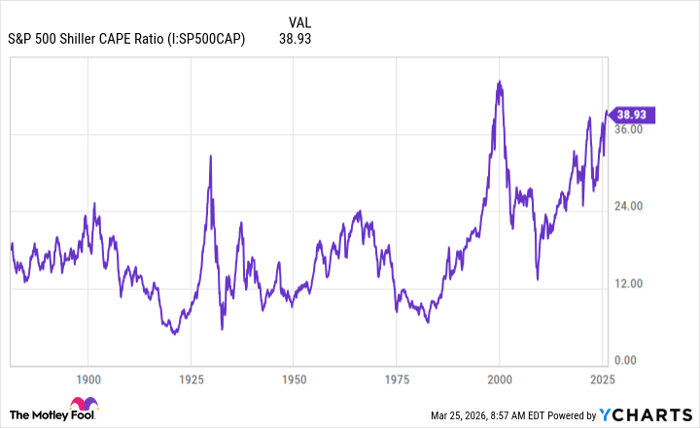
Meet the S&P 500 Shiller CAPE ratio. This metric measures the price of stocks in relation to earnings per share over a 10-year period -- this view over time is key because it accounts for shifts in the economy. So the CAPE ratio offers us a pretty accurate reading of whether stocks are expensive or cheap.
The S&P 500 Shiller CAPE ratio earlier this year reached its highest level, at more than 39, since the dot-com bubble burst back in 2000. Though it's come down slightly from that level, it still remains high, suggesting that, overall, stocks remain pricey.
S&P 500 Shiller CAPE Ratio data by YCharts
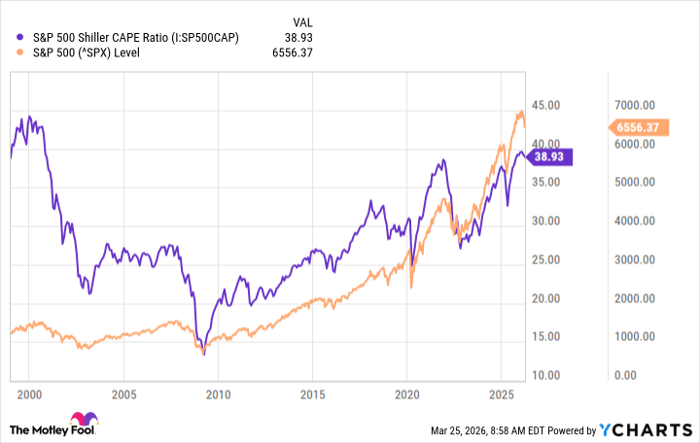
History shows, as you can see in the chart below, that each time the Shiller CAPE ratio has peaked, the S&P 500 has declined. I used the past 25 years as an example, as it's easy to see the pattern.
S&P 500 Shiller CAPE Ratio data by YCharts
This shows that, if history is right, the S&P 500 could take a clear direction at any moment, and that direction may be downward. Does this mean you should avoid stocks right now? Not at all, and here's why. History also shows us two other important things. First, when stocks fall following peaks in valuation, they don't necessarily decline for very long. So, it's possible that the S&P 500 will drop for a period of weeks and then rebound and go on to gain over the next few months.
Second -- and this is the most important point of all -- the index and quality stocks always have recovered after tough times. This is the best argument to support long-term investing. So, right now, it's a great idea to scour the market for bargains on top stocks and hold on for the long haul.
Should you buy stock in S&P 500 Index right now?
Before you buy stock in S&P 500 Index, consider this:
The Motley Fool Stock Advisor analyst team just identified what they believe are the 10 best stocks for investors to buy now… and S&P 500 Index wasn’t one of them. The 10 stocks that made the cut could produce monster returns in the coming years.
Consider when Netflix made this list on December 17, 2004... if you invested $1,000 at the time of our recommendation, you’d have $490,325!* Or when Nvidia made this list on April 15, 2005... if you invested $1,000 at the time of our recommendation, you’d have $1,074,070!*
Now, it’s worth noting Stock Advisor’s total average return is 900% — a market-crushing outperformance compared to 184% for the S&P 500. Don't miss the latest top 10 list, available with Stock Advisor, and join an investing community built by individual investors for individual investors.
See the 10 stocks »
*Stock Advisor returns as of March 26, 2026.
Adria Cimino has positions in Amazon. The Motley Fool has positions in and recommends Amazon, Nvidia, and Palantir Technologies. The Motley Fool has a disclosure policy.
Recommended Articles


