


The S&P 500 Is on Track to Finish Q1 in Negative Territory. Here's What History Suggests Comes Next.
Key Points
Negative starts to a year for the S&P 500 are the exception rather than the rule.
The index has delivered positive returns by year-end more often than negative returns in the past after a rocky start.
Investors have reason to be optimistic based on the S&P 500's history, but the market faces multiple headwinds.
- 10 stocks we like better than S&P 500 Index ›
Do beginnings matter? In books and movies, the answer is a resounding "yes." Losing the reader or viewer early on usually isn't good. But what about how stocks perform at the beginning of the year? Does a rocky start have any bearing on how the stock market finishes? The answer to that question is also a resounding "yes," based on how stocks have performed in the past.
I bring this up because the S&P 500 (SNPINDEX: ^GSPC) is on track to finish the first quarter of 2026 in negative territory. Here's what history suggests is next.
Will AI create the world's first trillionaire? Our team just released a report on the one little-known company, called an "Indispensable Monopoly" providing the critical technology Nvidia and Intel both need. Continue »

Image source: Getty Images.
Negative starts are the exception
You've probably heard that the stock market goes up more often than it goes down. That's true. And it also applies to performance during the first quarter of the year. Over the last 50 years, the S&P 500 has had a negative start to the year 18 times.
Double-digit percentage losses in the first quarter are even rarer. The S&P 500 has plunged by 10% or more in the first three months of the year only three times since 1976. It most recently began the year on such a bad note in 2020, with the COVID-19 pandemic causing a brief stock market crash.
The more moderate declines like the one we're seeing in 2026 are much more common. For example, just last year, the S&P 500 slid roughly 4.6% in the first quarter. The index also fell 4.95% in the first three months of 2022.
How the S&P 500 has fared in the past after rocky starts
Does a rocky start to a year for the S&P 500 often translate to a decline by the end of the year? Yes, but it's still the exception and not the rule.
The S&P 500 has ended the year down eight times over the last 50 years after finishing the first quarter in negative territory. In half of those years, the index delivered single-digit losses. For example, the S&P declined 1.2% in the first quarter of 2018 and was down roughly 6.2% by year's end.
However, the S&P 500 experienced much steeper losses in the other four cases. The worst performance came in 2008 during the Great Recession. The S&P 500 slid 9.9% in the first quarter of that year but plunged 38.5% by the end of 2008.
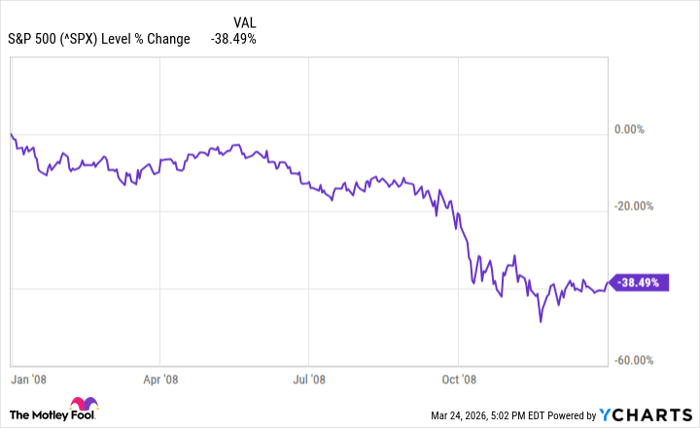
^SPX data by YCharts
The good news is that the index bounces back from a dismal start more often than not. And usually, the rebound is quite strong. The most recent example of this occurred last year. The S&P 500 was down around 4.6% at the end of the quarter but finished the year up a healthy 16.4%. Even more impressive was the index's performance in 2003, when it fell 3.6% in the first quarter only to post a 26.4% return for the full year.
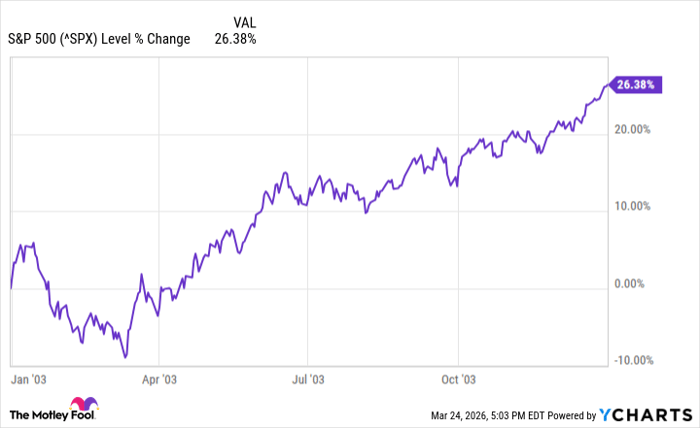
^SPX data by YCharts
What's next in 2026?
If history is any guide, the end of 2026 will be better than its beginning.
The rapid adoption of artificial intelligence (AI) and the resulting massive expansion of AI infrastructure could be enough to turn things around all by itself. The so-called "Magnificent Seven" stocks, all of which have invested heavily in AI, currently make up nearly one-third of the S&P 500's total market cap. If the AI boom continues, these stocks should perform well, lifting the S&P 500 in the process.
On the other hand, the stock market faces multiple headwinds. It's unclear how long Iran will disrupt traffic through the Strait of Hormuz and keep oil prices high. The U.S. economy seems at least a little wobbly, with February GDP growth well below expectations. Tariffs could still weigh on the economy.
Still, investors have reason to be optimistic based on the S&P 500's history. However, the most important driver of stock market performance isn't history but the history that has yet to be made.
Should you buy stock in S&P 500 Index right now?
Before you buy stock in S&P 500 Index, consider this:
The Motley Fool Stock Advisor analyst team just identified what they believe are the 10 best stocks for investors to buy now… and S&P 500 Index wasn’t one of them. The 10 stocks that made the cut could produce monster returns in the coming years.
Consider when Netflix made this list on December 17, 2004... if you invested $1,000 at the time of our recommendation, you’d have $503,592!* Or when Nvidia made this list on April 15, 2005... if you invested $1,000 at the time of our recommendation, you’d have $1,076,767!*
Now, it’s worth noting Stock Advisor’s total average return is 913% — a market-crushing outperformance compared to 185% for the S&P 500. Don't miss the latest top 10 list, available with Stock Advisor, and join an investing community built by individual investors for individual investors.
See the 10 stocks »
*Stock Advisor returns as of March 25, 2026.
Keith Speights has no position in any of the stocks mentioned. The Motley Fool has no position in any of the stocks mentioned. The Motley Fool has a disclosure policy.
Recommended Articles


