


The First Federal Reserve Inflation Forecast for March Is In -- and It's Not Pretty
Key Points
Oil price shock events are historically bad news for the Dow Jones Industrial Average, S&P 500, and Nasdaq Composite.
The virtual closure of the Strait of Hormuz has sent energy prices soaring, with the per-gallon price of gas and diesel up 33% and 39%, respectively, over the last month.
The Federal Reserve Bank of Cleveland's inflation forecasting tool projects a significant increase in prices for March, which is potentially terrible news for the central bank's rate-easing cycle.
- 10 stocks we like better than S&P 500 Index ›
For much of the last seven years, Wall Street's major stock indexes have been powering higher. With the exception of 2022, the benchmark S&P 500 (SNPINDEX: ^GSPC) has gained at least 16% each year since 2019. Meanwhile, the widely followed Dow Jones Industrial Average (DJINDICES: ^DJI) recently topped 50,000, and the growth-driven Nasdaq Composite (NASDAQINDEX: ^IXIC) briefly surpassed 24,000.
But if there's one near-constant on Wall Street, aside from the Dow, S&P 500, and Nasdaq Composite rising over multidecade periods, it's that when things seem too good to be true, they often are.
Will AI create the world's first trillionaire? Our team just released a report on the one little-known company, called an "Indispensable Monopoly" providing the critical technology Nvidia and Intel both need. Continue »
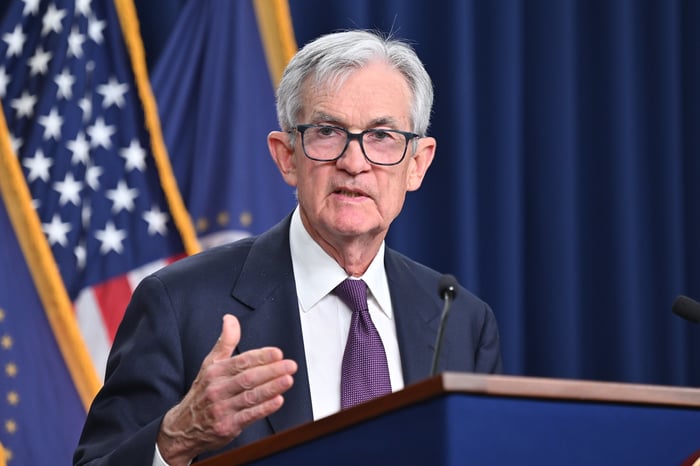
Fed Chair Jerome Powell and members of the Federal Open Market Committee have a challenging road ahead. Image source: Official Federal Reserve Photo.
While the stock market is always contending with headwinds threatening to pull the rug out from beneath investors, some are more nefarious than others. Historically, oil price shock events tend to be big-time trouble -- and the initial March inflation forecast from the Federal Reserve Bank of Cleveland proves it.
The largest energy supply chain disruption in history is hitting home
On Feb. 28, the U.S. and Israel began military operations against Iran. Subsequent to the start of these attacks, Iran virtually closed the Strait of Hormuz to oil exports. In a given day, approximately 20% of the world's liquid petroleum needs travel through the Strait of Hormuz, per the Energy Information Administration.
The Iran war represents the largest disruption to the global energy supply chain in history. While it's possible that the release of strategic reserves by select countries may temper the near-term demand shock, the impact of this disruption and the uncertainty of how long this military conflict may extend are being felt in the U.S.
Gas prices in the US have moved up to $3.88/gallon, their highest level since October 2022. The 33% spike over the last month ($2.92/gallon to $3.88/gallon) is the biggest we've seen in the past 30 years.
-- Charlie Bilello (@charliebilello) March 19, 2026
Video: https://t.co/QXjtf3WkP5 pic.twitter.com/H7vxUzGFNG
Over the last month, through March 19, the average nationwide price of a gallon of regular gas has jumped by 33%, according to data from AAA. Meanwhile, the average price for a gallon of diesel has surged by 39%.
Although prices at the pump are the most direct way consumers feel the sting of oil price shock events, they aren't the only way the U.S. economy is impacted. It suddenly costs quite a bit more to transport goods, be it by truck, air, boat, or train. This ripples throughout the U.S. economy and drives up the inflation rate. The million-dollar question is: By how much?
A big uptick in U.S. inflation is expected when the March inflation report is released
On March 11, the U.S. Bureau of Labor Statistics (BLS) released the February inflation report, which contained few surprises. The Consumer Price Index for All Urban Consumers (CPI-U) rose by 2.4% over the trailing 12-month period, with energy commodities dragging down inflation from the prior-year period.
This will not be the case come March. Following a surge in crude oil prices, the Federal Reserve Bank of Cleveland's Inflation Nowcasting tool expects the CPI to surge to 3.02% as of its March 19 update. Personal Consumption Expenditures (PCE) are also expected to jump from an estimated 2.67% in February to 3.14% in March, according to the Cleveland Fed.
The Cleveland Fed is now forecasting a 3% CPI Inflation reading for March, up from 2.4% in February.
-- Charlie Bilello (@charliebilello) March 19, 2026
There is now a higher probability of a Fed rate HIKE (8%) in April than a rate CUT (0%). pic.twitter.com/yoWBJBbDDN
These are not small adjustments, and they come at a time when inflationary pressures from President Donald Trump's tariff and trade policy are still working their way through the U.S. economy.
Although the length of the Iran war matters for the Federal Reserve's interest rate decision-making, a rapid increase in inflation has the potential to throw a monkey wrench into its current rate-easing cycle. The probability of the central bank cutting rates at the April Federal Open Market Committee (FOMC) meeting is effectively 0% now, while the probability of a rate hike is 8.3%. In a matter of weeks, we've shifted from an expectation of one or more rate cuts in 2026 to the very real possibility of rate hikes.
This is a mammoth problem, given how historically expensive the stock market was when the year began. The S&P 500's Shiller Price-to-Earnings (P/E) Ratio, also known as the Cyclically Adjusted P/E Ratio (CAPE Ratio), has been bouncing between 39 and 41 for months, compared to its average multiple of 17.35, dating back to January 1871.
To maintain such a historic valuation premium, which is exceeded only by the dot-com era, the FOMC would be expected to deliver several rate cuts in 2026. But with it looking likely that these rate cuts are off the table, sustaining the near-parabolic moves we've observed in the Dow Jones Industrial Average, S&P 500, and Nasdaq Composite will prove difficult, if not impossible.
Though we'll get additional updates from the Cleveland Fed's Inflation Nowcasting tool before the BLS releases the March inflation data on April 10, this initial projection is bad news for consumers, businesses, and Wall Street.
Should you buy stock in S&P 500 Index right now?
Before you buy stock in S&P 500 Index, consider this:
The Motley Fool Stock Advisor analyst team just identified what they believe are the 10 best stocks for investors to buy now… and S&P 500 Index wasn’t one of them. The 10 stocks that made the cut could produce monster returns in the coming years.
Consider when Netflix made this list on December 17, 2004... if you invested $1,000 at the time of our recommendation, you’d have $495,179!* Or when Nvidia made this list on April 15, 2005... if you invested $1,000 at the time of our recommendation, you’d have $1,058,743!*
Now, it’s worth noting Stock Advisor’s total average return is 898% — a market-crushing outperformance compared to 183% for the S&P 500. Don't miss the latest top 10 list, available with Stock Advisor, and join an investing community built by individual investors for individual investors.
See the 10 stocks »
*Stock Advisor returns as of March 24, 2026.
Sean Williams has no position in any of the stocks mentioned. The Motley Fool has no position in any of the stocks mentioned. The Motley Fool has a disclosure policy.
Recommended Articles


