


Meet the Artificial Intelligence (AI) ETF With 20% of Its Portfolio Parked in Alphabet, Nvidia, Micron, and Amazon
Key Points
Investors who lack exposure to artificial intelligence (AI) stocks have probably underperformed the broader market over the last few years.
The Roundhill Generative AI and Technology ETF is a simple way for investors to buy an entire portfolio of leading AI stocks.
Over one-fifth of its assets are invested in Alphabet, Nvidia, Micron, and Amazon, but they aren't the only AI powerhouses it holds.
- 10 stocks we like better than Tidal Trust II - Roundhill Generative Ai & Technology ETF ›
Artificial intelligence (AI) stocks have led the broader market higher over the last few years. In fact, investors who haven't owned a slice of the AI revolution since it started gathering momentum at the start of 2023 have likely underperformed the benchmark S&P 500 (SNPINDEX: ^GSPC) index.
Fortunately, there is a simple way to rectify that in 2026. The Roundhill Generative AI and Technology ETF (NYSEMKT: CHAT) exclusively invests in companies developing AI infrastructure, AI software, and AI platforms, with over one-fifth of its assets parked in Nvidia, Alphabet, Micron Technology, and Amazon alone.
Will AI create the world's first trillionaire? Our team just released a report on the one little-known company, called an "Indispensable Monopoly" providing the critical technology Nvidia and Intel both need. Continue »
Here's why this exchange-traded fund (ETF) could be a great addition to a diversified portfolio that's lacking exposure to the AI boom.

Image source: Getty Images.
An complete AI portfolio packaged into one ETF
The Roundhill Generative AI and Technology ETF holds just 43 stocks. It's actively managed by a team of investment professionals who make adjustments to the portfolio based on what they believe will deliver the best returns.
This can lead to higher returns compared to passively managed ETFs that simply track indexes like the S&P 500, but on the flip side, volatility is a key risk because the AI industry is moving so quickly.
Volatility can also be a side effect of the Roundhill ETF's top-heavy portfolio construction. As I alluded to, the fund has invested 20.7% of its assets in just four of the AI industry's top companies, so its performance is sometimes disproportionately affected by them alone:
|
Stock |
Roundhill ETF Portfolio Weighting |
|---|---|
|
Alphabet |
6.92% |
|
Nvidia |
6.43% |
|
Amazon |
4.01% |
|
Micron Technology |
3.33% |
Data source: Roundhill Investments. Portfolio weightings are accurate as of March 1, 2026, and are subject to change.
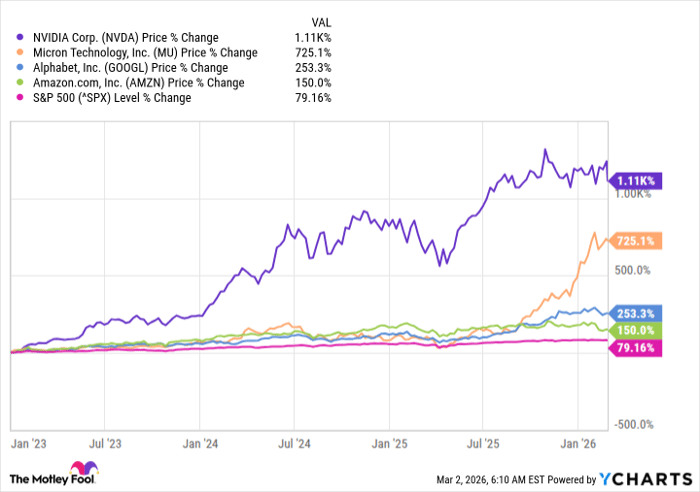
Fortunately, those four stocks have been standout performers since the start of 2023, delivering an average return of 559% over the three-year period. For some perspective, the S&P 500 climbed by just 79%.
Data by YCharts.
There is certainly a case for further upside in those four names. Nvidia's new Vera Rubin semiconductor platform for the data center is scheduled to enter mass production later this year, and it's expected to significantly bring down the cost of training and serving AI models. The company's chief financial officer, Colette Kress, says every major developer is likely to deploy them.
That's also good news for Micron, because its high-bandwidth memory solutions are embedded in Nvidia's AI chips, where they manage the seamless flow of data to unlock maximum processing speeds. In fact, the company's revenue growth is expected to accelerate from here thanks to AI-related demand.
As chips and other hardware components become more efficient, leasing computing capacity to developers via the cloud also becomes a more profitable business model due to much lower costs. Alphabet and Amazon operate two of the world's largest cloud platforms, so this will be a massive tailwind for both companies.
Some of the other prominent AI stocks in the Roundhill ETF include Microsoft, Advanced Micro Devices, Broadcom, Meta Platforms, Palantir Technologies, and two of Micron's largest global competitors, SK Hynix and Samsung Electronics.
A short track record, but blistering returns so far
The Roundhill Generative AI and Technology ETF was established in May 2023, so it doesn't have a very long track record. The AI industry has experienced very little turbulence over that period (broadly speaking), so we don't know how well this ETF will weather a potential storm when one inevitably arrives.
That said, the Roundhill ETF has gained 146% since its inception, obliterating the S&P 500, which returned 64% over the same period.
Those high returns come at a cost, because the ETF has an expense ratio of 0.75%, which means a $10,000 investment would incur an annual fee of around $75. That doesn't sound too bad at face value, but it's 25 times higher than the expense ratio of the Vanguard S&P 500 ETF, which is just 0.03%. An actively managed fund is typically more expensive to run because it requires the full attention of a team of experts, which costs money.
Considering its high cost, high portfolio concentration, and potential for volatility, investors shouldn't be betting the farm on an ETF like this one. Instead, it could be a great addition to a portfolio of other ETFs and individual stocks that currently lack exposure to the AI boom.
Should you buy stock in Tidal Trust II - Roundhill Generative Ai & Technology ETF right now?
Before you buy stock in Tidal Trust II - Roundhill Generative Ai & Technology ETF, consider this:
The Motley Fool Stock Advisor analyst team just identified what they believe are the 10 best stocks for investors to buy now… and Tidal Trust II - Roundhill Generative Ai & Technology ETF wasn’t one of them. The 10 stocks that made the cut could produce monster returns in the coming years.
Consider when Netflix made this list on December 17, 2004... if you invested $1,000 at the time of our recommendation, you’d have $534,817!* Or when Nvidia made this list on April 15, 2005... if you invested $1,000 at the time of our recommendation, you’d have $1,123,912!*
Now, it’s worth noting Stock Advisor’s total average return is 964% — a market-crushing outperformance compared to 192% for the S&P 500. Don't miss the latest top 10 list, available with Stock Advisor, and join an investing community built by individual investors for individual investors.
See the 10 stocks »
*Stock Advisor returns as of March 7, 2026.
Anthony Di Pizio has no position in any of the stocks mentioned. The Motley Fool has positions in and recommends Advanced Micro Devices, Alphabet, Amazon, Meta Platforms, Micron Technology, Microsoft, Nvidia, Palantir Technologies, and Vanguard S&P 500 ETF. The Motley Fool recommends Broadcom. The Motley Fool has a disclosure policy.
Recommended Articles


