


Surprise! America Has Chosen Its Favorite Auto Brand -- and It's Not Ford, General Motors, or Tesla!
Key Points
Car buyers expect meaningful value and dependability when purchasing a new vehicle -- and having a historic or household name only goes so far to incite brand loyalty.
Although the immense popularity of Ford's F-Series pickups has helped it rise up the customer loyalty ranks, it, General Motors, and Tesla don't take the crown.
Meanwhile, an international automaker's value proposition, top-tier warranty, and production quality have made it the cream of the crop, yet again, in Brand Keys' 2026 Customer Loyalty Engagement Index rankings.
- 10 stocks we like better than Ford Motor Company ›
Aside from a home, the largest purchase the typical American will make is a new vehicle. As reported by Kelley Blue Book, the average new-car buyer paid a whopping $49,191 in January 2026, down a little over 2% from an all-time high of more than $50,000 per transaction in December. Meanwhile, it's become virtually impossible to find a new vehicle with a price tag of less than $20,000.
With new vehicle prices rising at every turn, consumers are expecting meaningful value and dependability from their investment. This means that having a historic or household name, such as Ford Motor Company (NYSE: F), General Motors (NYSE: GM), or Tesla (NASDAQ: TSLA), isn't enough, by itself, to incentivize loyalty among car buyers.
Will AI create the world's first trillionaire? Our team just released a report on the one little-known company, called an "Indispensable Monopoly" providing the critical technology Nvidia and Intel both need. Continue »
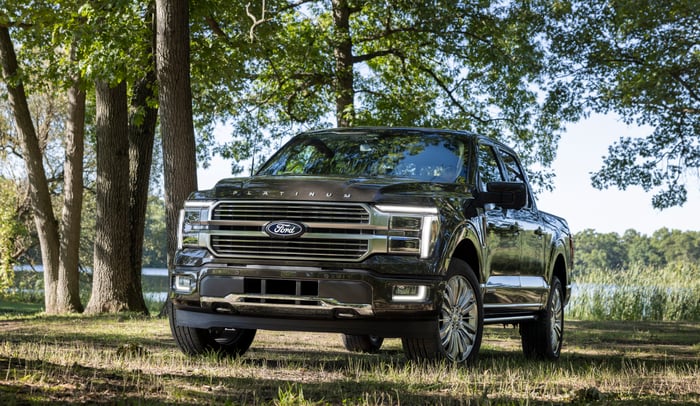
Ford's F-Series trucks have been America's top-selling vehicle for 44 consecutive years. Image source: Ford Motor Company.
But for automakers that can instill trust and engage with their customers during and beyond the sale, the rewards can be bountiful.
For roughly three decades, global brand research consultancy firm Brand Keys has published the results of a survey that quantifies how customer loyalty and engagement positively or negatively impact businesses across dozens of categories. Brand Keys' 2026 Customer Loyalty Engagement Index (CLEI) examined over 1,100 brands in 106 categories -- automotive among them.
For the 17th consecutive year, one automaker walked away with the brand loyalty and engagement crown -- and it wasn't one of Detroit's automakers or Elon Musk's Tesla.
Ford has shone, but not enough to take the top spot
Although Ford hasn't driven to the front of the pack, it has placed as high as second in the CLEI rankings, which is nothing to sneeze at when competing against dozens of prominent auto brands.
Ford's customer base is particularly loyal thanks to its top-selling F-Series pickups. Last year marked the 49th consecutive year that the F-Series was the best-selling truck in America, and the 44th straight year that it was the best-selling vehicle, period. The latest U.S. Automotive Brand Loyalty Study from J.D. Power found that Ford's truck loyalty rate was 66.6%, compared to just 49% across all brands and vehicle types. Roughly two-thirds of all F-Series buyers return to buy another truck with Ford.
While bigger isn't always better in the business world, trucks and SUVs typically generate higher margins than sedans for automakers. Thus, Ford's F-Series maintaining its ultra-high loyalty rate and top-sales status is paramount to the company's success.
Comparatively, GM (as General Motors is more commonly known) and Tesla haven't been able to keep pace on the loyalty and engagement front.
The Tesla brand may be hurt by the outspoken nature of its CEO, Elon Musk, as well as his propensity to overpromise and underdeliver. Though Musk has overseen the rollout of several mass-produced electric vehicles (EVs), including the Model 3 sedan, Model Y SUV, and Cybertruck, his promises have, in many instances, fallen short or not been kept.
For instance, Musk has been touting that Level 5 full-self driving (FSD) is "one year away" for more than a decade. However, Tesla's FSD hasn't moved beyond Level 2 autonomy. Overpromising what Tesla's EVs are capable of appears to be compromising meaningful brand-building efforts with consumers.
Having an edgy vehicle or more than a century of storied history as a tailwind simply isn't enough to automatically command the loyalty of car buyers.
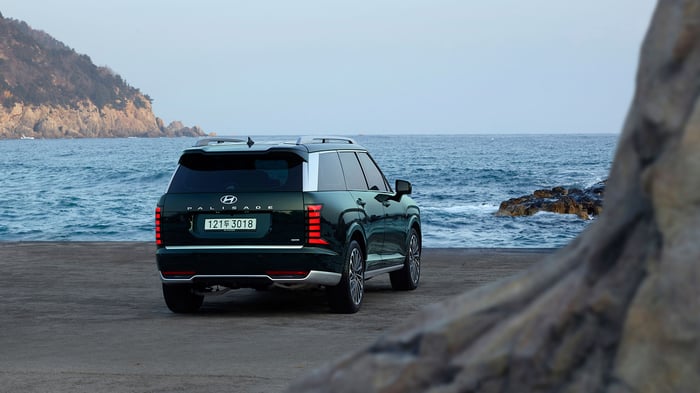
The Palisade is Hyundai's premium SUV. Image source: Hyundai Motor Group.
This is the auto brand that engenders loyalty among American car buyers
According to Brand Keys' 2026 CLEI, Hyundai Motor Company took the crown as the auto brand car buyers are most loyal to for a 17th consecutive year.
To begin with, Hyundai excels thanks to its value proposition. The South Korean automaker sported an average sales price of $36,584 across its lineup in 2023-2024. This is notably below the average sales price per vehicle in January 2026, per Kelley Blue Book. Across an assortment of vehicle types, including sedans, SUVs of all sizes, and EVs, Hyundai is consistently undercutting its competitors on price.
To build on the above, Hyundai has a vehicle for all stages of life. Its entry-level SUV (Venue) and Elantra sedan are ideal for first-time buyers, while its mid-size Santa Fe SUV or three-row Palisade SUV cater to growing families. The trust Hyundai has instilled with consumers should result in more buyers trading up to its higher-margin Palisade.
Brand Keys' CLEI also suggests that consumers appreciate "America's best warranty." New vehicle buyers receive a 10-year/100,000-mile powertrain warranty, a five-year/60,000-mile new vehicle limited warranty, and five years of roadside assistance, regardless of mileage. In the event that a buyer has issues with their vehicle, Hyundai is standing behind its product.
Lastly, Hyundai's quality has been among the best in the auto industry. The 2025 J.D. Power U.S. Initial Quality Study, which examines problems per 100 vehicles in the first 90 days of ownership across 33 brands, found that Hyundai ranked third, with only 173 problems per 100 vehicles. For context, Ford and Tesla clocked in at 193 and 200 problems per 100 vehicles, respectively, while GM-owned brands Chevrolet, Buick, GMC, and Cadillac had 178, 183, 199, and 200 problems per 100 vehicles.
While it's unlikely that Hyundai will lose its spot atop the loyalty and engagement pedestal anytime soon, Ford is perhaps the one U.S. automaker that can give it a run for its money.
Should you buy stock in Ford Motor Company right now?
Before you buy stock in Ford Motor Company, consider this:
The Motley Fool Stock Advisor analyst team just identified what they believe are the 10 best stocks for investors to buy now… and Ford Motor Company wasn’t one of them. The 10 stocks that made the cut could produce monster returns in the coming years.
Consider when Netflix made this list on December 17, 2004... if you invested $1,000 at the time of our recommendation, you’d have $534,817!* Or when Nvidia made this list on April 15, 2005... if you invested $1,000 at the time of our recommendation, you’d have $1,123,912!*
Now, it’s worth noting Stock Advisor’s total average return is 964% — a market-crushing outperformance compared to 192% for the S&P 500. Don't miss the latest top 10 list, available with Stock Advisor, and join an investing community built by individual investors for individual investors.
See the 10 stocks »
*Stock Advisor returns as of March 7, 2026.
Sean Williams has no position in any of the stocks mentioned. The Motley Fool has positions in and recommends Tesla. The Motley Fool recommends General Motors. The Motley Fool has a disclosure policy.
Recommended Articles


