


Where Will Rocket Lab Stock Be in 5 Years?
Key Points
The rocket maker expects to achieve significant progress on its Neutron rocket ship program this year.
However, the stock is quite expensive, and the complex development process could see further delays.
- 10 stocks we like better than Rocket Lab ›
When it comes to growth-focused investing, it can pay to bet on small companies pioneering potentially large markets. While these types of companies have a bigger risk of failure compared to more established peers, they promise multibagger returns if things work out.
Aerospace specialist Rocket Lab (NASDAQ: RKLB) fits into this category. Let's explore the risk-to-potential-reward ratio for buying the stock and decide what the next five years might have in store for investors.
Will AI create the world's first trillionaire? Our team just released a report on the one little-known company, called an "Indispensable Monopoly" providing the critical technology Nvidia and Intel both need. Continue »
The space opportunity looks solid
McKinsey & Co. expects the global space industry to hit $1.8 trillion by 2035, driven by demand for satellites and their ground-based applications. By now, investors should be numb to extremely optimistic projections about future technologies. But in this case, there are already some early signs that this could be a transformational opportunity.
The best example comes from Starlink. Reuters reports that the privately owned rocket company generated a whopping $8 billion in profits (on $15 billion to $16 billion of revenue) last year. If true, this would suggest that this industry is capable of supporting impressive margins and growth potential. But with SpaceX expected to IPO this year at a valuation of $1.5 trillion, much of the larger company's value could already be priced in.
Smaller space companies like Rocket Lab (with its market cap of just $38 billion) could offer investors the chance to get in on the ground floor of a long-term opportunity as it scales up its business model.
Is Rocket Lab a good alternative to SpaceX?
Rocket Lab provides end-to-end space-related services ranging from manufacturing to launch and satellites. Right now, its bread and butter comes from its expendable orbital launch vehicle, Electron, which is capable of transporting payloads of up to 300 kilograms to low Earth orbit (LEO). The company has prioritized cost-efficiency and scalability by integrating technologies like 3D printing into the manufacturing process.
The company's relatively small payload capacity puts it at a disadvantage compared to its rival, SpaceX, which boasts massive rocket designs like Starship, capable of transporting 100 to 150 metric tons of material into LEO. That said, Rocket Lab could eventually bridge the gap by expanding its lineup with new models like the Neutron, which management expects to put into service later this year.
Neutron will be significantly larger than Electron, with an expected payload capacity of 13,000 kg. The dramatic increase in payload size could give Rocket Lab significant economies-of-scale advantages by lowering its payload cost per kilogram to orbit. Neutron's larger size will also help Rocket Lab compete for larger commercial and government clients in the market for satellite constellations, where multiple devices need to be placed into orbit within a single mission.
Rocket Lab has also designed the Neutron to be reusable, potentially saving materials costs and making the business model more scalable.
When will Rocket Lab become commercially viable?
On the surface, Rocket Lab's Neutron looks like the magic bullet that will transform the company from a speculative start-up into a serious player in the space industry. That said, early-stage companies often overpromise and underdeliver, especially regarding timelines.
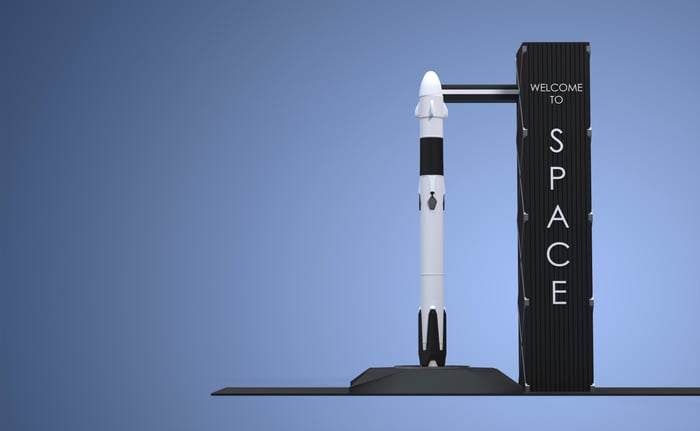
Image source: Getty Images.
Since its announcement in 2021, Rocket Lab's Neutron launch has been delayed several times -- most recently with management pushing the timeline from 2025 to 2026. Given this pattern, there is no reason to assume the mid-2026 launch is set in stone. And investors shouldn't be surprised if dates continue to be pushed back while technical details are worked out. Meanwhile, operational results show challenges.
While third-quarter revenue jumped 48% year over year to $155 million, operating losses remain stubbornly high at $59 million.
What will the next five years have in store?
Rocket Lab is right on the cusp of becoming a sustainable and attractive business. And over the next five years, it could become a viable alternative to industry leaders like SpaceX. Still, with a price-to-sales multiple of 62, success looks already priced into its current valuation.
For context, the S&P 500 averages 3.4, and Rocket Lab's premium could lead to a sharp correction if there are more delays or uncertainty regarding the company's Neutron launch. Long-term investors should take a wait-and-see approach before considering a position in the stock.
Should you buy stock in Rocket Lab right now?
Before you buy stock in Rocket Lab, consider this:
The Motley Fool Stock Advisor analyst team just identified what they believe are the 10 best stocks for investors to buy now… and Rocket Lab wasn’t one of them. The 10 stocks that made the cut could produce monster returns in the coming years.
Consider when Netflix made this list on December 17, 2004... if you invested $1,000 at the time of our recommendation, you’d have $420,864!* Or when Nvidia made this list on April 15, 2005... if you invested $1,000 at the time of our recommendation, you’d have $1,182,210!*
Now, it’s worth noting Stock Advisor’s total average return is 903% — a market-crushing outperformance compared to 192% for the S&P 500. Don't miss the latest top 10 list, available with Stock Advisor, and join an investing community built by individual investors for individual investors.
See the 10 stocks »
*Stock Advisor returns as of February 25, 2026.
Will Ebiefung has no position in any of the stocks mentioned. The Motley Fool has positions in and recommends Rocket Lab. The Motley Fool has a disclosure policy.
Recommended Articles


