


Alibaba has been receiving a series of positive news, but this has not been reflected in its stock price.
TradingKey - Alibaba is making a rapid succession of moves, recently unveiling a new AI model, reporting better-than-expected AI business growth, and launching Qwen-powered smart glasses. The company debuted its next-generation AI model, Qwen 3 Max, on Monday, which garnered over 10 million downloads in just one week of public beta. Its quarterly earnings, released on Tuesday, revealed AI business progress that exceeded market expectations, reinforcing investor confidence in Alibaba's next growth cycle. Furthermore, Alibaba began selling its first Qwen AI-powered smart glasses on Thursday, marking its official entry into the consumer hardware arena.
Earnings Highlights: AI Remains Market's Focus
Investors are clearly most concerned with Alibaba's AI strategy. This quarter, Alibaba Cloud's revenue surged 34.5% year-over-year. This figure not only surpassed market expectations, which had been generally revised upwards to over 30%, but also saw a quarter-over-quarter increase of nearly 9 percentage points, marking two consecutive quarters of high growth.
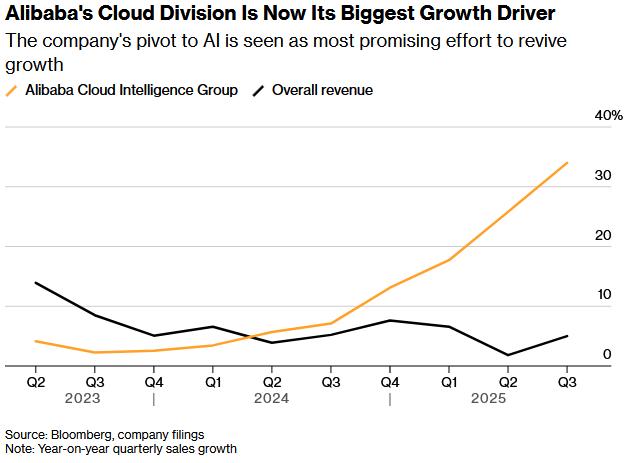
Institutional analysis indicates that this growth was primarily driven by the group's internal computing power demand. Excluding internal contributions, Alibaba Cloud's quarter-over-quarter growth was approximately 3 percentage points. While this might seem modest, it is not uncommon given the development trajectory of global cloud service giants, as nearly all providers prioritize satisfying their internal AI demands in the early stages.
Alibaba had previously outlined a "3-year, 380 billion yuan" capital expenditure plan during its last two earnings calls. The latest earnings report indicates that approximately 70 billion yuan has already been invested in the first half of fiscal year 2026, suggesting that the overall investment pace might be ahead of schedule. Compared to Tencent, Alibaba's Capex appears significantly more aggressive.
Management stated during the earnings call that the company plans to evolve Qwen into an intelligent tool capable of handling complex tasks such as Taobao shopping, map navigation, travel bookings, and educational learning. This aims to build an AI ecosystem spanning multiple scenarios.
CEO Eddie Wu also reiterated that Alibaba is advancing a "full-stack AI strategy," encompassing everything from advanced large models to the semiconductor infrastructure supporting their operations. This signifies that Alibaba is constructing an integrated closed-loop system, from AI infrastructure to large models (Qwen) and applications (such as Taobao and Amap).
E-commerce business growth slowed but remained steady. This quarter, Alibaba's Customer Management Revenue (CMR) grew 10% to 78.9 billion yuan, a slowdown compared to previous quarters. Nevertheless, it remained robust when compared to peers like PDD and JD.com, benefiting from the boost provided by "Taobao Flash Sale."
The e-commerce group's adjusted EBITA stood at 10.5 billion yuan, marking a year-over-year decrease of approximately 34 billion yuan. While profitability evidently contracted, Alibaba's performance remained relatively resilient compared to rivals like JD.com and Meituan, whose profits were eroded during the "era of heavy subsidies."
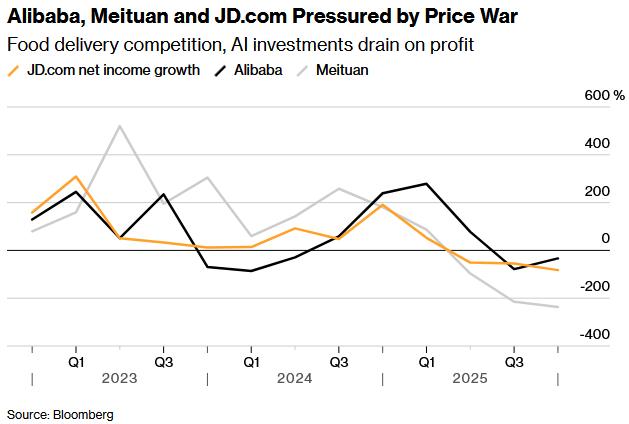
Market estimates suggest losses from instant retail were around 36 billion yuan, a considerable amount, yet significantly more optimistic than Meituan's halving of profits. Excluding the impact of "flash sales," China's e-commerce segment is still projected to maintain low single-digit profit growth, generally aligning with market expectations. Looking ahead to the fourth quarter, the key question is whether Alibaba can maintain its instant retail market share once subsidy levels decline.
Notably, possibly influenced by changes in overseas policies, Alibaba's international e-commerce revenue growth continued to decelerate to around 10% annually, with a clear strategic shift back towards the domestic market.
Overall, Alibaba's total revenue for the quarter reached 247.8 billion yuan, a 5% year-over-year increase. This was primarily driven by robust growth in its cloud business and contributions from Taobao Flash Sale. Excluding the impact of divesting Intime and Sun Art Retail, the actual year-over-year growth would be approximately 15%, slightly exceeding Bloomberg consensus estimates and higher than the previous quarter's growth rate.
Consumer Quark AI Glasses Make Official Debut
Beyond models and cloud services, Alibaba is now bringing AI directly to consumers. The company launched its first self-developed Quark AI Glasses series, positioned as an "integrated AI assistant," which combines features like voice interaction and real-time translation, and is deeply integrated with the Alibaba ecosystem, spanning from shopping and travel to payment services.
Unlike Meta's AR approach, Quark AI Glasses prioritize everyday use cases and practicality. Priced at just 1,899 yuan, these glasses significantly lower the entry barrier for AI wearables, making AI-powered assistive tools accessible to a broader user base. In contrast, Meta's recently launched Ray-Ban Display smart glasses are priced at $799, highlighting Alibaba's more mass-market oriented pricing strategy for this product.
Additionally, Alibaba has integrated its ecosystem resources into the new hardware, including Taobao shopping, Fliggy travel booking, and Alipay payment services. The company has also partnered with NetEase and Tencent to expand its music content ecosystem.
Qwen Max: Performance Potentially Surpassing GPT-5 and Claude Opus 4
Following Alibaba's announcement on Monday that Qwen 3 Max downloads surpassed 10 million, its Hong Kong-listed shares climbed over 5% in a single day. The market views this as a crucial step for Alibaba in "benchmarking" its valuation against OpenAI.
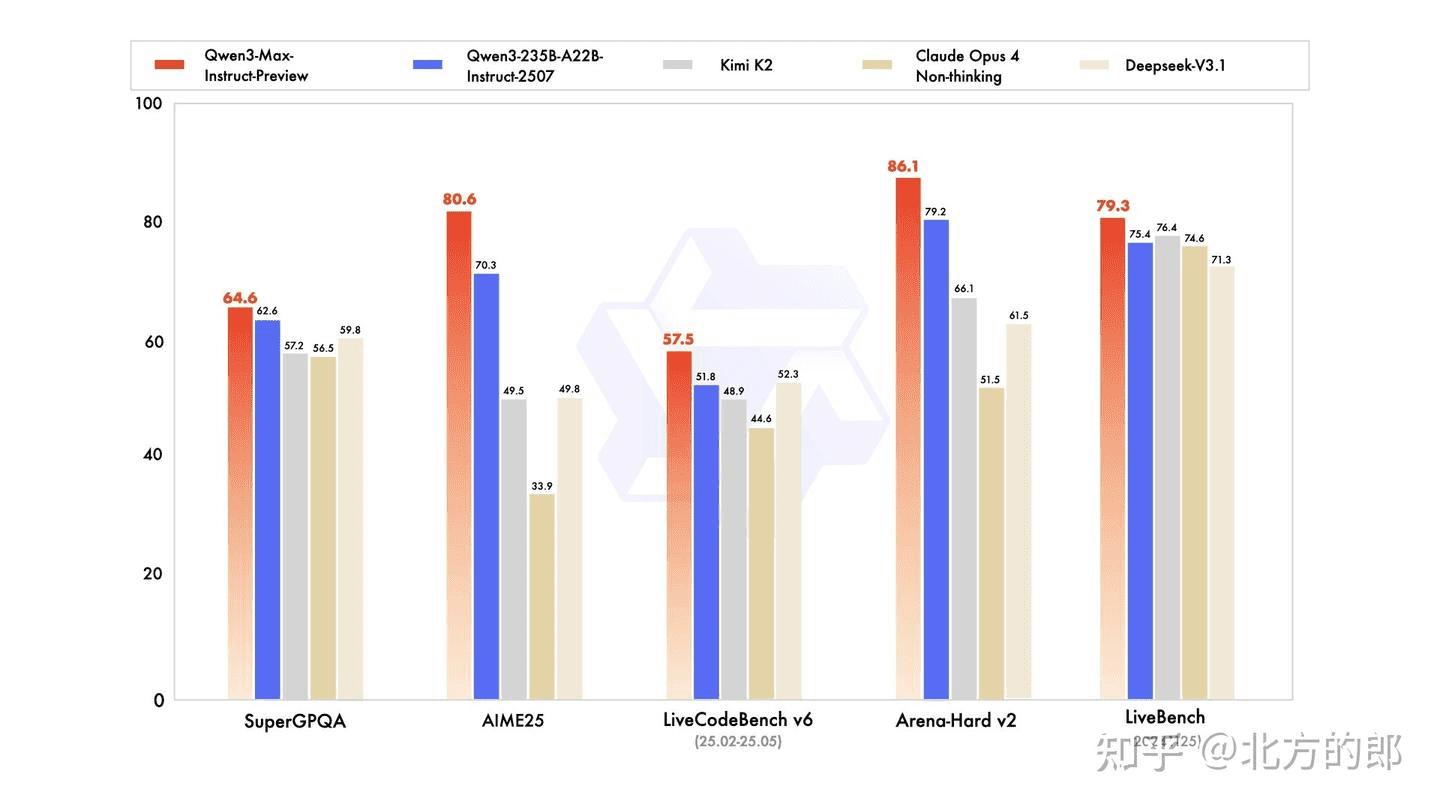
Third-party benchmark data indicates that Qwen 3 Max has comprehensively set new records for the Tongyi series across a range of authoritative evaluation sets, including MMLU, GSM8K, HumanEval, and BIG Bench Hard. In certain aspects, its performance even surpassed that of GPT-5 and Claude Opus 4.
More critically, Alibaba's underlying user ecosystem is a significant factor. The company plans to directly integrate core lifestyle services such as digital maps, food delivery, travel, office, education, health management, and e-commerce into the Qwen application system. Leveraging its shopping functionalities, Alibaba aims to utilize its e-commerce DNA to forge new pathways for AI commercialization. According to informed sources, Alibaba also plans to launch an overseas version of Qwen in the future, with intentions to expand its AI business globally.
Market Reaction Muted
Despite a flurry of positive news surrounding its AI and cloud businesses, Alibaba's stock price has not rebounded to its annual high. Management stated during the earnings call that the group's primary objective is to solidify its medium-to-long-term market share, which implies potential short-term volatility in e-commerce CMR and profitability.
Goldman Sachs noted that this statement was one reason for the muted stock price reaction. Investors' core concerns revolve around intensifying e-commerce competition, extended user re-engagement cycles, and the high base effect from software service fees in the prior year. Although Alibaba Cloud is seen as a future growth engine, the company's primary business currently remains e-commerce. Consequently, adjustments in domestic subsidy policies, shifts in instant retail market share, and substantial Capex investments will continue to impact profitability.
Recommended Articles


