


Can Nvidia Become a $10 Trillion Stock by 2030?
Key Points
Nvidia is sharpening its edge by rolling out vertically integrated products that make it easier for its clients to engage with AI.
Its new Blackwell architecture is still rolling out, but it has new products in the works for next year.
Nvidia stock trades at a pricey valuation.
- 10 stocks we like better than Nvidia ›
Artificial intelligence (AI) powerhouse Nvidia (NASDAQ: NVDA) has produced eye-popping gains for investors over the past decade and longer. Yet, the investing community doesn't have a clear consensus on where it will go from here.
There's no question that the company is building the infrastructure of the future for AI, but there's increasing competition, and there can always be unforeseen events.
Where to invest $1,000 right now? Our analyst team just revealed what they believe are the 10 best stocks to buy right now, when you join Stock Advisor. See the stocks »
At the current price, Nvidia has a market cap of $4.9 trillion, making it the highest valued stock in the world. To reach $10 trillion, it would have to increase 104%, a little more than double its current value. Can it get there by 2030?
Why Nvidia is still one of the hottest stocks on the market
Nvidia has become the face of artificial intelligence. Its graphics processing units (GPUs) are the chips that drive the most powerful generative AI applications. While there are some competitors, Nvidia controls somewhere between 70% and 95% of the market, according to different analysts.
However, it's launching new products that could enable it to grab an even greater market share. It's rolling out vertically integrated hardware and software that make it easier and faster for clients to run applications and data centers. For example, Nvidia's CUDA software is designed for developers to work easily with Nvidia GPUs, data centers, and workstations, with its GPUs embedded in the system. It just shipped the DGX Spark, the world's smallest supercomputer, to Tesla. This is a full-stack, completely integrated supercomputer that can sit on someone's desktop.
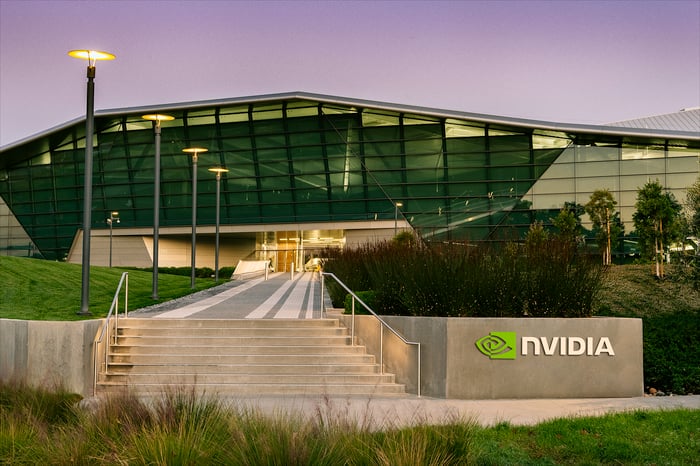
Image source: Nvidia.
Although growth is slowing down on a percentage basis -- the natural process when a company gets as big as Nvidia -- it's still growing quickly in absolute terms, and its growth, even percentage-wise, is still impressive.
In the 2025 fiscal third quarter (ended July 27), sales were up 56% year over year. That's pretty incredible for any company. Total sales were driven by data center sales, which were up 73% over last year.
These results don't include sales in China, which were on hold due to government regulations. With that market back in action, fourth-quarter results could be even more spectacular.
What's coming up at Nvidia
Nvidia stock has increased nearly 1,500% over the past five years, or roughly 74% annually, as the market recognized the incredible opportunities in AI. Numerous aspects of daily life, encompassing shopping, education, work, and leisure, have already been reshaped by this technology.
The question on many investors' minds is how much further there is to go, and what role Nvidia is going to play in the continued opportunities.
From the view down here, it doesn't look like Nvidia's part is ending anytime soon.
The company is still in the rollout stage for its latest architecture, the Blackwell line, but it's already seeing tremendous results. Sales increased 17% quarter over quarter in Q3.
It's also gearing up to launch the next wave of AI architecture, the Vera Rubin line, in 2026 to carry even greater data loads.
Making it to $10 trillion
Nvidia has come from behind to become the largest company in the world by market cap and the first company to reach a $4 trillion value. From here, it's not too difficult to imagine it reaching $10 trillion, but can it happen by 2030?
For the stock to increase 104% using today's price-to-sales (P/S) ratio of 30, total trailing 12-month sales would need to increase to $333 billion from the current $165.2 billion. To get there from today's number by 2030, it would need to increase at a compound annual growth rate (CAGR) of at least 15% over the next five years. That's achievable, even with a slight slowdown, given that revenue grew at an incredible average annual rate of 64% during the previous five fiscal years.
However, keep in mind that as it slows down, the price-to-sales ratio is likely to decline as well. At a lower valuation, revenue will need higher increases to reach $10 trillion five years from now.
A more realistic scenario would be to use the 10-year average P/S ratio of 18.6. Trailing 12-month sales after five years should reach $538 billion, at a CAGR of 27%, which -- barring a recession -- still doesn't seem unreasonable considering AI's accelerated growth rate.
Can Nvidia become a $10 trillion stock in five years? I believe the answer is yes, but as with anything in the stock market, there are no guarantees.
Should you invest $1,000 in Nvidia right now?
Before you buy stock in Nvidia, consider this:
The Motley Fool Stock Advisor analyst team just identified what they believe are the 10 best stocks for investors to buy now… and Nvidia wasn’t one of them. The 10 stocks that made the cut could produce monster returns in the coming years.
Consider when Netflix made this list on December 17, 2004... if you invested $1,000 at the time of our recommendation, you’d have $594,569!* Or when Nvidia made this list on April 15, 2005... if you invested $1,000 at the time of our recommendation, you’d have $1,232,286!*
Now, it’s worth noting Stock Advisor’s total average return is 1,065% — a market-crushing outperformance compared to 196% for the S&P 500. Don’t miss out on the latest top 10 list, available when you join Stock Advisor.
See the 10 stocks »
*Stock Advisor returns as of October 27, 2025
Jennifer Saibil has no position in any of the stocks mentioned. The Motley Fool has positions in and recommends Nvidia and Tesla. The Motley Fool has a disclosure policy.
Recommended Articles


