

Why Smaller Crypto Companies Are Struggling Under MICA

Source Beincrypto

MiCA introduced a unified European crypto market framework with one license valid across 27 countries. Large exchanges like Binance, Kraken, and Coinbase have successfully obtained MiCA licenses for all 27 EU countries.

For smaller companies, however, MiCA is proving to be a different kind of challenge. The regulation functions as a quality filter, but interpretations differ: some argue it removes bad actors, while others contend it disproportionately affects companies without deep capital reserves.

The True Cost of Compliance

The cost breakdown reveals significant barriers to entry. Minimum licensing and compliance costs for crypto startups range from €250,000 to €500,000 for licensing alone, with additional expenses including compliance officer salaries (€80,000–€150,000 annually) and legal fees (€50,000–€200,000). Stablecoin issuers must also maintain a reserve capital of €5 million.

The impact varies considerably by company profile. Venture-backed exchanges treat these costs as manageable business expenses. Bootstrapped startups and small teams encounter substantially higher operational friction. The cumulative cost structure establishes a de facto market entry threshold that advantages capitalized players and disadvantages smaller entrants.

Holger Kuhlmann, speaking at the BeInCrypto expert council, articulated the operational pressure directly:

“A lot of companies are under pressure because they either do not have enough staff to handle the new rules properly or they need to hire more people and that quickly becomes expensive. Many companies have to make a decision between accepting more bureaucracy or taking on the cost and risk of relocation.”
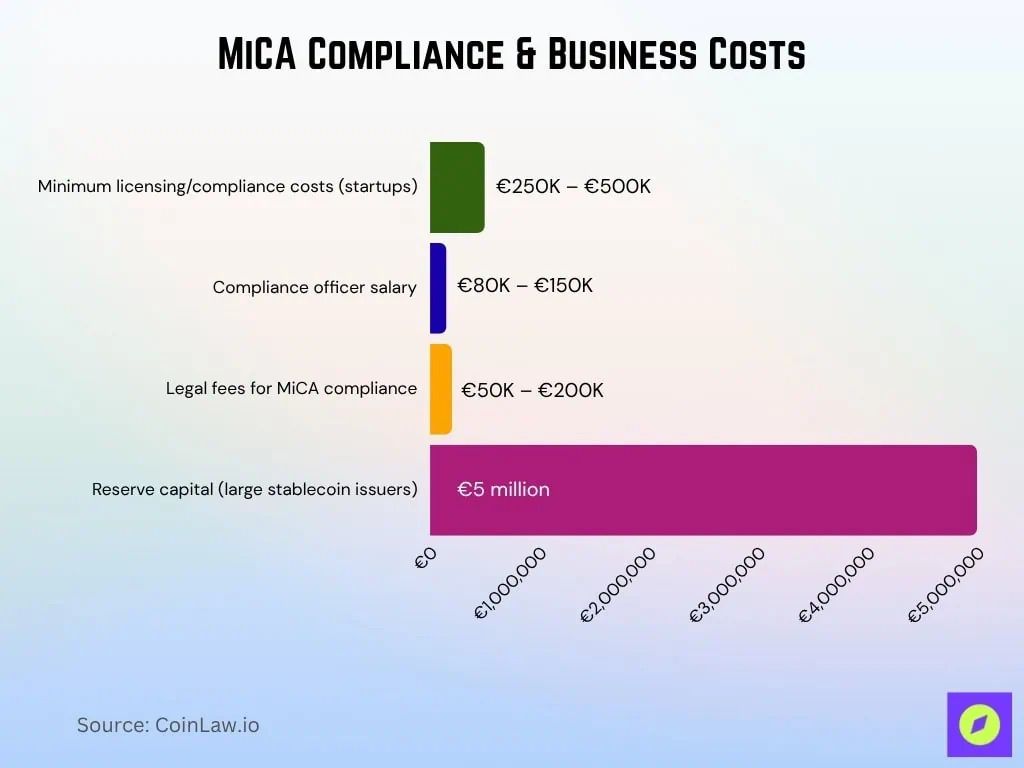
MICA Compliance & Business CostsMICA Compliance & Business Costs, Source: CoinLaw.io

This choice Kuhlmann describes is playing out across Europe. Industry data shows over 40% of crypto exchanges reported difficulty meeting MiCA’s reporting requirements specifically because of high compliance costs. At least 25% of exchanges that applied for MiCA licensing faced delays or rejections over incomplete AML documentation or other paperwork issues.

Subscribe to our YouTube channel to watch leaders and journalists provide expert insights

The Bureaucracy or Relocation Choice

For many smaller firms, relocation increasingly means Vienna. Austria’s Financial Market Authority offers licensing timelines under six months, significantly faster than German timelines. For companies that cannot afford to wait or to hire additional compliance staff, moving becomes the pragmatic economic choice despite the costs of relocation.

Germany’s strict interpretation of MiCA amplifies this pressure considerably. While most EU countries kept the full 18-month transition window that MiCA allowed, Germany shortened its deadline to just 12 months. Less time to prepare means higher costs, more pressure on limited resources, and more companies reaching the conclusion that relocation is preferable to compliance within the German framework.

This pattern has real consequences. Germany’s crypto hub status, as detailed in related analysis on the crypto hub question, depends partly on retaining startup ecosystems. Yet the compliance burden is precisely what pushes those startups elsewhere.

Winners and Losers Under MiCA

The data reveals a stark divide. MiCA-compliant businesses saw a 45% increase in institutional investments compared to non-compliant platforms. Large exchanges with existing institutional relationships, capital reserves, and compliance infrastructure have used MiCA as a moat against smaller competitors.

Binance, Kraken, and Coinbase secured MiCA licenses for all 27 EU countries. For them, MiCA functions as intended: it unified the market and removed uncertainty. The regulation brought legitimacy and enabled them to deepen institutional relationships.

Chris Pliessnig, whose firm Tirox navigated the MiCA transition for multiple clients, acknowledged both sides of the impact: “It opened up the product offering, the service offering, and it brought it to a new level.” That elevation happened—but only for companies with sufficient resources to reach the new level.

The Structural Shift

Germany granted over 30 MiCA licenses, but most went to traditional banks entering crypto for the first time. The startups that once made Berlin and Frankfurt attractive crypto destinations are licensing elsewhere, often in Vienna. The effect is a hollowing out of the startup ecosystem that originally built Germany’s reputation for innovation in digital assets.

One expert observed that Germany risks losing its status as a crypto hub not because of MiCA itself, but because of how strictly it applies the rules. The regulation is uniform across the EU, but enforcement strictness is not.

The Path Forward Remains Unclear

Smaller companies must navigate three constrained options: absorb compliance costs while accepting thinner margins and slower growth, relocate to Vienna or Lisbon and forgo existing customer relationships and German market access, or exit the market entirely.

This outcome diverges substantially from MiCA’s regulatory design intent. Experts interviewed for this analysis agreed that rather than creating market unification, the regulation has produced market consolidation favoring large, well-capitalized players. The barrier to entry for smaller competitors is now substantially higher. Some experts characterize this as necessary quality control; others view it as an unintended regulatory burden. The relocation patterns, however, indicate that companies themselves have already decided.

Disclaimer: For information purposes only. Past performance is not indicative of future results.
placeholder
Bitcoin CME gaps at $35,000, $27,000 and $21,000, which one gets filled first?Prioritize filling the $27,000 gap and even try higher.
Author  FXStreet
Aug 22, 2023
Prioritize filling the $27,000 gap and even try higher.
placeholder
Pinduoduo Earnings Incoming: Morgan Stanley Sees Long-Term Profit Potential​Insights – On November 21, Chinese e-commerce giant Pinduoduo (PDD) will release its Q3 2024 earnings.
Author  Mitrade
Nov 20, 2024
​Insights – On November 21, Chinese e-commerce giant Pinduoduo (PDD) will release its Q3 2024 earnings.
placeholder
Elon Musk’s xAI and Neuralink Launch New Funding Rounds​Billionaire Elon Musk recently raised funds for his two high-profile tech companies, xAI and Neuralink.
Author  Insights
Jun 03, 2025
​Billionaire Elon Musk recently raised funds for his two high-profile tech companies, xAI and Neuralink.
placeholder
Bitcoin briefly loses 2025 gains as crypto plunges over the weekend.Bitcoin experienced a sharp decline this weekend, briefly erasing its 2025 gains and dipping below its year-opening value of $93,507. The cryptocurrency fell to a low of $93,029 on Sunday, representing a 25% drop from its all-time high in October. Although it has rebounded slightly to around $94,209, the pressures on the market remain significant. The downturn occurred despite the reopening of the U.S. government on Thursday, which many had hoped would provide essential support for crypto markets. This year initially appeared promising for cryptocurrencies, particularly after the inauguration of President Donald Trump, who has established the most pro-crypto administration thus far. However, ongoing political tensions—including Trump's tariff strategies and the recent government shutdown, lasting a historic 43 days—have contributed to several rapid price pullbacks for Bitcoin throughout the year. Market dynamics are also being influenced by Bitcoin whales—investors holding large amounts of Bitcoin—who have been offloading portions of their assets, consequently stalling price rallies even as positive regulatory developments emerge. Despite these sell-offs, analysts from Glassnode argue that this behavior aligns with typical patterns seen among long-term investors during the concluding stages of bull markets, suggesting it is not indicative of a mass exodus. Notably, Bitcoin is not alone in its struggles, as Ethereum and Solana have also recorded declines of 7.95% and 28.3%, respectively, since the start of the year, while numerous altcoins have faced even steeper losses. Looking ahead, questions linger regarding the viability of the four-year cycle thesis, particularly given the increasing institutional support and regulatory frameworks now in place in the crypto landscape. Matt Hougan, chief investment officer at Bitwise, remains optimistic, suggesting a potential Bitcoin resurgence in 2026 driven by the “debasement trade” thesis and a broader trend toward increased adoption of stablecoins, tokenization, and decentralized finance. Hougan emphasized the soundness of the underlying fundamentals, pointing to a positive outlook for the sector in the longer term.
Author  Mitrade
Nov 17, 2025
Bitcoin experienced a sharp decline this weekend, briefly erasing its 2025 gains and dipping below its year-opening value of $93,507. The cryptocurrency fell to a low of $93,029 on Sunday, representing a 25% drop from its all-time high in October. Although it has rebounded slightly to around $94,209, the pressures on the market remain significant. The downturn occurred despite the reopening of the U.S. government on Thursday, which many had hoped would provide essential support for crypto markets. This year initially appeared promising for cryptocurrencies, particularly after the inauguration of President Donald Trump, who has established the most pro-crypto administration thus far. However, ongoing political tensions—including Trump's tariff strategies and the recent government shutdown, lasting a historic 43 days—have contributed to several rapid price pullbacks for Bitcoin throughout the year. Market dynamics are also being influenced by Bitcoin whales—investors holding large amounts of Bitcoin—who have been offloading portions of their assets, consequently stalling price rallies even as positive regulatory developments emerge. Despite these sell-offs, analysts from Glassnode argue that this behavior aligns with typical patterns seen among long-term investors during the concluding stages of bull markets, suggesting it is not indicative of a mass exodus. Notably, Bitcoin is not alone in its struggles, as Ethereum and Solana have also recorded declines of 7.95% and 28.3%, respectively, since the start of the year, while numerous altcoins have faced even steeper losses. Looking ahead, questions linger regarding the viability of the four-year cycle thesis, particularly given the increasing institutional support and regulatory frameworks now in place in the crypto landscape. Matt Hougan, chief investment officer at Bitwise, remains optimistic, suggesting a potential Bitcoin resurgence in 2026 driven by the “debasement trade” thesis and a broader trend toward increased adoption of stablecoins, tokenization, and decentralized finance. Hougan emphasized the soundness of the underlying fundamentals, pointing to a positive outlook for the sector in the longer term.
placeholder
Gold edges lower below $4,750 amid fragile Middle East ceasefire Gold price (XAU/USD) trades in negative territory around $4,705 during the early Asian session on Thursday. The precious metal edges lower amid a temporary two-week ceasefire between the US and Iran.   
Author  FXStreet
Yesterday 09: 04
Gold price (XAU/USD) trades in negative territory around $4,705 during the early Asian session on Thursday. The precious metal edges lower amid a temporary two-week ceasefire between the US and Iran.   
goTop
quote