


5 Asset Managers That Control Wall Street’s Crypto in 2026
As of 2026, about 25 US asset managers directly offer crypto products (ETFs, trusts, or funds). But the five largest crypto-focused asset managers now collectively oversee well over $100 billion in digital asset products.
Their dominance reflects how deeply institutional capital has embedded itself into crypto through regulated ETFs.
Five Firms Control Nearly $100 Billion in Bitcoin ETFs
Spot Bitcoin ETFs alone surpassed $86 billion in combined assets under management as of this writing, according to Coinglass data.
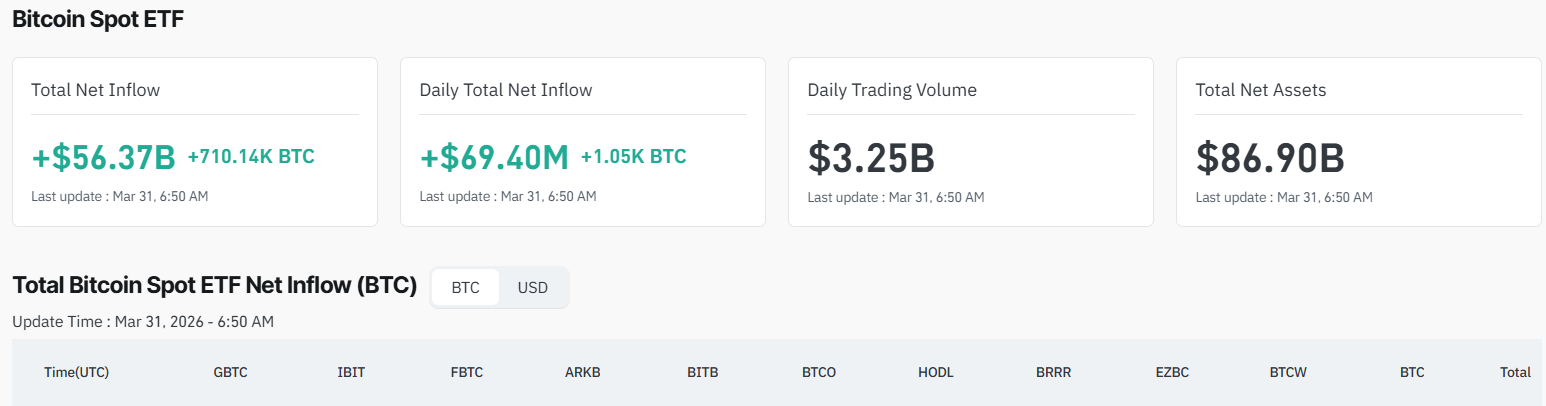 Bitcoin Spot ETFs Total Net Assets. Source: Coinglass
The competition among issuers has intensified as fee wars, product variety, and institutional distribution networks determine who captures the most capital.
BlackRock Leads by a Wide Margin
BlackRock’s iShares Bitcoin Trust (IBIT) sits at $51.9 billion in AUM, representing approximately 45% of all spot Bitcoin ETF assets, according to SoSoValue data. During Q1 2026, IBIT pulled in $8.4 billion in net inflows, more than double any competitor.
The fund held approximately 782,180 BTC as of March 27, 2026, with BlackRock’s iShares Ethereum Trust (ETHA) adding several billion more. This pushes total crypto ETF exposure near $60 billion.
 BlackRock’s BTC Holdings. Source: BlackRock
The firm’s unmatched distribution network across $12.5 trillion in total AUM gives it structural advantages no crypto-native competitor can replicate.
Fidelity Holds a Strong Second Position
Meanwhile, Fidelity’s Wise Origin Bitcoin Fund (FBTC) manages $12.8 billion in AUM, holding approximately 187,813 BTC as of early March, and its Ethereum Fund (FETH) adds over $1.3 billion.
Fidelity attracted $4.1 billion in Q1 2026 net inflows, ranking second behind BlackRock.
The firm’s self-custody model through Fidelity Digital Assets and its 0.25% fee structure have made it a preferred choice among compliance-focused institutional allocators.
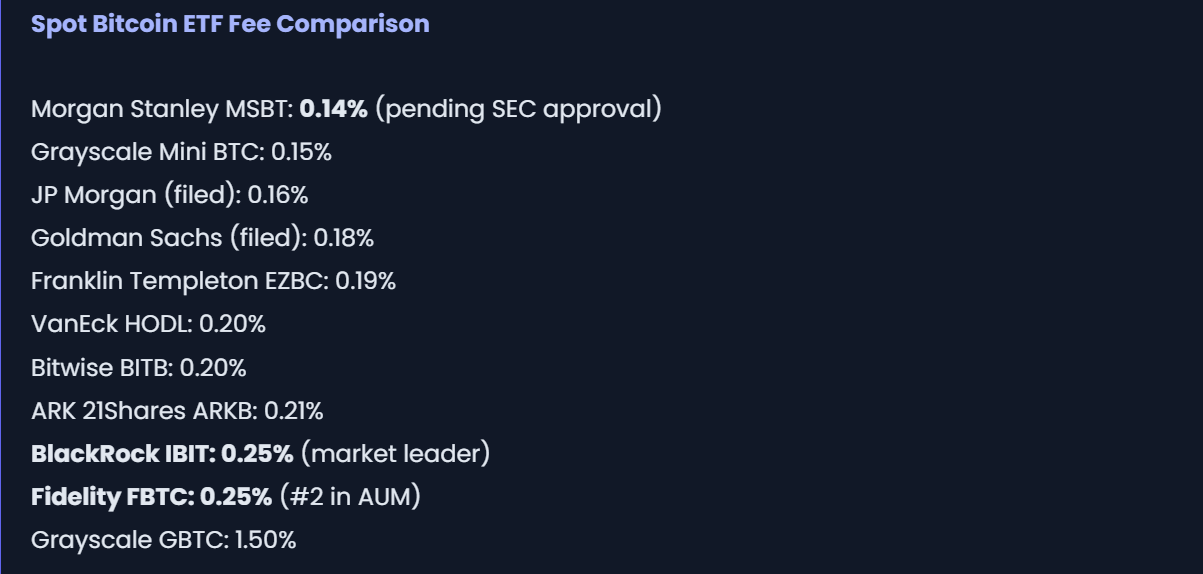 Spot Bitcoin ETF Fee Comparison. Source: Fibo
Grayscale Defends Its Legacy
Still, Grayscale Investments remains the oldest and broadest crypto-focused asset manager, operating since 2013.
Its Bitcoin Trust (GBTC) held approximately 154,710 BTC as of this writing, valued at approximately $10 billion. The lower-fee Bitcoin Mini Trust (BTC) added another $3.4 billion, according to Grayscale.
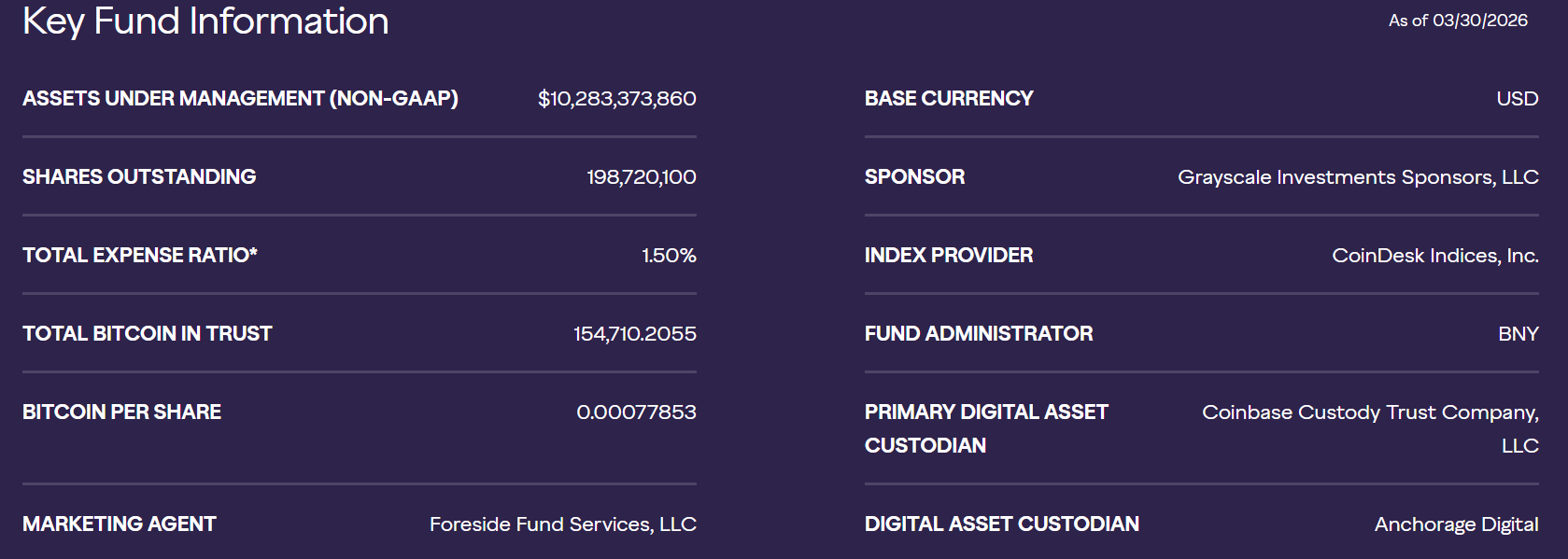 Grayscale Fund Information. Source: Grayscale
GBTC outflows slowed to $1.2 billion in Q1 2026, a sharp decline from the multi-billion-dollar monthly outflows of 2024.
Grayscale’s total platform exceeded $35 billion in AUM as of late 2025, and it maintains the broadest product pipeline, with a 36-asset watchlist for potential future ETF launches.
Bitwise Wins on Variety and Altcoin Exposure
Elsewhere, Bitwise Asset Management surpassed $15 billion in client assets across more than 40 products. These span ETFs, separately managed accounts, private funds, hedge strategies, and staking.
Its standout position is in Solana ETFs. As of early January 2026, Bitwise controlled approximately 67% of all Solana ETF AUM, capturing $731 million out of the $1.09 billion total.
Its BSOL Solana Staking ETF hit $500 million in AUM within just 18 days of trading. That staking-based yield strategy has resonated with institutions seeking alternatives beyond plain Bitcoin exposure.
BeInCrypto 100 Institutional Awards Is Recognizing the Leaders and Pioneers in digital asset integration, innovation, governance and compliance judged by our Expert Councils
Galaxy Digital Plays the Long Game
Galaxy Digital operates as a full-service merchant bank rather than a pure ETF issuer. Its asset management arm reported $9 billion in AUM with $2 billion in quarterly net inflows by Q3 2025.
By the end of 2025, total platform assets reached $12 billion, despite reporting a $482 million loss in the fourth quarter.
Galaxy partners with State Street Global Advisors on actively managed digital asset ETFs and maintains exposure across trading, lending, staking, and venture capital.
Its hybrid model positions it as the go-to for institutions that need more than passive ETF access.
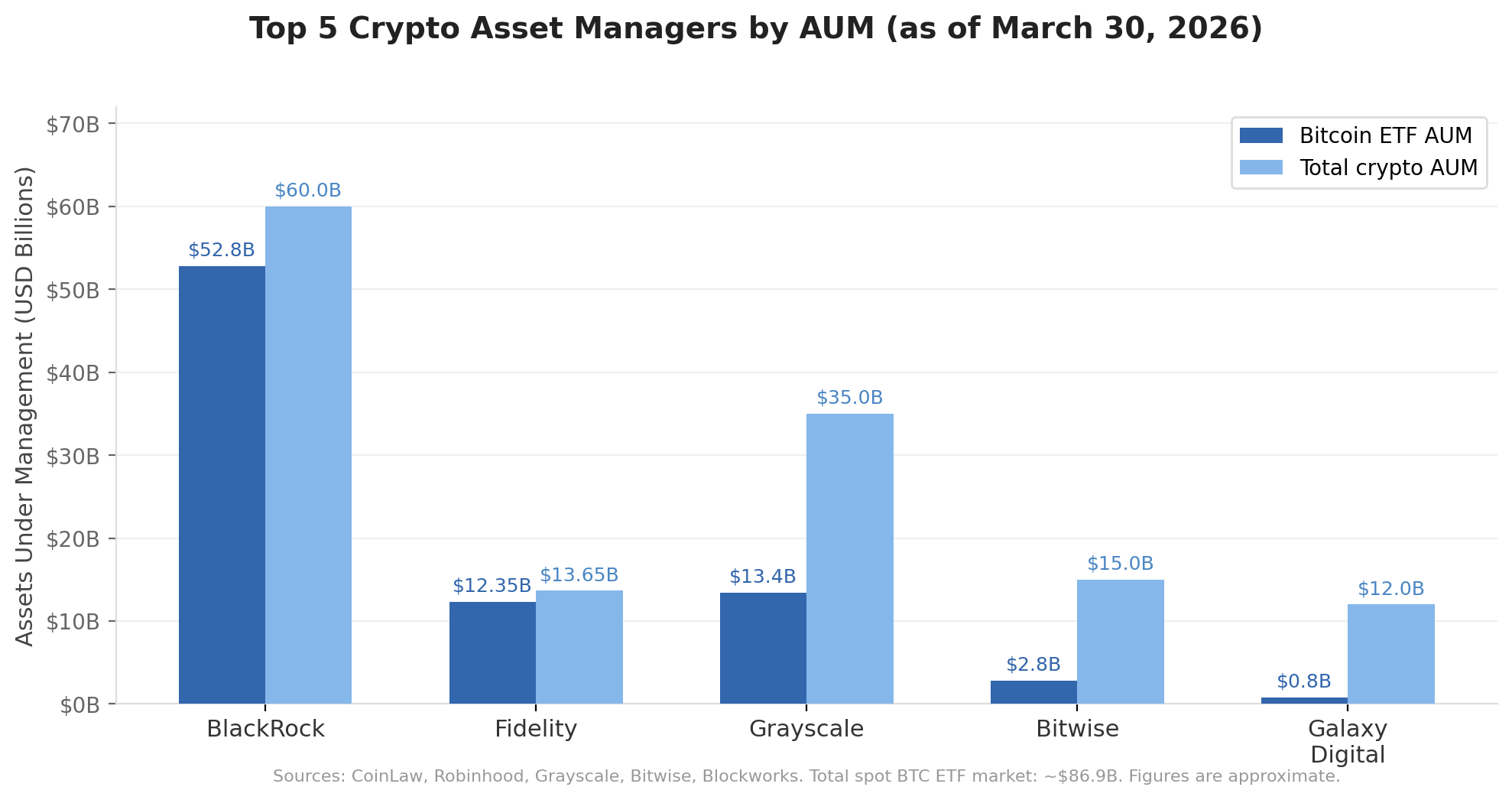 Bar chart comparing AUM of top 5 crypto asset managers in 2026, Source: BeInCrypto
The 2026 crypto asset management race has a clear hierarchy.
- BlackRock dominates on scale
- Fidelity on institutional trust
- Grayscale on history and breadt
- Bitwise on product innovation, and
- Galaxy on full-service infrastructure.
And then there is Morgan Stanley, which is not yet in the race but could reshape it entirely.
Morgan Stanley’s $160 Billion Wildcard Could Rewrite the Entire Leaderboard
The bank filed an amended S-1 for its spot Bitcoin ETF, MSBT, with a 0.14% fee that undercuts every existing competitor, including BlackRock’s 0.25%.
It would be the first spot Bitcoin ETF issued directly by a major U.S. bank rather than an asset manager. However, the ETF is just one piece.
- Morgan Stanley has also applied for a national trust bank charter through a new subsidiary called Morgan Stanley Digital Trust. This would handle custody, trading, staking, and transfers of digital assets under federal oversight.
- The bank is simultaneously preparing to launch retail crypto trading through E*Trade in the first half of 2026 and exploring Bitcoin lending and yield products.
With $8 trillion in wealth management assets and over 16,000 advisors, even a modest 2% allocation would represent $160 billion in potential demand, roughly three times the size of IBIT.
If all these pieces come together, Morgan Stanley would not just enter the crypto race. It would be building the entire track.
“They’re not just offering exposure anymore, they’re building the full stack. BNY Mellon + Coinbase as dual custodians is smart redundancy,” one user highlighted.
With spot Bitcoin ETFs now past $128 billion in combined AUM, the question is no longer whether institutions will adopt crypto. It is the managers who will capture the next wave of capital.
Recommended Articles


