


Iran Conflict Sweeps Energy Markets, Why Has Russia Become the Biggest Winner?
TradingKey - Gunfire in the Strait of Hormuz is reshaping the landscape of the global energy map. As the conflict between the U.S., Israel, and Iran pushed international oil prices to a 2022 high of $120 a barrel, an unexpected winner is quietly emerging: Russia.
Driven by both a temporary easing of sanctions and a global supply gap, Russian crude prices have surged nearly 80%, and a 130-million-barrel inventory backlog has been cleared. This geopolitical storm originating in the Middle East is creating historic growth opportunities for the Russian energy industry.
From Desperation to a Bonanza
Just over a week ago, the Russian energy sector was mired in its worst crisis in years. Western sanctions coupled with low oil prices left the Russian economy starved for cash, with millions of barrels of crude floating at sea with nowhere to go. However, the war in the Persian Gulf has completely reversed the situation, transforming Russian crude from a shunned "hot potato" into a highly sought-after global energy commodity.
Henning Gloystein, managing director for energy and resources at Eurasia Group, stated bluntly that Russia has "benefited greatly from this crisis."
Data shows that Russian seaborne crude is currently trading at approximately $90 per barrel, an increase of nearly 80% since before the outbreak of the war with Iran.
The steep discounts previously demanded by traders purchasing Russian crude in India have begun to reverse, with some traders even attempting to sell at prices above global benchmarks.
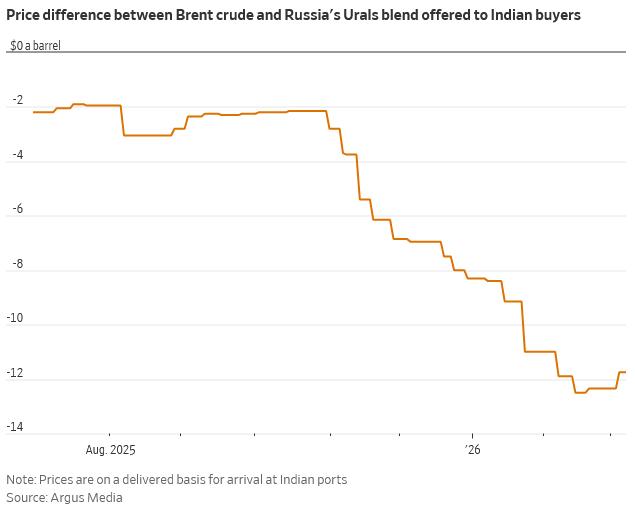
At the same time, Russia's offshore crude inventories have dropped from 132.9 million barrels at the end of February to 118.3 million barrels, as massive stockpiles are rapidly absorbed by the market.
In addition to the direct gains from rising oil prices, a temporary easing of U.S. sanctions on Russian crude has also provided a shot in the arm for its energy industry.
According to reports, the Trump administration is not only allowing countries like India to continue purchasing Russian crude but is also considering further easing of sanctions. This has enabled Russia to break through the blockade of Western sanctions and expand its share of the global energy market.
Naveen Das, senior crude analyst at ship-tracking data provider Kpler, said the longer the conflict lasts, the more dependent the world becomes on Russian crude and refined products.
Alexandra Prokopenko, an expert on the Russian economy at the Carnegie Russia Eurasia Center, believes that the growth in Russia's energy revenues will largely depend on how long the Strait of Hormuz remains closed.
A brief spike in oil prices will not fundamentally change Russia's economic destiny, but if a prolonged closure of the strait drives prices sustainably to $108 per barrel, Russia will reap the "ultimate windfall."
Is the Prosperity Sustainable?
Although the Russian energy industry is facing a historic opportunity, analysts warn that this prosperity is not without limits.
Carole Nakhle, founder of energy consultancy Crystol Energy, pointed out that years of sanctions and Ukrainian strikes on Russian energy facilities have damaged some infrastructure, limiting Russia's ability to rapidly expand production or export scale.
Furthermore, the over-concentration of Russian oil export buyers in a few countries like India, along with shipping and insurance restrictions, also constrains its potential gains to some extent.
More importantly, uncertainty in the global energy market remains. The G7 has expressed readiness to take "necessary measures" to support global energy supplies, not ruling out the release of strategic oil reserves, which would put downward pressure on prices. Meanwhile, if tensions in the Middle East ease, international oil prices could retreat, weakening Russia's energy export revenues.
Europe's Energy Dilemma
The energy crisis triggered by the Middle East conflict has left Europe in an unprecedented dilemma. Over the past few years, the EU has been pushing a strategy of diversifying energy supplies, attempting to shed its dependence on Russian energy by turning to U.S. and Middle Eastern markets for alternatives.
However, the ongoing volatility in the Middle East has dampened Europe's energy transition plans. Production disruptions in Middle Eastern oil-producing countries like Qatar have directly led to a global tightening of liquefied natural gas (LNG) supplies, intensifying the bidding war for LNG between European and Asian buyers. As the Asian market offers higher prices, several LNG carriers originally destined for Europe have diverted, further exacerbating the uncertainty of Europe's energy supply.
Even more concerning for Europe is that despite efforts to reduce reliance on Russian energy, 13% of its total natural gas and LNG imports still come from Russia. As the stability of Middle Eastern energy supplies declines, Europe's implicit dependence on Russian energy is actually showing an upward trend.
This passive situation has given Russian President Vladimir Putin more geopolitical leverage—he has publicly threatened to cut off remaining energy supplies to Europe ahead of schedule and pivot to the more "reliable" Asian market.
"Other markets are opening now. If they close our supplies in a month or two, wouldn't it be better to stop now and work with those reliable partner countries instead?" This signal, sent by Putin in a televised speech on Wednesday, reflects Russia's significantly elevated status in the global energy market.
For Europe, if Russia actually cuts off gas supplies and Middle Eastern energy cannot fill the gap in time, the continent will face a severe energy shortage crisis. In such a scenario, the EU might be forced to re-examine its plans to ban Russian energy, which would undoubtedly create more room for growth in the Russian energy industry.
Recommended Articles


