


EUR/USD edges toward 1.16 as falling claims fail to shake dovish mood
- EUR/USD rises 0.22% as traders maintain 85% odds of a December Fed rate cut.
- US jobless claims fall again and Durable Goods beat forecasts but remain softer than August levels.
- ECB officials reiterate steady policy stance, saying further cuts need clearer disinflation evidence.
The EUR/USD registers back-to-back bullish days boosted by speculation that the Federal Reserve might cut rates at the December meeting, following the release of a strong jobs report. At the time of writing, the pair trades at 1.1595, up 0.22% after bouncing off daily lows of 1.1547.
Euro extends gains for a second day as easing expectations stay elevated despite solid US data and mixed Fed commentary
Economic data in the US continues to flow yet dovish comments by Fed officials are driving EUR/USD’s price action. The number of Americans filling for jobless insurance decreased compared to the November’s 14 print, reaffirmation of the low-firing low-hiring environment, expressed by several Fed policymakers.
Other data revealed that Durable Goods Orders for September exceeded forecasts but trailed August’s numbers.
Following the data release, the CME FedWatch Tool shows that odds for a 25 basis points (bps) rate cut at the December meeting are steady at 85%.
According to Bloomberg, JP Morgan flipped their forecast about the Fed’s upcoming meeting, and they expect a rate cut in December.
In the Eurozone, European Central Bank (ECB) officials crossed the newswires. The Vice-President Luis de Guindos said that the current level of rates is the correct one. Boris Vujcic said that “For another cut, you would have to see the inflation path going down.”
The ECB Chief Economist Philip Lane said that to keep inflation at target, “we need to see more deceleration in non-energy inflation.” Money markets expect the ECB to hold rates unchanged for the rest of the year.
Daily market movers: Euro boosted by Fed dovish expectations
- The US Dollar Index (DXY). which tracks the buck’s performance versus six currencies, dives 0.21% down to 99.57.
- Initial Jobless Claims for the week ending November 21 fell to 216,000, below expectations of 225,000 and down from the prior 222,000 print. Continuing Claims ticked higher to 1.96 million for the week ending November 14, up from 1.95 million.
- Durable Goods Orders slowed sharply in September, rising 0.5% month-over-month after August’s 2.9% surge, though the figure still beat the 0.3% consensus. Excluding transportation and defense, core orders jumped 0.9% MoM, far exceeding expectations of 0.2%.
- The euro extended gains as US data signaled easing inflation, softer consumer spending, and rising pessimism among households regarding the labor market, income prospects, and overall financial conditions.
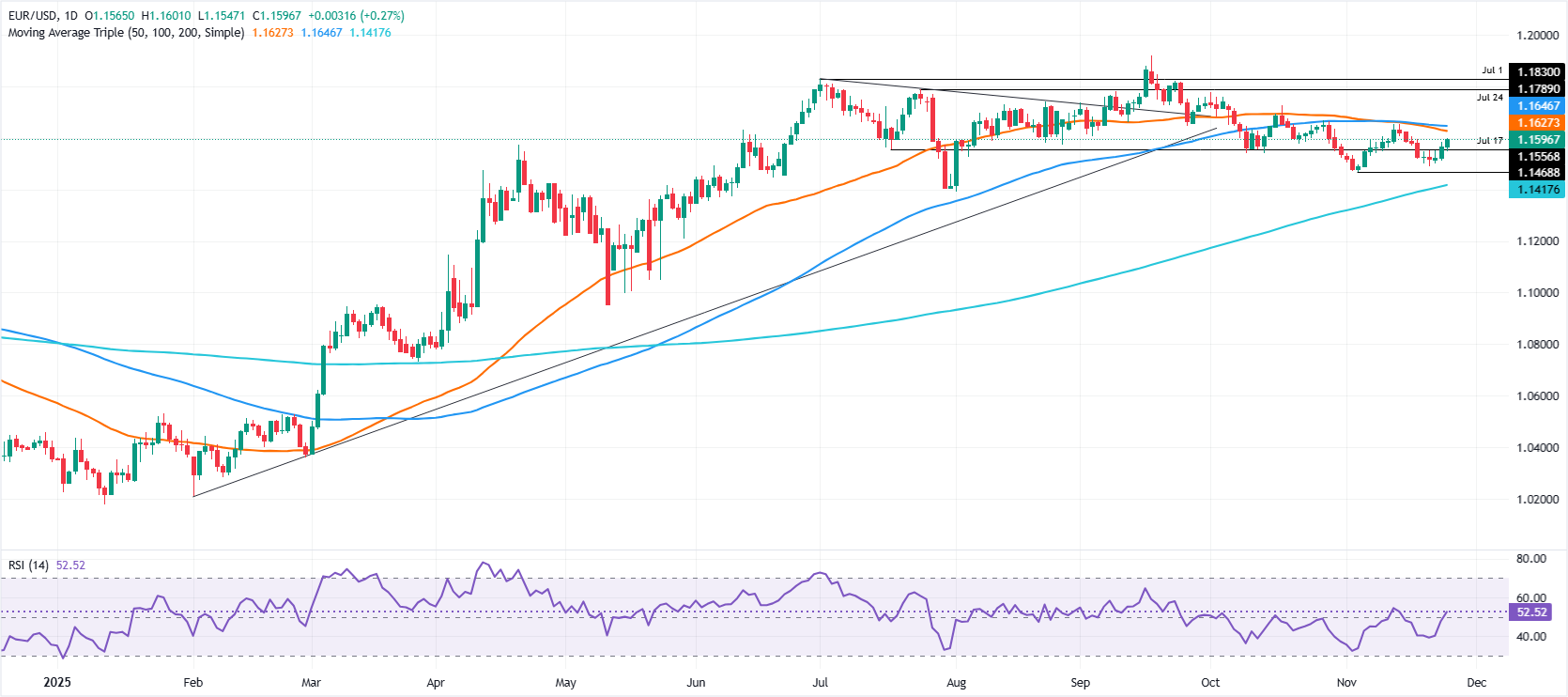
Technical Outlook: EUR/USD clears 20-day SMA, eyes on 1.1600
The EUR/USD continues to trade sideways with buyers unable to decisively crack the 1.1600 figure. Although momentum remains bullish as depicted by the Relative Strength Index (RSI) it has turned flattish an indication that further consolidation lies ahead.
If EUR/USD breaks 1.1600, buyers will face stir resistance at the confluence of the 50- and 100-day SMAs at 1.1631/1.1646 ahead of 1.1700. Conversely, if the shared currency slides below 1.1550, the next area of demand would be 1.1500. On further weakness the next support would be the
EUR/USD resumed its uptrend, clearing the 20-day Simple Moving Average (SMA) at 1.1556, yet it remains shy of extending its gains. If the pair clears 1.1600 would face key resistance like the confluence of the be the November 5 low at 1.1468 and the 200-day SMA near 1.1426.
Euro FAQs
The Euro is the currency for the 20 European Union countries that belong to the Eurozone. It is the second most heavily traded currency in the world behind the US Dollar. In 2022, it accounted for 31% of all foreign exchange transactions, with an average daily turnover of over $2.2 trillion a day. EUR/USD is the most heavily traded currency pair in the world, accounting for an estimated 30% off all transactions, followed by EUR/JPY (4%), EUR/GBP (3%) and EUR/AUD (2%).
The European Central Bank (ECB) in Frankfurt, Germany, is the reserve bank for the Eurozone. The ECB sets interest rates and manages monetary policy. The ECB’s primary mandate is to maintain price stability, which means either controlling inflation or stimulating growth. Its primary tool is the raising or lowering of interest rates. Relatively high interest rates – or the expectation of higher rates – will usually benefit the Euro and vice versa. The ECB Governing Council makes monetary policy decisions at meetings held eight times a year. Decisions are made by heads of the Eurozone national banks and six permanent members, including the President of the ECB, Christine Lagarde.
Eurozone inflation data, measured by the Harmonized Index of Consumer Prices (HICP), is an important econometric for the Euro. If inflation rises more than expected, especially if above the ECB’s 2% target, it obliges the ECB to raise interest rates to bring it back under control. Relatively high interest rates compared to its counterparts will usually benefit the Euro, as it makes the region more attractive as a place for global investors to park their money.
Data releases gauge the health of the economy and can impact on the Euro. Indicators such as GDP, Manufacturing and Services PMIs, employment, and consumer sentiment surveys can all influence the direction of the single currency. A strong economy is good for the Euro. Not only does it attract more foreign investment but it may encourage the ECB to put up interest rates, which will directly strengthen the Euro. Otherwise, if economic data is weak, the Euro is likely to fall. Economic data for the four largest economies in the euro area (Germany, France, Italy and Spain) are especially significant, as they account for 75% of the Eurozone’s economy.
Another significant data release for the Euro is the Trade Balance. This indicator measures the difference between what a country earns from its exports and what it spends on imports over a given period. If a country produces highly sought after exports then its currency will gain in value purely from the extra demand created from foreign buyers seeking to purchase these goods. Therefore, a positive net Trade Balance strengthens a currency and vice versa for a negative balance.
Recommended Articles


