


EUR/USD (EURUSD) is down 0.53% on Oct 14: The Reason Has Emerged
EUR/USD (EURUSD) is down 0.53% at Oct 14 08:45(ET), now at $1.11382, with a 7-day down of 0.50%.
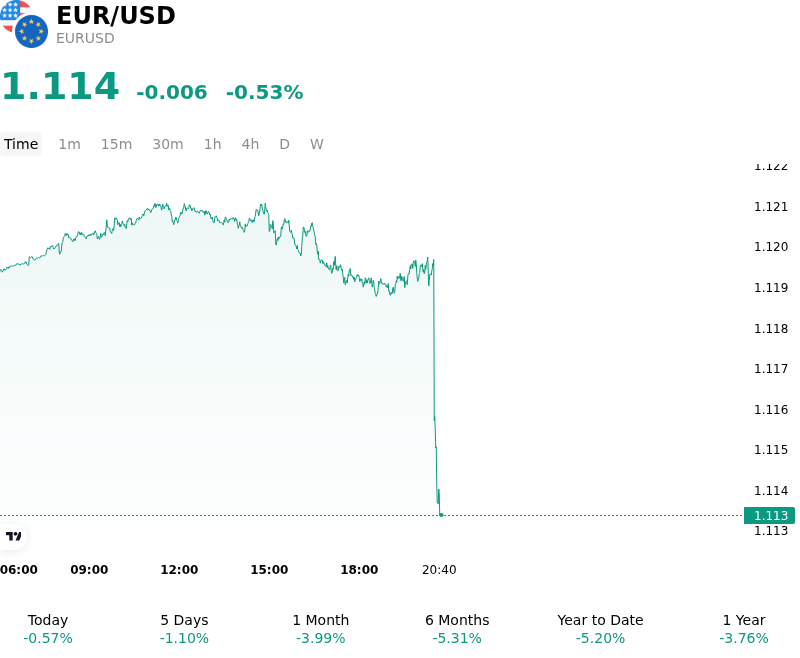
What is driving EUR/USD (EURUSD)’s stock price down today?
The downward trajectory in EUR/USD reflects a further widening of interest-rate differentials favoring the U.S. dollar, driven by diverging central bank policy paths. Investors continue to price in a more hawkish stance from the Federal Reserve relative to the European Central Bank. While the Federal Reserve recently pushed its policy rate higher to counter persistent inflationary pressures, financial markets increasingly expect the European Central Bank to maintain its deposit facility rate at its upcoming meeting. This policy divergence has expanded short-term government bond yield spreads between the U.S. and the euro area, bolstering greenback demand and encouraging institutional capital flows into higher-yielding U.S. dollar assets.
Pre-data positioning ahead of critical U.S. inflation benchmarks further reinforced dollar strength throughout the trading session. Market participants recalibrated Federal Reserve interest-rate expectations toward a potential additional rate hike before year-end, driven by elevated underlying inflation risks and resilient domestic economic indicators. Conversely, macroeconomic momentum across the euro area remains sluggish, characterized by subdued consumer demand and weak manufacturing activity. The combination of sticky U.S. inflation expectations and soft euro-area growth fundamentals has curtailed investor appetite for the single currency.
Euro performance was also undermined by political friction and fiscal uncertainty in key euro-area economies, notably France. Lingering concerns regarding national debt consolidation and upcoming fiscal budget negotiations have injected a risk premium into French sovereign bonds, widening spreads against German Bunds. This broadening of European sovereign risk premia has dampened global investor confidence in the bloc's financial stability, creating an additional structural headwind for the euro against a resilient U.S. dollar.
From a broader macro perspective, the downside move in EUR/USD is firmly anchored in fundamental monetary policy imbalances and relative economic momentum rather than a temporary headline shock. While stretched technical short positioning could trigger occasional countertrend bounces, sustained downward pressure is likely to persist as long as U.S. real yield advantages remain intact. Institutional investors will continue to monitor upcoming U.S. price reports, Federal Reserve policy guidance, and shifts in energy-driven terms of trade for signals regarding the pair's medium-term trajectory.
Technical Analysis of EUR/USD (EURUSD)
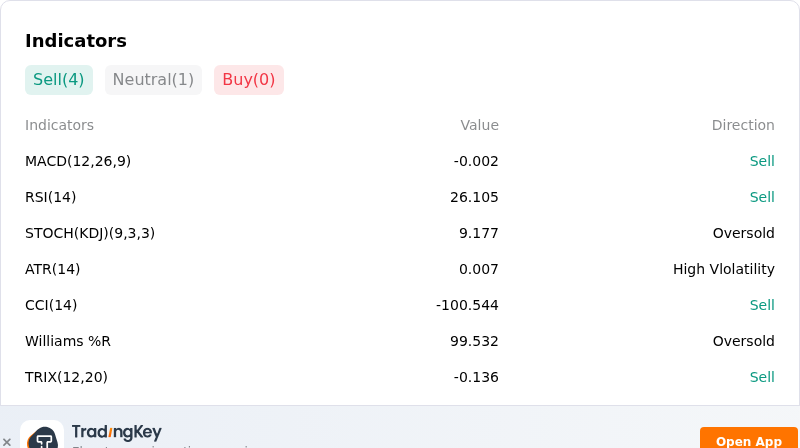
Technically, EUR/USD (EURUSD) shows a MACD (12,26,9) value of -0.002, indicating a sell signal. The RSI at 26.105 suggests sell condition and the Williams %R at 99.532 suggests oversold condition. Please monitor closely.
More details about EUR/USD (EURUSD)
Recent Events and Risks:
- US Inflation Volatility and Hawkish Fed Expectations: Market caution surrounding US Consumer Price Index data releases and sustained expectations of elevated Federal Reserve interest rates have reinforced US dollar strength, keeping EUR/USD under persistent selling pressure near multi-month lows.
- French Fiscal Stress and Bond Yield Turbulence: Expanding spreads between French government bonds and German Bunds, fueled by domestic political conflict over budget consolidation, have introduced a persistent euro-specific fiscal risk premium.
- Widening Fed-ECB Interest Rate Differential: A structural policy rate advantage favoring the US dollar over the euro, alongside an unwinding of market expectations for near-term ECB tightening due to stagnant regional growth, reinforces negative yield spreads for the pair.
- Energy Price Shocks and Safe-Haven Capital Flows: Sustained elevation in global crude oil prices negatively impacts terms of trade for energy-importing Eurozone economies while triggering risk-off market sentiment that drives capital into safe-haven greenback assets.
Recommended Articles


