Whale Dump Meets Quantum Panic: Bitcoin Slips to $86,000 and Blows $220 Million Longs

Mitrade
coverImg
Source: DepositPhotos

Bitcoin fell below $87,000 on November 20, 2025, amid a storm of quantum security fears and $1.3 billion whale capitulation. In the process, it blew almost $220 million in long positions out of the water.

This sharp decline extended a two-day pattern of Asian rebounds erased by US market sell-offs. Traders struggled with mixed signals from institutional buyers and a wave of retail panic.

Quantum Computing Panic Triggers Market-Wide Fear

The latest sell-off accelerated after billionaire Ray Dalio raised concerns about Bitcoin’s vulnerability to advances in quantum computing.

His remarks reignited debate in the cryptocurrency community, focusing attention on cryptographic security risks.

“I have a small percentage of Bitcoin I’ve had forever, like 1% of my portfolio. I think the problem with Bitcoin is that it’s not going to be a reserve currency for major countries because it can be tracked, and it could be conceivably controlled, hacked, and so on,” Ray Dalio stated.

However, market analysts pushed back on the quantum panic narrative. Mel Mattison, a financial analyst, argued that these fears are overblown and overlook Bitcoin’s strong cryptography in comparison to traditional banks.

“If people are selling BTC on quantum decryption, they should be selling the hell out of every bank on the planet. JPM should be down 20%. Every account will be hackable. BTC is SHA-256, which is tougher than RSA,” Mel Mattison countered.

This debate reflects a significant divide in how investors assess long-term tech risks. While Dalio highlighted theoretical vulnerabilities as quantum computing develops, critics point out that Bitcoin’s SHA-256 provides stronger security than the RSA standard used by most banks.

If quantum computers pose a threat to Bitcoin, global banking may face even greater risks.

Early Bitcoin Adopter Exits With $1.3 Billion Sale

Adding to quantum security worries, blockchain analytics firm Arkham reported a massive capitulation. Owen Gunden, an early Bitcoin adopter who accumulated holdings since 2011, sold his entire 11,000 BTC for about $1.3 billion.

Gunden’s exit came at a precarious time for sentiment. According to data from BeInCrypto, Bitcoin was trading at $86,767 at the latest update, down 2.55% over 24 hours.
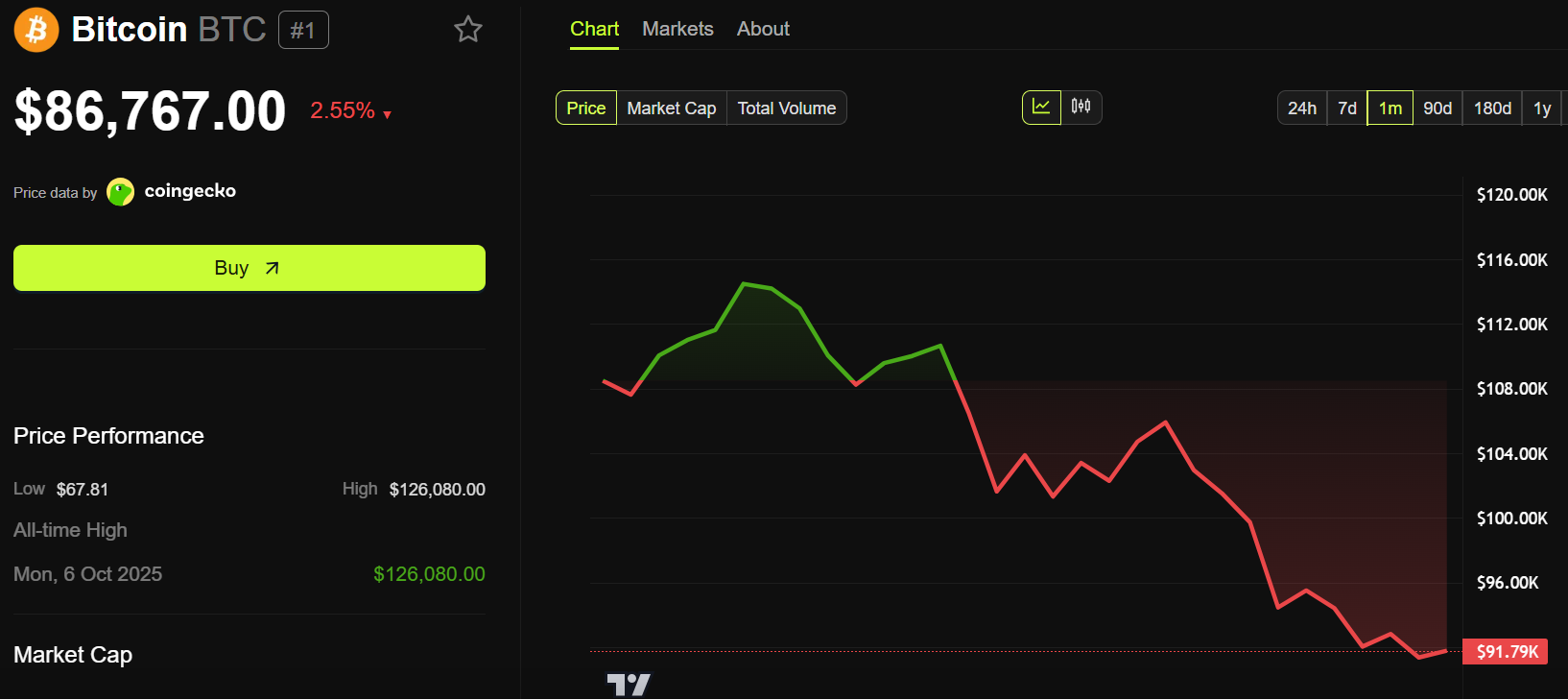
Bitcoin (BTC) Price Performance. Source: BeInCrypto

This whale’s decision to sell after 14 years highlights a shift from the usual long-term holding mentality. The reasons are unclear, whether profit-taking, rebalancing, or concerns about Bitcoin’s outlook.

Still, the sale injected extra supply into an oversold market and deepened the price slide.

Massive Liquidation Cascade Accelerates Decline

Quantum fears and whale selling sparked a large liquidation cascade across exchanges. CoinGlass data shows over $910 million in crypto positions were liquidated in 24 hours, forcing out 222,008 traders.

During one hour in early US trading, long liquidations spiked to $264.79 million while shorts hit $256.44 million.
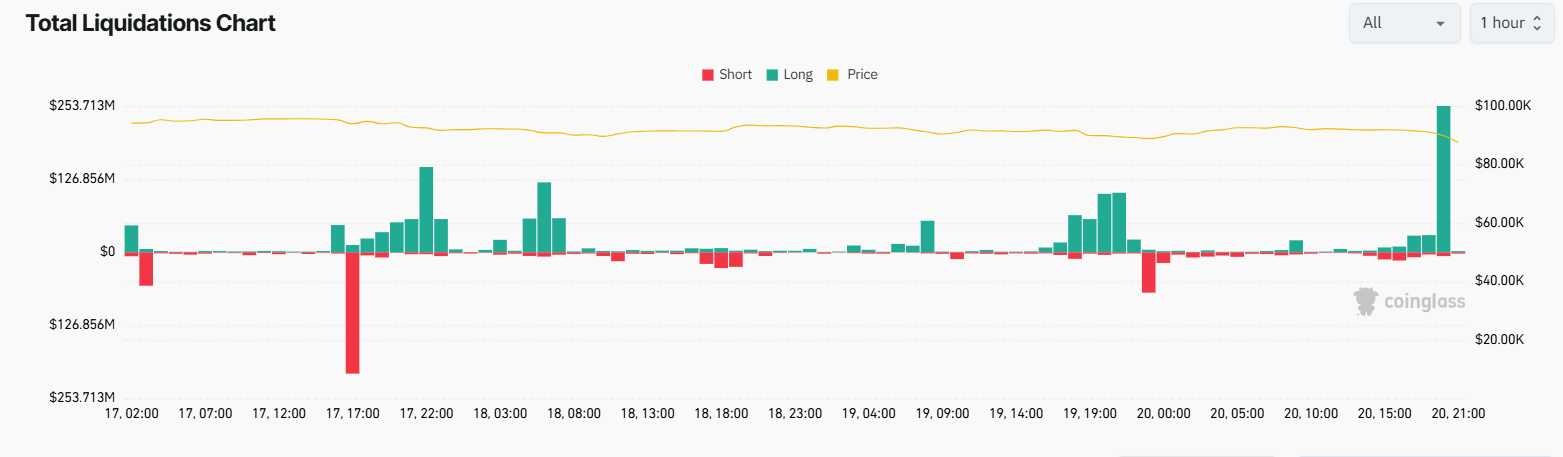
Crypto Liquidations in the Last Hour.Crypto Liquidations in the Last Hour. Source: Coinglass

These forced closures highlight the significant leverage in crypto markets and how quickly positions can unwind during sharp market moves.

This cascade revealed structural weaknesses in crypto derivatives as well. As Bitcoin dropped from above $91,000 to $86,000 in 48 hours, leveraged traders faced margin calls and had their positions automatically closed.

This automated selling created further price declines and additional liquidations, fueling a cycle of volatility.

Institutional Buyers Return Despite Retail Panic

Despite the sell-off, US Bitcoin ETFs (exchange-traded funds) saw $75 million in net inflows on Wedneday, ending a five-day outflow streak.

BlackRock’s IBIT and Grayscale’s mini ETF accounted for all the inflows, showing that some institutional investors viewed the dip as a buying opportunity.

Yet, sentiment among ETF issuers remained mixed. VanEck, Fidelity, and other large issuers reported flat or negative flows, indicating cautious optimism.
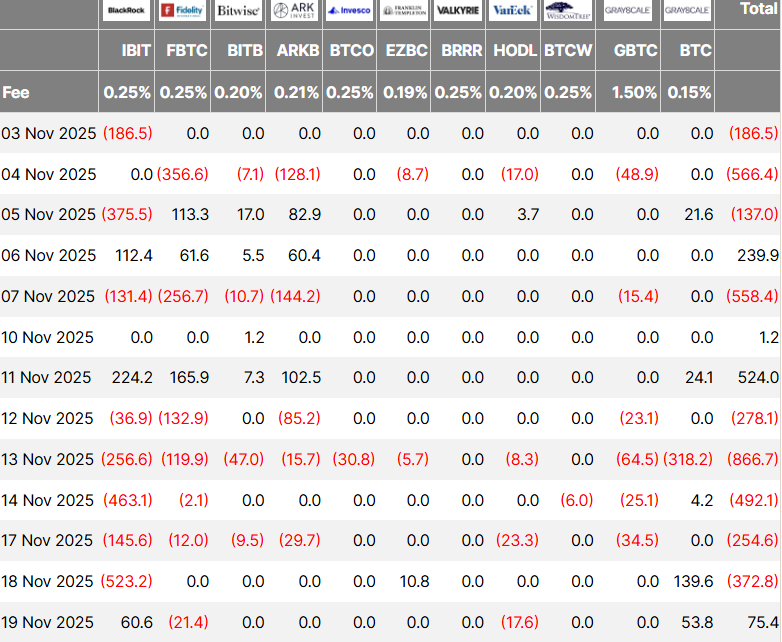
Bitcoin ETF Flows on November 19Bitcoin ETF Flows on November 19. Source: Farside Investors

This split highlights the mixed outlook in Bitcoin markets. Some institutions view the current levels as valuable, while others hesitate due to near-term uncertainties.

The collision of whale sales, quantum security concerns, and institutional buying has driven sharp volatility. Investors now face the question of whether the quantum narrative signals real risk or simply profit-taking after Bitcoin’s rally this year.

The next days will show whether institutional support can hold prices steady or if more declines lie ahead as the market processes these risks and the influx of long-term holder supply.

Read more

  • Spot Gold Breaches Four Key Levels, Putting $3,500 at Risk as Technicals Enter Oversold Alert Zone
  • * The content presented above, whether from a third party or not, is considered as general advice only.  This article should not be construed as containing investment advice, investment recommendations, an offer of or solicitation for any transactions in financial instruments.

    goTop
    quote
    Related Articles
    placeholder
    Bitcoin Plunges 13% in a Week as Market Retreats to $60,000 LevelBitcoin plunged 13% over the past seven days as bullish defense lines crumbled in succession, officially kicking off the battle to defend the $60,000 mark.On November 16, following a viol
    Author  TradingKey
    Nov 16, Mon
    Bitcoin plunged 13% over the past seven days as bullish defense lines crumbled in succession, officially kicking off the battle to defend the $60,000 mark.On November 16, following a viol
    placeholder
    Bitcoin lost its 200-day average — but the exit started three sessions before the CPIBitcoin fell 2.5% to about $73,400 on 11 November, an 11-week low, breaking its 200-day moving average near $73,100. The 24-hour liquidation tally reached $632 to $705 million, roughly 82% of it longs. But spot ETF outflows began three sessions earlier and USDT's market cap has shrunk $6.6 billion in 60 days — the leveraged length left before the inflation print did. A double top at 81,890 and 81,080 leaves a measured target of 69,366.
    Author  Suzie
    Nov 11, Wed
    Bitcoin fell 2.5% to about $73,400 on 11 November, an 11-week low, breaking its 200-day moving average near $73,100. The 24-hour liquidation tally reached $632 to $705 million, roughly 82% of it longs. But spot ETF outflows began three sessions earlier and USDT's market cap has shrunk $6.6 billion in 60 days — the leveraged length left before the inflation print did. A double top at 81,890 and 81,080 leaves a measured target of 69,366.
    placeholder
    Bitcoin ETFs sold $1.28 billion in a week — and BTC is still above 75,000US spot Bitcoin ETFs logged $1.28 billion of net outflows in the week to Nov 6, the largest since late June, with BlackRock's IBIT accounting for $1.21 billion. Yet BTC only fell from $80,405 to $74,940, a 6.8% move. The gap between the fund flow and the price is the story: leveraged longs were flushed, but spot holders did not follow the ETFs out — and $75,000 is the line that decides whether that reading holds.
    Author  Suzie
    Nov 09, Mon
    US spot Bitcoin ETFs logged $1.28 billion of net outflows in the week to Nov 6, the largest since late June, with BlackRock's IBIT accounting for $1.21 billion. Yet BTC only fell from $80,405 to $74,940, a 6.8% move. The gap between the fund flow and the price is the story: leveraged longs were flushed, but spot holders did not follow the ETFs out — and $75,000 is the line that decides whether that reading holds.
    placeholder
    Binance replaced 95% of a $6.3bn hole — Bitcoin is trading the plumbing, not the coinBinance resumed withdrawals on November 1 after a record $6.3bn theft. In the first 9.5 hours, users withdrew $4.64bn and deposited $1.01bn, a net outflow of $3.64bn, or 2.1% of assets. Bitcoin fell to 76,173 and is now 78,473. The market is pricing the exchange, not the supply.
    Author  Suzie
    Nov 02, Mon
    Binance resumed withdrawals on November 1 after a record $6.3bn theft. In the first 9.5 hours, users withdrew $4.64bn and deposited $1.01bn, a net outflow of $3.64bn, or 2.1% of assets. Bitcoin fell to 76,173 and is now 78,473. The market is pricing the exchange, not the supply.
    placeholder
    Bitcoin is back above $80,000 — but 75% of the bounce was shorts, not buyersBitcoin trades at $80,669, back above the $80,000 line after touching $79,145 on October 24. But 75.4% of the last 24 hours of futures liquidations were shorts, CME open interest fell 36,545 BTC in October, and spot ETFs lost $773.5 million on October 22-23. Price is up; positioning is down. Here is why the bounce is a squeeze, and the four things that would make it real.
    Author  Suzie
    Oct 28, Wed
    Bitcoin trades at $80,669, back above the $80,000 line after touching $79,145 on October 24. But 75.4% of the last 24 hours of futures liquidations were shorts, CME open interest fell 36,545 BTC in October, and spot ETFs lost $773.5 million on October 22-23. Price is up; positioning is down. Here is why the bounce is a squeeze, and the four things that would make it real.
    Live Quotes
    Name / SymbolChart% Change / Price
    BTCUSD
    BTCUSD
    0.00%0.00
    ETHUSD
    ETHUSD
    0.00%0.00

    Bitcoin Related Articles

    • Bitcoin Leverage And Margin Trading in 2026: The Ultimate Beginner's Guide
    • Gold vs Bitcoin 2026: Which Is the Better Investment?Best Hedge Asset Comparison
    • Best Strategies When BTC Price Drops: From Hedging to Accumulating
    • How to Day Trade Crypto? Simplest Day Trading Strategy Ever
    • Bitcoin Price Prediction 2026-2030: Long-Term Outlook Driven by Data & Macro Cycles
    • Bitcoin Mining Beginner Guide: What Is Bitcoin Mining and How to Mine Bitcoin?

    Click to view more