


Nvidia CEO Jensen Huang Just Delivered Fantastic News to Shareholders
Key Points
Nvidia CEO Jensen Huang told investors the company projects at least $1 trillion in chip sales between its Blackwell and Vera Rubin models over the next two years.
Huang also provided more fantastic news for shareholders that was likely somewhat overshadowed by the chip guidance.
- 10 stocks we like better than Nvidia ›
At Nvidia's (NASDAQ: NVDA) highly anticipated GPU (graphics processing unit) Technology Conference, CEO Jensen Huang came ready to impress. He kicked things off by telling attendees and the world that the company is projecting $1 trillion of sales from its Blackwell and Vera Rubin GPUs and platforms over the next 21 months through 2027.
Not only is that number double what Nvidia expects artificial intelligence hardware sales to be in 2025 and 2026, it also beat consensus estimates from Wall Street analysts. Huang didn't stop there -- he delivered more fantastic news to shareholders.
Will AI create the world's first trillionaire? Our team just released a report on the one little-known company, called an "Indispensable Monopoly" providing the critical technology Nvidia and Intel both need. Continue »
Sales to China to resume
At the GTC conference, Huang told a group of reporters that the company plans to resume sales of its H200 processors to businesses in China for the first time in several quarters. The H200 is an older Nvidia GPU model, but it's the one Nvidia has historically been allowed to sell to companies in China. The U.S. government has historically prevented Nvidia from selling its most advanced chips in the region, due to national security concerns.
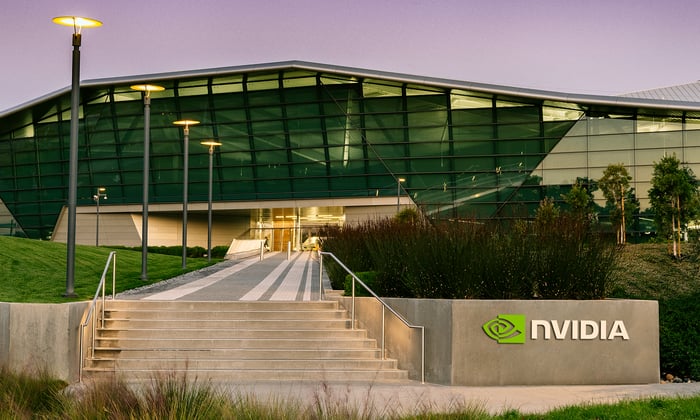
Image source: Nvidia.
"We have received purchase orders, and we're in the process of restarting our manufacturing," Huang said, according to CNBC. "That's new news for all of you, and it's different than it was two weeks ago or three weeks ago, but that's our condition today ... and our supply chain is getting fired up."
In the first half of 2025, the Trump administration effectively banned Nvidia from selling its H200 chips to businesses in China, requiring Nvidia to obtain export licenses before doing so. In April of last year, Nvidia also said it would take a $5.5 billion charge associated with H20 inventory, purchase commitments, and associated reserves.
Since then, Huang has gone to Washington, D.C., to lobby the Trump administration, effectively arguing that blocking countries from purchasing Nvidia chips is unlikely to curb AI ambitions. In December, it appeared that Huang had convinced President Donald Trump to approve at least some sales to China, provided the U.S. government received 25% of the revenue from the sales.
However, up until recently, there had been no official sales. In February, Nvidia CFO Colette Kress said some H200 products had been approved for sale to China but had yet to commence, due to national security reviews conducted by the governments of both the U.S. and China.
Why it's great news for shareholders
As one might expect, given the size of China's economy and its innovative technology sector, the market is not small, so it could grow into an even larger revenue contributor for Nvidia over time.
Last August, during an earnings call, Huang estimated the opportunity in China at about $50 billion, assuming Nvidia had been able to sell its products in the country all last year. Huang also said he would expect the opportunity to grow about 50% per year, along with the rest of the global AI market.
That's a big number. It's also one that Wall Street analysts likely haven't been factoring into their models, due to the geopolitical tensions between the U.S. and China, and the difficulty in predicting how the situation would unfold.
The economics of this revenue may not be as good as they used to be. Nvidia may have to give a quarter of this revenue to the U.S. government. Still, if sales in China can resume, that's great news for shareholders for several reasons.
For one, analysts will likely raise their revenue and earnings estimates for Nvidia, which should benefit the stock. Nvidia also does not trade at a demanding valuation right now. It's trading below 22 forward earnings.
It will also enable Nvidia to continue to build out its business in China, which represents an even bigger potential opportunity for the company over time.
Should you buy stock in Nvidia right now?
Before you buy stock in Nvidia, consider this:
The Motley Fool Stock Advisor analyst team just identified what they believe are the 10 best stocks for investors to buy now… and Nvidia wasn’t one of them. The 10 stocks that made the cut could produce monster returns in the coming years.
Consider when Netflix made this list on December 17, 2004... if you invested $1,000 at the time of our recommendation, you’d have $495,179!* Or when Nvidia made this list on April 15, 2005... if you invested $1,000 at the time of our recommendation, you’d have $1,058,743!*
Now, it’s worth noting Stock Advisor’s total average return is 898% — a market-crushing outperformance compared to 183% for the S&P 500. Don't miss the latest top 10 list, available with Stock Advisor, and join an investing community built by individual investors for individual investors.
See the 10 stocks »
*Stock Advisor returns as of March 23, 2026.
Bram Berkowitz has no position in any of the stocks mentioned. The Motley Fool has positions in and recommends Nvidia. The Motley Fool has a disclosure policy.
Recommended Articles


