




Prediction: This Quantum Computing Stock Is Going to Plummet Over the Next 12 Months
Key Points
Rigetti Computing developed some of the world's best quantum computing systems, but they still make too many errors to solve real-world problems.
The company doesn't generate much revenue, and it's burning through truckloads of cash while it continues to invest in research and development.
Rigetti stock is a whopping 61 times more expensive than the Nasdaq-100 technology index, opening the door to significant potential downside from here.
- 10 stocks we like better than Rigetti Computing ›
Quantum computers can be better at processing data-heavy workloads in areas like science and cryptography, because they can use a concept called superposition to simulate multiple solutions to a problem at the same time. However, even the best quantum systems today are still making far too many errors to solve complex real-world problems.
Rigetti Computing (NASDAQ: RGTI) is one of the industry leaders right now, and it's making genuine progress. But considering even the company's most powerful quantum computers aren't overly useful yet, it's struggling to generate meaningful sales, so it's burning through truckloads of cash while it continues to conduct research and development.
Missed Nvidia in 2009? This Rare Signal Is Flashing Again. In 2009, a "Double Down" signal flashed for a little-known chipmaker called Nvidia. For the first time in years, that same "Total Conviction" signal is flashing for a company 1/100th the size of Nvidia. Continue »
That creates a problem for shareholders, because Rigetti stock is trading at a sky-high valuation, which opens the door to potential downside if the company can't find a way to bring in significantly more revenue in the near future. Here's why I predict the stock will plummet over the next 12 months.

Image source: Getty Images.
Exciting technology, but concerning financial numbers
Rigetti built its own fabrication facility to produce chips, developed its own quantum programming language, and even created its own cloud platform, which it can rent to other businesses, thereby monetizing quantum computing capacity. By effectively operating its own end-to-end supply chain, the company can bring new systems to market much faster than many of its competitors.
Rigetti's Cepheus-1-108Q is one of the industry's largest multichip quantum systems. It boasts a single-qubit gate fidelity of 99.9%, meaning it can be expected to make one error per every 1,000 quantum operations. But qubits are very sensitive to interference, so getting two of them to work together in harmony is one of the industry's greatest challenges. As a result, Cepheus-1-108Q has a 2-qubit gate fidelity of just 99.1%, implying nine errors per 1,000 operations.
Solving complex real-world problems would require an error rate of around one in 1 million, or even one in 1 billion in some cases. Therefore, although Cepheus-1-108Q is objectively powerful by industry standards, it still isn't overly useful. Rigetti thinks it could take another three years to achieve a 2-qubit gate fidelity of 99.9%, and it will require improved chip designs, materials, and fabrication processes.
As a result, Rigetti is generating minimal sales. Its revenue totaled just $5.1 million during the second quarter of 2026, and although that represented a whopping 185% increase compared to the year-ago period, it's a tiny amount of money relative to the company's market capitalization of $5 billion.
Rigetti's second-quarter revenue also paled in comparison to its $30.2 million in operating costs, resulting in a significant net loss of $52.6 million at the bottom line. The company had $541 million in cash and cash equivalents on hand at the end of the quarter, so it can sustain its losses for the foreseeable future. However, since it could take years to develop commercially viable quantum systems, I wouldn't rule out the need for a cash injection in the future through a debt or equity offering.
Rigetti stock could face sharp losses over the next 12 months
Based on Rigetti's minuscule revenue and its hefty market cap, its stock is trading at a price-to-sales (P/S) ratio of 374. For some perspective, that makes Rigetti a whopping 61 times more expensive than the Nasdaq-100 index, which has a P/S ratio of 6.1, suggesting it's heavily overvalued compared to a basket of America's highest quality technology companies.
Even if we value Rigetti stock based on Wall Street's average 2027 revenue estimate of $44.1 million (provided by Yahoo Finance), its forward P/S ratio is still a sky-high 114.
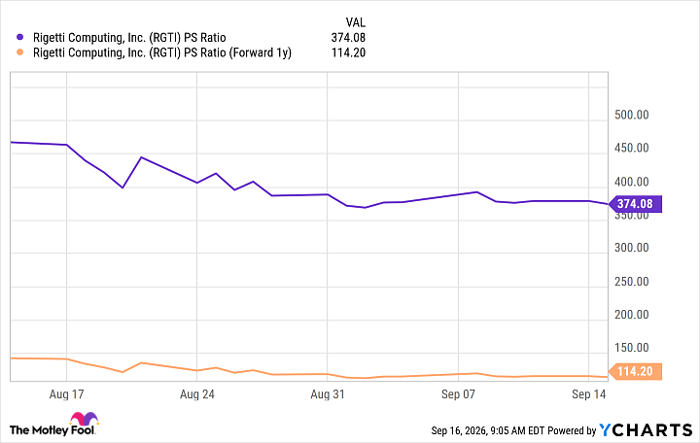
RGTI PS Ratio data by YCharts
Even if Rigetti's stock crashed by 95% over the next 12 months, it would still be more expensive than the Nasdaq-100. I'm not predicting a decline that steep because I'm sure many investors will hold stocks like Rigetti for the long term regardless of their valuation, simply because of the potential of quantum computing.
However, I think the stock could easily fall below $10 over the next year, and potentially even hit $5 if the company fails to meet Wall Street's revenue expectations.
It's worth noting that Ark Investment Management, which is run by seasoned tech investor Cathie Wood, thinks it could take 20 to 40 years for quantum computers to become truly disruptive in areas like cryptography. If that timeline proves accurate, Rigetti will have to raise a lot more cash to fund its operations, which will likely dilute the holdings of every existing investor. That will be a major drag on future returns.
Should you buy stock in Rigetti Computing right now?
Before you buy stock in Rigetti Computing, consider this:
The Motley Fool Stock Advisor analyst team just identified what they believe are the 10 best stocks for investors to buy now… and Rigetti Computing wasn’t one of them. The 10 stocks that made the cut could produce monster returns in the coming years.
Consider when Netflix made this list on December 17, 2004... if you invested $1,000 at the time of our recommendation, you’d have $412,074!* Or when Nvidia made this list on April 15, 2005... if you invested $1,000 at the time of our recommendation, you’d have $1,314,319!*
Now, it’s worth noting Stock Advisor’s total average return is 932% — a market-crushing outperformance compared to 209% for the S&P 500. Don't miss the latest top 10 list, available with Stock Advisor, and join an investing community built by individual investors for individual investors.
See the 10 stocks »
*Stock Advisor returns as of September 17, 2026.
Anthony Di Pizio has no position in any of the stocks mentioned. The Motley Fool has no position in any of the stocks mentioned. The Motley Fool has a disclosure policy.
Recommended Articles


