




Intel Jumps 10% to Nearly Two-Month High as CEO Lip-Bu Tan Cites Surge in CPU Demand Driven by AI Inference
TradingKey - Intel (INTC) CEO Lip-Bu Tan recently delivered a keynote speech at the Splunk.conf26 conference in Denver, Colorado, and addressed the market's three most pressing concerns—CPU supply and demand, process node progress, and foundry strategy—during a fireside chat. He estimated that the AI compute bottleneck is spreading from GPUs to CPUs.
Meanwhile, Intel's stock price rose for a second consecutive day, with gains touching 10% today at one point to hit a new high since July 10.
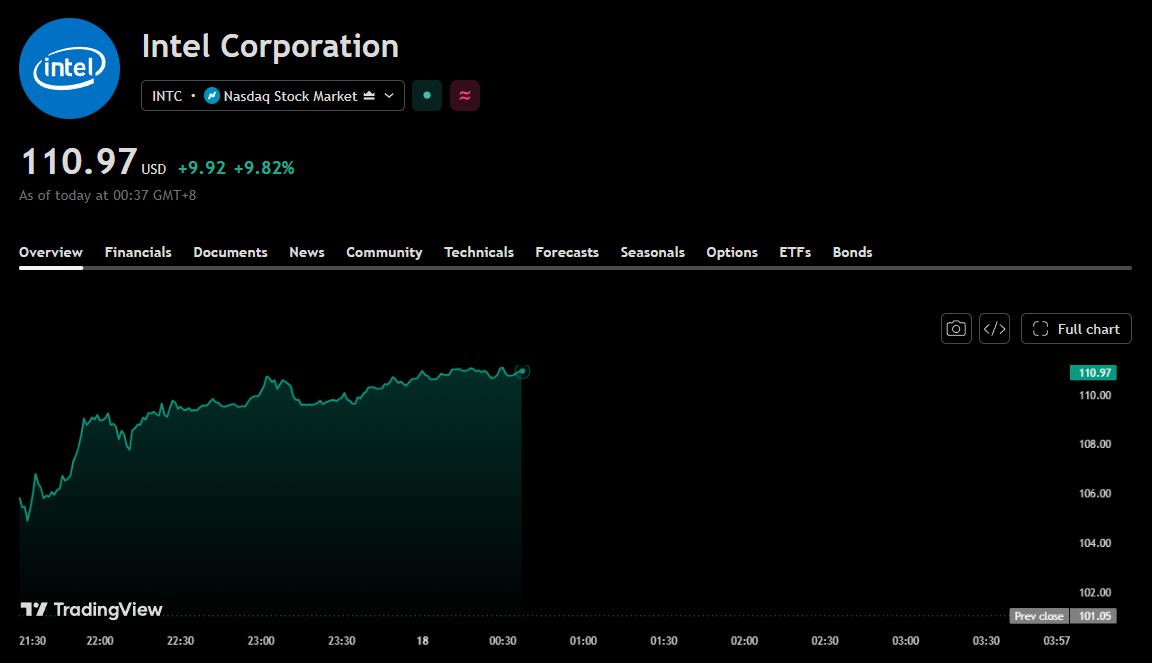
Intel stock price chart, Source: TradingView
Lip-Bu Tan stated that as AI agents rapidly expand in scale, CPU demand has far exceeded Intel's existing supply capacity, currently meeting only about 50% of leading-edge customers' requirements. He noted that several big tech CEOs have called him directly requesting more CPU shipments: "I have to apologize because our capacity cannot keep up."
He attributed the shortage to an explosion in CPU demand for AI inference scenarios. There is a widespread market misconception that AI development relies solely on GPUs; Tan pointed out that while GPUs excel at model training, compute requirements reverse when moving into AI agents and reinforcement learning inference. "When orchestration, control flow, and complex single-threaded or multi-threaded scheduling are needed, the CPU is the best choice."
He projected that as millions or even trillions of AI agents go online in the future, compute infrastructure—including CPUs, memory, and network bandwidth—will remain in a "supply-constrained" environment.
The wafer foundry business is at the core of Intel's turnaround. Tan emphasized that the foundry business is essentially a "customer service industry." "Foundry is not about acting superior; you need to serve customers with pleasing and humble attitudes," seamlessly accommodating customers' preferred EDA tools or specific third-party IP libraries.
He also confirmed the latest timeline: the Intel 18A node has entered full-scale mass production, and the Intel 14A node will officially begin production in the first quarter of next year. Intel 14A (1.4nm-class) had previously faced yield challenges; in April, the company agreed to transfer 14A process technology to the Terafab project led by Tesla and SpaceX, with the latter's first product expected to launch in mid-2028.
He also issued a supply chain warning: global key packaging substrate materials are monopolized by a very small number of vendors, and massive prepayments are required to secure capacity. "Having 95% of global advanced packaging capacity concentrated in a single region is extremely dangerous." Intel is investing massive capital expenditures to accelerate the onshore deployment of advanced packaging and manufacturing capabilities in the US. Regarding the foundry landscape, he also advocated diversifying orders across multiple suppliers, stating that "relying on a single company for 95% of capacity carries extremely high risk."
Recommended Articles


