




Ethereum's Vitalik Buterin Isn't Worried About AI Breaking Crypto. Here's Why That's Fantastic News For Crypto Investors.
Key Points
Vitalik Buterin recently argued that AI couldn’t crack Bitcoin or Ether.
Instead, the indirect threat from AI will likely emerge in phishing scams.
- 10 stocks we like better than Bitcoin ›
Liron Shapira, the co-founder and CEO of Relationship Hero, recently claimed there was a 50% chance that Bitcoin (CRYPTO: BTC) would crash by more than 50% within two years as AI undermined its security features. Vitalik Buterin, the co-founder of Ethereum (CRYPTO: ETH), dismissed that notion in a post on X, saying he took the "opposite side" of that view.
Buterin argued that AI would strengthen cybersecurity platforms just as much as it enabled new attacks, that Bitcoin was already capable of countering most security challenges, and that the risk of actual cracks appearing in Bitcoin's consensus mechanism was "tiny."
Missed AI’s "Act 1"? Act 2 Could Be 15x Bigger. Most investors think they missed the AI boat because they didn't buy Nvidia in 2005. But according to our analysts, we’re only at the end of "Act 1"—the R&D phase. "Act 2" is the global rollout. Continue »
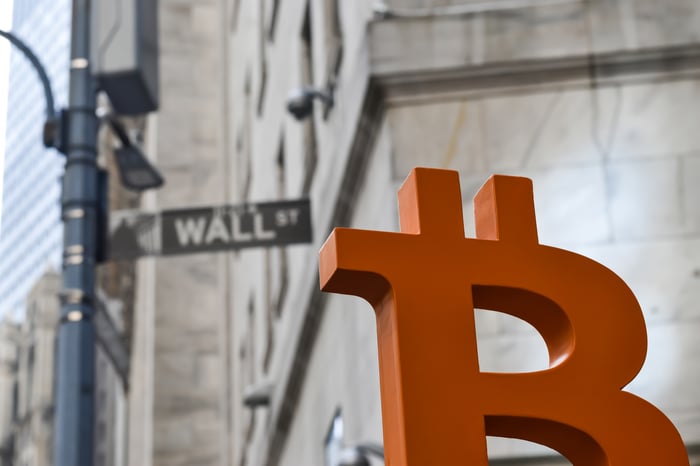
Image source: Getty Images.
Buterin said that the same logic applied to Ether, which he assumed Shapira was also bearish on. He told Shapira that he'd "offer a bet" against his gloomy prediction, but that he was "basically taking this bet with 90% of my net worth already" through his Ether holdings. Let's see why Buterin's optimistic outlook is great news for crypto investors.
Are sunnier days ahead for Bitcoin?
Bitcoin is still mined with the energy-intensive proof-of-work (PoW) consensus mechanism, which requires powerful application-specific integrated circuits (ASICs) to mine profitably. More than 20 million of Bitcoin's maximum supply of 21 million tokens have already been mined, and its mining rewards are halved every four years. That scarcity makes it more comparable to gold than other cryptocurrencies, and the bulls believe it will follow gold's lead as a hedge against inflation and the devaluation of fiat currencies.
On its own, it would take the world's most advanced AI applications millions of years to crack Bitcoin's cryptographic locks. In theory, quantum computers could eventually reverse engineer Bitcoin's public keys to find their private keys. Still, Bitcoin's developers are already countering that threat with hidden public keys and quantum-proof locks.
Therefore, there's no real threat of AI applications or quantum computers "breaking" Bitcoin. Instead, AI applications could indirectly disrupt Bitcoin with more sophisticated phishing scams, which trick users into handing over their seed phrases, but those types of attacks will also threaten traditional banking accounts.
What's next for the crypto market?
Bitcoin, Ether, and most other cryptocurrencies are trading far below their all-time highs because geopolitical conflicts, fears of interest rate hikes, and other macro headwinds are driving investors toward more conservative investments. Investors should focus on those challenges -- rather than the speculation about AI and quantum computing -- to see if the crypto market will finally recover over the next few months.
Should you buy stock in Bitcoin right now?
Before you buy stock in Bitcoin, consider this:
The Motley Fool Stock Advisor analyst team just identified what they believe are the 10 best stocks for investors to buy now… and Bitcoin wasn’t one of them. The 10 stocks that made the cut could produce monster returns in the coming years.
Consider when Netflix made this list on December 17, 2004... if you invested $1,000 at the time of our recommendation, you’d have $420,109!* Or when Nvidia made this list on April 15, 2005... if you invested $1,000 at the time of our recommendation, you’d have $1,303,689!*
Now, it’s worth noting Stock Advisor’s total average return is 938% — a market-crushing outperformance compared to 211% for the S&P 500. Don't miss the latest top 10 list, available with Stock Advisor, and join an investing community built by individual investors for individual investors.
See the 10 stocks »
*Stock Advisor returns as of September 16, 2026.
Leo Sun has no position in any of the stocks mentioned. The Motley Fool has positions in and recommends Bitcoin and Ethereum. The Motley Fool has a disclosure policy.
Recommended Articles


