




Bond Investors Are on Edge. Here's Why Stock Investors Should Pay Attention.
Key Points
Rising yields can damage both economic growth and corporate profits.
Higher yields also make bonds more competitive with stocks.
- These 10 stocks could mint the next wave of millionaires ›
The bond market is flashing bright red warning signals for stock and bond investors alike.
On Monday, the yield on the 10-year Treasury note rose above 5% for the first time since late 2023. And even back then, it remained above that level for just one day. The 10-year yield is now a full percentage point higher than it was before the Iran war began.
Missed AI’s "Act 1"? Act 2 Could Be 15x Bigger. Most investors think they missed the AI boat because they didn't buy Nvidia in 2005. But according to our analysts, we’re only at the end of "Act 1"—the R&D phase. "Act 2" is the global rollout. Continue »
And it's not just the 10-year Treasury. The yield on the five-year Treasury has been rising dramatically since February, as has the 30-year yield.
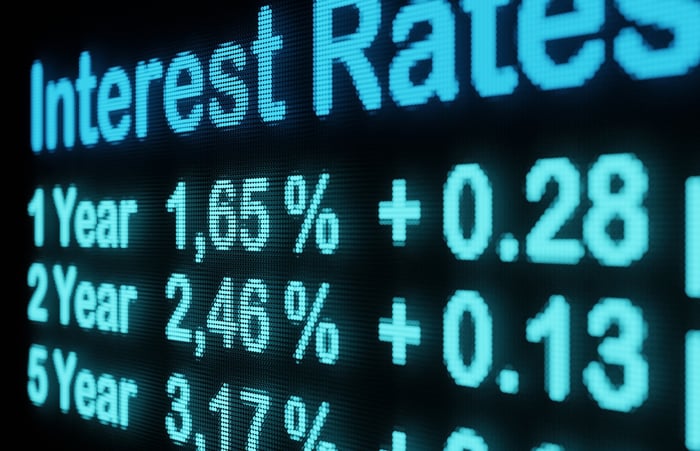
Image source: Getty Images.
What does it mean to stock investors?
Well, first and foremost, it means that holders of Treasuries have been selling them, which has sent prices of the securities down and yields, which move in the opposite direction of price, higher. Apparently, many bond investors are unhappy with elevated inflation, which has remained well above the Fed's target for 65 months, as well as with rising U.S. debt and the utter lack of any policy in Washington to address it.
That's bad for the U.S. economy, as long-dated Treasury yields set rates for corporate borrowing and many consumer loans, such as mortgages and auto loans. And we're already seeing that play out, with rates on 30-year mortgages now at 6.76%, up from around 6% early this year and double the rate homebuyers enjoyed five years ago.
That negatively impacts the housing market, which accounts for between 15% and 18% of U.S. gross domestic product. Lots of companies, from homebuilders to real estate investment trusts to home improvement retailers, rely on a robust housing market to remain profitable.
Rising Treasury yields also make it harder for the U.S. government to fund itself, as the U.S. has relied heavily on borrowing in recent years to bridge the gap between what it spends and what it collects in taxes and other revenue. The U.S. debt recently exceeded $40 trillion.
Rising yields make bonds more attractive
In addition, when bond yields rise as they've been doing for most of 2026, bonds become more attractive relative to risk assets like stocks. That sucks capital out of the stock market and into the bond market.
And companies' interest rates and borrowing costs rise with Treasury yields, which squeezes their profit margins and earnings.
So far, however, the rise in Treasury yields has been relatively orderly, and many bond market observers think that if the Federal Reserve hikes its benchmark interest rate this week, it will relieve some of the upward pressure on long-term yields. Futures traders are pricing in a 90% chance that the Fed will raise its interest rate this week, and a 77% chance it will hike again by the end of 2026.
That should provide some relief to rising yields and encourage the stock market, suggesting that the Fed is willing to raise rates to address elevated inflation. So, at the moment, rising yields remain a warning signal. If they climb much higher, however, they could prove to be real trouble for stock market investors.
Where to invest $1,000 right now
When our analyst team has a stock tip, it can pay to listen. After all, Stock Advisor’s total average return is 949%* — a market-crushing outperformance compared to 212% for the S&P 500.
They just revealed what they believe are the 10 best stocks for investors to buy right now, available when you join Stock Advisor.
See the stocks »
*Stock Advisor returns as of September 16, 2026.
The Motley Fool has a disclosure policy.
Recommended Articles


