




Chip Stocks Recovered Today and the Major Indexes Fell Anyway
Key Points
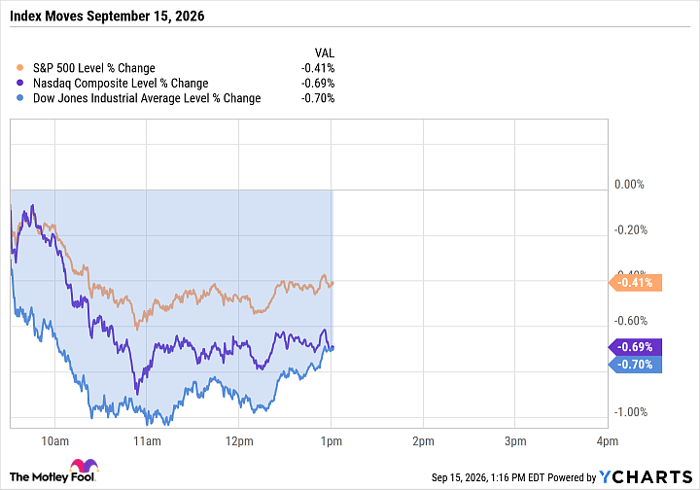
The Dow and Nasdaq Composite each fell 0.7% by midday while the S&P 500 held up better at a 0.4% loss.
Chip stocks reversed Monday's selloff, with Qualcomm up 4% and Advanced Micro Devices gaining 2.3%.
The 10-year Treasury yield touched 5.041%, its highest level since July 2007.
- 10 stocks we like better than Dow Jones Industrial Average ›
Yesterday the market was worried about artificial intelligence. Today it went back to worrying about interest rates, which have a much longer track record.
The Dow Jones Industrial Average (DJINDICES: ^DJI) dropped 0.7% as of 1:16 p.m. ET, with the Nasdaq Composite (NASDAQINDEX: ^IXIC) matching it. The S&P 500 (SNPINDEX: ^GSPC) took a lighter hit, falling 0.4%. Only seven of the Dow's 30 stocks posted gains at this checkpoint.
Missed AI’s "Act 1"? Act 2 Could Be 15x Bigger. Most investors think they missed the AI boat because they didn't buy Nvidia in 2005. But according to our analysts, we’re only at the end of "Act 1"—the R&D phase. "Act 2" is the global rollout. Continue »
^SPX data by YCharts
Treasury yields just hit a 19-year high
The 10-year Treasury yield climbed to 5.041% on Tuesday morning, a level not seen since July 2007. The 30-year hit 5.401%, setting another 19-year record, and 30-year mortgage rates crossed 7% last week. These numbers can reprice everything from car loans to corporate borrowing.
Oil kept pushing in the same direction. Brent crude rose 2.6% to $108.41 and U.S. crude added 3.3% to $104.76 while traders tried to figure out how long Saudi Arabia's East-West oil pipeline stays offline.
Energy Secretary Chris Wright says days. Oil analyst Andy Lipow, looking at satellite photos of the wrecked pumping station, says months. Someone will be wrong, and real-world oil prices will eventually set the record straight. The United States Oil Fund (NYSEMKT: USO) gained 4.1% today.

Image source: Getty Images.
Monday's AI panic mostly unwound. Nvidia edged higher, Qualcomm rose 4%, and Advanced Micro Devices gained 2.3%. The chip wreck has stopped at least for today, and the indexes fell anyway.
The damage just moved to a different corner of Wall Street. Goldman Sachs (NYSE: GS) fell 2.9% and took 171 Dow points with it, easily the day's biggest single drag, and JPMorgan Chase (NYSE: JPM) dropped 1.6%. Big tech joined in, with several Magnificent 7 names falling 1% or more. Some of them had more than macroeconomic concerns, though. Amazon (NASDAQ: AMZN) lost access to cloud computing centers in Bahrain and the UAE due to irreparable damage from the Iran war. Apple (NASDAQ: AAPL) faces a regulatory review of its software warranty policy in India.
Chevron (NYSE: CVX) was about the only place to hide among the Dow components, posting a 2% gain. That's another sign of rising oil prices.
What to listen for when Kevin Warsh takes the podium tomorrow
The Fed wraps up its meeting on Wednesday, and futures give a quarter-point hike better than 92% odds. So the decision isn't really the news. What Chair Kevin Warsh says about the meetings after this one is.
The bond market has already made a guess. Yields at 19-year highs imply traders expect rates to stay elevated for a while, not just tick up once. Treasury Secretary Scott Bessent spent Tuesday in front of the House Financial Services Committee defending his bond buybacks, arguing yields would be worse without them, while ranking Democrat Maxine Waters pointed out that Treasuries keep selling off anyway.
Energy is the complication underneath all of it. It was the only S&P 500 sector to trend higher on Tuesday, up 1.9%, and energy costs drove more than a third of August's inflation increase. Every day that pipeline stays shut makes the Fed's next decision harder than this one.
Wednesday's hike is a foregone conclusion -- rates will rise. Beyond that, everything is guesswork.
Should you buy stock in Dow Jones Industrial Average right now?
Before you buy stock in Dow Jones Industrial Average, consider this:
The Motley Fool Stock Advisor analyst team just identified what they believe are the 10 best stocks for investors to buy now… and Dow Jones Industrial Average wasn’t one of them. The 10 stocks that made the cut could produce monster returns in the coming years.
Consider when Netflix made this list on December 17, 2004... if you invested $1,000 at the time of our recommendation, you’d have $433,160!* Or when Nvidia made this list on April 15, 2005... if you invested $1,000 at the time of our recommendation, you’d have $1,296,254!*
Now, it’s worth noting Stock Advisor’s total average return is 949% — a market-crushing outperformance compared to 212% for the S&P 500. Don't miss the latest top 10 list, available with Stock Advisor, and join an investing community built by individual investors for individual investors.
See the 10 stocks »
*Stock Advisor returns as of September 15, 2026.
JPMorgan Chase is an advertising partner of Motley Fool Money. Anders Bylund has positions in Amazon and Nvidia. The Motley Fool has positions in and recommends Advanced Micro Devices, Amazon, Apple, Chevron, Goldman Sachs Group, JPMorgan Chase, Nvidia, and Qualcomm. The Motley Fool has a disclosure policy.
Recommended Articles


