




New Fed Chair Warsh Vowed a Policy Overhaul to Crush Inflation When He Took Office. Has He Followed Through?
Key Points
Inflation was 3.4% in August, largely driven by higher energy costs from the Iran war.
“Trumpflation” might force the Fed’s hand to raise interest rates, despite the president’s preference for lower rates.
- 10 stocks we like better than Vanguard Total Bond Market ETF ›
As of this writing, investor consensus in the bond market is that the Federal Reserve will hike interest rates at its next gathering on Sept. 15-16.
Recent inflation data has been hotter than expected. Energy prices have surged again due to the Iran war. Long-term interest rates have reached levels not seen since 2007. And President Donald Trump's newly expanded trade war with Canada is unlikely to help. President Trump appointed Fed Chair Kevin Warsh with two conflicting goals: lower interest rates and lower inflation. Trump has been vocal about his desire for the Fed to cut interest rates.
Missed Nvidia in 2009? This Rare Signal Is Flashing Again. In 2009, a "Double Down" signal flashed for a little-known chipmaker called Nvidia. For the first time in years, that same "Total Conviction" signal is flashing for a company 1/100th the size of Nvidia. Continue »
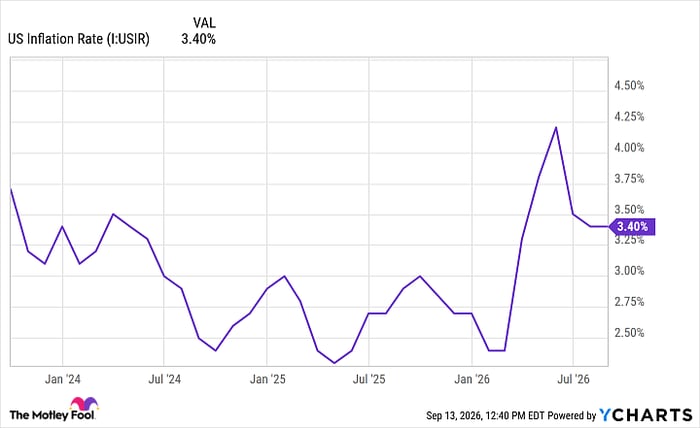
But inflation hasn't gone away. The U.S. inflation rate in August was 3.4%, unchanged from the month before. That's higher than the Fed's so-called target of 2%. When Warsh was first nominated and appointed as Fed chair, he got some initial credit from the bond market. Warsh had a reputation as an inflation hawk, willing to be an independent voice to raise interest rates if necessary.

Federal Reserve Chair Kevin Warsh. Image source: Federal Reserve.
But despite his recent strong comments about reining in inflation, the inflation problem might be beyond Kevin Warsh's control. Let's look at what's driving inflation in the U.S. and what it might mean for investors.
U.S. inflation in August: Mostly driven by energy costs
For the past few years, inflation has been coming down from its post-pandemic highs. It still wasn't meeting the Fed's 2% target, but the situation was improving. Then in February 2026, the Iran war started.
Here's what happened next -- that big spike on the chart began in February:
Data by YCharts.
According to Motley Fool research, as of August 2026, energy inflation increased to 16.9% due to uncertainty in the Middle East. Global energy supplies have been disrupted by the Iran conflict and its on-again, off-again closure of the Strait of Hormuz. This is an example of "Trumpflation" in the economy. Trump administration policy choices, such as tariffs and the Iran war, have contributed to rising costs and higher inflation.
How to invest for higher inflation
If Kevin Warsh and his colleagues at the Fed do what bond investors expect, we will likely see a rate hike on Sept. 16. But the Fed can only do so much. They have the power to raise or lower short-term interest rates. This affects the supply of money in the economy by increasing or decreasing borrowing costs.
But it seems the biggest factors driving inflation are not Kevin Warsh's choices but Donald Trump's. If you believe that the Iran war will be over soon, gas prices and inflation will come down, and the Fed will soon start cutting interest rates again, now could be a good time to buy bonds. The Vanguard Total Bond Market ETF (NASDAQ: BND) can be an easy, low-cost way to add the combined equivalent of thousands of U.S. bonds to your portfolio.
But if you believe that inflation is likely to stay higher for longer and interest rates will keep climbing, you might want to consider inflation-proof investments. These could include stocks with strong balance sheets, commodities, and real estate investment trusts (REITs).
Should you buy stock in Vanguard Total Bond Market ETF right now?
Before you buy stock in Vanguard Total Bond Market ETF, consider this:
The Motley Fool Stock Advisor analyst team just identified what they believe are the 10 best stocks for investors to buy now… and Vanguard Total Bond Market ETF wasn’t one of them. The 10 stocks that made the cut could produce monster returns in the coming years.
Consider when Netflix made this list on December 17, 2004... if you invested $1,000 at the time of our recommendation, you’d have $417,413!* Or when Nvidia made this list on April 15, 2005... if you invested $1,000 at the time of our recommendation, you’d have $1,341,294!*
Now, it’s worth noting Stock Advisor’s total average return is 950% — a market-crushing outperformance compared to 212% for the S&P 500. Don't miss the latest top 10 list, available with Stock Advisor, and join an investing community built by individual investors for individual investors.
See the 10 stocks »
*Stock Advisor returns as of September 14, 2026.
Ben Gran has positions in Vanguard Total Bond Market ETF. The Motley Fool has positions in and recommends Vanguard Total Bond Market ETF. The Motley Fool has a disclosure policy.
Recommended Articles


