




How to Turn $100,000 Into $1 Million for Retirement: 3 Smart Investment Strategies
Key Points
Compound earnings work better the more time you have.
Dividends play a major role in many stocks' or ETFs' total returns.
Dividend reinvestment plans automatically reinvest the dividends you receive.
- The $23,760 Social Security bonus most retirees completely overlook ›
When it comes to retirement savings, the $1 million mark has long been a major milestone for most people. How far that takes you in retirement is a different story, but there's something about hitting the seven-figure mark that feels like a bit of financial freedom.
The good news is that reaching $1 million doesn't require luck or getting in early on the next big thing. It can be accomplished with time and consistency. If you're currently around the $100,000 mark, here are three things you can do to potentially 10x it to $1 million.
Will AI create the world's first trillionaire? Our team just released a report on the one little-known company, called an "Indispensable Monopoly" providing the critical technology Nvidia and Intel both need. Continue »

Image source: Getty Images.
1. Start as early as possible
This might seem like "well, of course" type of advice, but I've noticed that people often underestimate just how powerful time can be in investing, thanks to compound earnings. It's the gift that keeps on giving and one of the keys to building wealth in the stock market.
To see it in action, let's imagine you invest $100,000 in a stock or exchange-traded fund (ETF) that averages 10% annual returns. Below is how much your investment would grow to over different amounts of time:
| Years Invested | Investment Value |
|---|---|
| 10 | $259,300 |
| 15 | $417,700 |
| 20 | $672,000 |
| 25 | $1.08 million |
| 30 | $1.74 million |
Calculations by author via investor.gov. Investment values are rounded down to the nearest hundred.
In this scenario, the difference between giving yourself 20 years versus 15 years is over $254,000. The difference between 30 and 25 years is around $660,000. The more time you give yourself, the more it pays off.
2. Invest in dividend stocks
Since stock price movements get a lot of attention, many people don't realize how much dividends can contribute to a stock's total gains. Over the past 20 years, the S&P 500 has averaged 8.8% annual returns. When you include dividends, the average goes up to 10.9%.
If a one-time $100,000 investment were made back then, the 2.1% difference would equal more than a $250,000 difference in investment value.
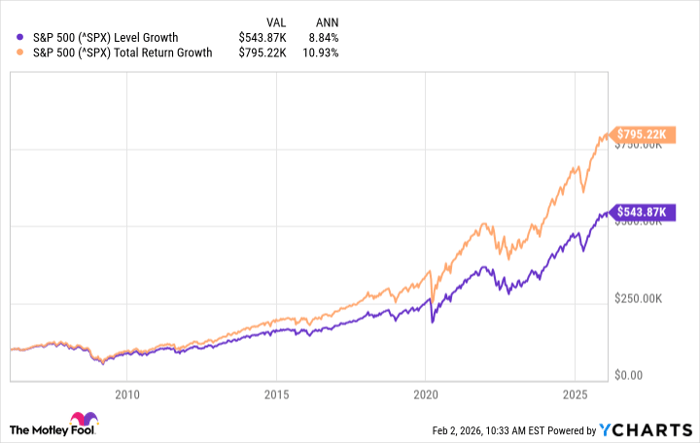
^SPX data by YCharts
Even investing in a dividend ETF like the Schwab U.S. Dividend Equity ETF can be lucrative. It has a 3.5% average dividend yield over the past decade. Maintaining that would mean $100,000 invested would pay out $3,500 annually to help compound your investment.
3. Use a dividend reinvestment plan
Receiving dividends in cash is cool, but the real magic happens when you use a dividend reinvestment plan (DRIP). When you elect into a DRIP, your broker automatically reinvests the dividends you're paid back into the stock or ETF that paid them.
Continuing our above example, instead of receiving $3,500 in cash, it's better to have it reinvested to buy more SCHD shares. That's then $3,500 worth of SCHD shares that are now going to earn dividends and hopefully increase in price. If the yield remains 3.5%, that's an extra $122.50 made from reinvesting. It's a lucrative cycle.
The $23,760 Social Security bonus most retirees completely overlook
If you're like most Americans, you're a few years (or more) behind on your retirement savings. But a handful of little-known "Social Security secrets" could help ensure a boost in your retirement income.
One easy trick could pay you as much as $23,760 more... each year! Once you learn how to maximize your Social Security benefits, we think you could retire confidently with the peace of mind we're all after. Join Stock Advisor to learn more about these strategies.
View the "Social Security secrets" »
Stefon Walters has no position in any of the stocks mentioned. The Motley Fool has no position in any of the stocks mentioned. The Motley Fool has a disclosure policy.
Recommended Articles


