




Should You Buy Rivian Automotive Stock While It's Below $17?
Key Points
Rivian's deliveries have stagnated.
The company is building a new factory and working on autonomous driving.
The business is highly unprofitable right now.
- 10 stocks we like better than Rivian Automotive ›
The automotive world is changing. Out are the legacy gasoline-powered vehicles. In are electric motors and autonomous driving systems, leading to disruption from new car manufacturers -- especially from China -- as well as self-driving technology from the likes of Alphabet's Waymo and Tesla. One company aiming straight at both these markets is Rivian Automotive (NASDAQ: RIVN).
A fallen angel from the 2021 bull market, Rivian stock is down 90% from its all-time highs, driven by its heavy cash burn and failure to significantly grow its vehicle output. However, the company is making large investments into software, has a funding partnership with Volkswagen, and is about to launch a new, cheaper vehicle this calendar year.
Where to invest $1,000 right now? Our analyst team just revealed what they believe are the 10 best stocks to buy right now. Continue »
Does that make Rivian stock a buy-the-dip candidate below $17?
New factory and big plans in autonomy
When Rivian first started to deliver its premium electric vehicles (EVs) to pre-order customers in 2022, its output began to grow like gangbusters. Deliveries quickly hit a 15,000-unit quarterly rate, with revenue soaring into the billions.
Since then, this quarterly rate of deliveries has stagnated due to the high price points of Rivian's initial launch of a premium truck and SUV. While highly rated vehicles, there is simply a limited addressable market for cars that cost $100,000 or more to purchase. To widen its addressable market, Rivian is launching the smaller R2 SUV in 2026 that will cost closer to $50,000.
Over the longer term, the company has begun construction on a larger factory in Georgia, which will begin producing vehicles such as the R2 within the next few years. Importantly, the U.S. government has proposed loans worth $6.6 billion to Rivian based on development milestones at this Georgia factory that will help bridge the company's funding gap.
In the meantime, Rivian is aiming to improve its profit margins by investing in software and autonomous vehicle systems, including a custom-made computer chip for its vehicles. Self-driving software for Rivian vehicles is launching this year and will cost $50 a month. For every 100,000 people that sign up for self-driving with Rivian, that is $60 million in annual subscription revenue that will help with margin expansion and keep customers locked in over the long term.

Image source: Getty Images.
Cash flow improvements are not what they seem
As a start-up trying to vertically integrate vehicle manufacturing, Rivian's free cash flow has been deeply negative for years. It peaked at over $6 billion in negative free cash flow in 2023. Now, the company has made great strides to improve this cash burn, with trailing-12-month free cash flow at only negative $489 million.
Investors should remain skeptical that this cash flow improvement will turn positive in the next year or two. The main reason Rivian's cash burn has improved is that the company has delivered more vehicles than it has produced for two straight quarters, thereby reducing inventory on its balance sheet. If you look at the company's operating loss, it is still $3.4 billion and nowhere near reaching breakeven.
Rivian is going to burn money for years as it scales up manufacturing. The company may have the funding to do so with its U.S. government loan and partnership with Volkswagen, but it is a risk to the business that investors should pay attention to.
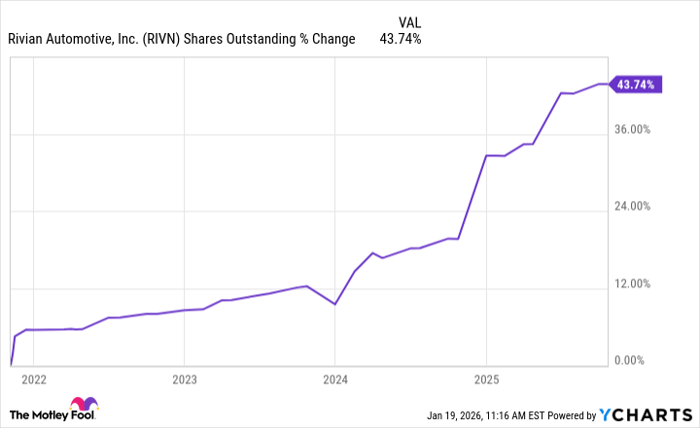
RIVN Shares Outstanding data by YCharts
Time to buy Rivian Automotive stock?
After its Autonomy Day in December, Rivian's stock jumped to over $20. It has since given back most of these gains, trading below $17 as of this writing on Jan. 19, 2026.
That gives the stock a market cap of $20 billion. If the company can scale up its manufacturing and software programs to improve profit margins, this may seem like a reasonable market cap 10 years from now. However, investors need to consider the debt/dilution risk when valuing this stock. Rivian's shares outstanding are up 44% in the past five years since going public.
Rivian is a fascinating business. But with huge operating losses, the stock seems too risky for investors to buy at its current trading price.
Should you buy stock in Rivian Automotive right now?
Before you buy stock in Rivian Automotive, consider this:
The Motley Fool Stock Advisor analyst team just identified what they believe are the 10 best stocks for investors to buy now… and Rivian Automotive wasn’t one of them. The 10 stocks that made the cut could produce monster returns in the coming years.
Consider when Netflix made this list on December 17, 2004... if you invested $1,000 at the time of our recommendation, you’d have $474,578!* Or when Nvidia made this list on April 15, 2005... if you invested $1,000 at the time of our recommendation, you’d have $1,141,628!*
Now, it’s worth noting Stock Advisor’s total average return is 955% — a market-crushing outperformance compared to 196% for the S&P 500. Don't miss the latest top 10 list, available with Stock Advisor, and join an investing community built by individual investors for individual investors.
See the 10 stocks »
*Stock Advisor returns as of January 20, 2026.
Brett Schafer has no position in any of the stocks mentioned. The Motley Fool has positions in and recommends Alphabet and Tesla. The Motley Fool recommends Volkswagen Ag. The Motley Fool has a disclosure policy.
Recommended Articles


