




If I Could Own Only 1 Quantum Computing Stock in 2026, This Would Be It
Key Points
We're still years away from practical full-scale quantum computing systems.
That makes many quantum computing stocks risky.
There is one quantum computing company that is a leader in the space, and its strong balance sheet makes it particularly appealing.
- 10 stocks we like better than Alphabet ›
There are a handful of companies all pushing us toward the next big advancement in processing capabilities. Quantum computing promises to solve problems that are physically impossible with classical computers and their strict binary inputs and outputs. Researchers could use them for drug discovery, or to improve material design in construction, or provide stronger cybersecurity (or crack cybersecurity), or even just get a more accurate weather forecast.
As such, there's a lot of excitement surrounding companies that design and build quantum computing systems. Companies including Rigetti Computing (NASDAQ: RGTI) and IonQ (NYSE: IONQ) have seen their share prices soar over the last few years as investors pile into the pure-play stocks. But another company stands out as the best quantum computing stock to own for long-term investors.
Where to invest $1,000 right now? Our analyst team just revealed what they believe are the 10 best stocks to buy right now. Continue »
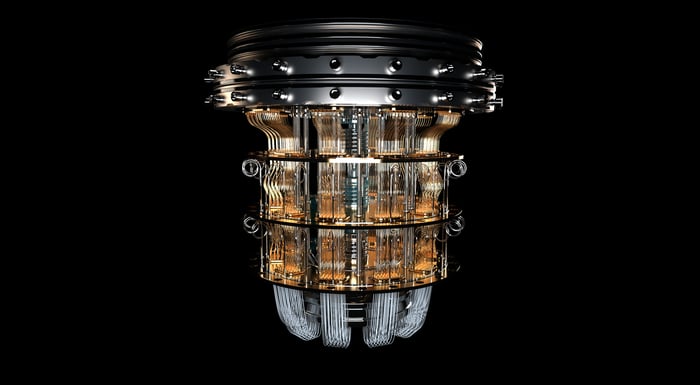
Image source: Getty Images.
The challenge facing Rigetti and IonQ
While some quantum computing systems are currently in use, helping to optimize models in fields such as logistics and financial services, we're still years away from achieving true breakthroughs in quantum computing.
The largest pure-play companies, such as IonQ and Rigetti, generate minimal revenue. Meanwhile, they're spending huge sums of cash on research and development and other operating expenses. As a result, both are burning tens of millions in cash every quarter. Rigetti produced negative free cash flow of $67.6 million over the last 12 months. IonQ saw its cash burn accelerate to $263.6 million over the past year as a result of some aggressive acquisitions.
Both companies rely on external funding to support their operations. Thanks to their soaring stock prices, though, they can easily tap into their equity to raise cash. Both companies issued additional equity to raise cash in 2025. Rigetti raised $350 million in June, and IonQ raised $2 billion in October.
Even with the new cash infusions, both companies still have a relatively short timeline before they deplete what's currently available on their balance sheets. Both sport cash and cash equivalents worth roughly seven years of cash burn based on their most recent financial results. Even with the marked advancements they've made in quantum computing in the last few years, it's likely they'll need to raise more cash before they turn cash-flow-positive.
For investors, that means further dilution of their ownership stake in the business. In effect, the price you pay today is actually higher than the sticker price. That makes the already high valuations of these businesses even higher. And while one might turn out to become the leader in quantum computing, they're both extremely risky investments.
The one stock to own if you can only buy a single company
While pure-play stocks like Rigetti and IonQ must operate within financial constraints, larger tech companies with substantial cash flow from existing businesses have the significant advantage of being able to take more economic leeway. Some can even commit relatively large amounts of capital to quantum computing research and development without a significant impact on their bottom line. And that's part of what makes Alphabet (NASDAQ: GOOG) (NASDAQ: GOOGL) the most attractive single stock to own in quantum computing.
Alphabet generated $73.5 billion in free cash flow over the last 12 months. Committing even $1 billion per year to quantum computing (twice the run rate of IonQ's cash burn) pales in comparison to the amount it's spending on building new data centers for its Google Cloud services (which management estimates will be around $92 billion for 2025).
More importantly, Alphabet is making significant advances in quantum computing. Its Willow chip broke new ground in late 2024, completing a benchmark test in under five minutes that would take the world's fastest supercomputers an estimated 10 septillion years to complete. More importantly, the researchers developed a system where error correction improved as they added more qubits to the system. Quantum errors are introduced because qubits, the building blocks of quantum computers, are inherently unstable. Typically, the more qubits in the system, the more errors it produces, generating unreliable results.
In other words, Willow provides a clear path to scale quantum computers to levels where they become useful for practical applications like those discussed in the introduction. Alphabet showed further progress last year by successfully executing the Quantum Echoes algorithm, demonstrating a quantum advantage.
That said, Alphabet's efforts have merely produced theoretical advantages in quantum computing. It will take years before it reaches its ultimate goal of a large-scale quantum computer.
But when it does make the technological breakthroughs that enable full-scale quantum computing, it's well-positioned to scale and deploy them because it has immense amounts of capital at hand. Moreover, it already has many of the pieces in place to offer its systems to other companies through Google Cloud, which provides a seamless path to turning its theoretical breakthroughs into a viable business.
Here's the biggest reason investors should consider Alphabet as the top quantum computing stock to own: It trades for a reasonable valuation. You can buy shares for about 29.5 times earnings right now. By comparison, IonQ and Rigetti trade for 91 and 408 times sales as of this writing. And while there's plenty of upside for the pure-play stocks, they could easily become irrelevant over the next decade. It's hard to think of a world without Alphabet 10 years from now.
Should you buy stock in Alphabet right now?
Before you buy stock in Alphabet, consider this:
The Motley Fool Stock Advisor analyst team just identified what they believe are the 10 best stocks for investors to buy now… and Alphabet wasn’t one of them. The 10 stocks that made the cut could produce monster returns in the coming years.
Consider when Netflix made this list on December 17, 2004... if you invested $1,000 at the time of our recommendation, you’d have $477,544!* Or when Nvidia made this list on April 15, 2005... if you invested $1,000 at the time of our recommendation, you’d have $1,122,686!*
Now, it’s worth noting Stock Advisor’s total average return is 955% — a market-crushing outperformance compared to 196% for the S&P 500. Don't miss the latest top 10 list, available with Stock Advisor, and join an investing community built by individual investors for individual investors.
See the 10 stocks »
*Stock Advisor returns as of January 15, 2026.
Adam Levy has positions in Alphabet. The Motley Fool has positions in and recommends Alphabet and IonQ. The Motley Fool has a disclosure policy.
Recommended Articles


