




Want the Max $5,181 Social Security Benefit? Here's the Salary You Need
Key Points
The wage base limit is the maximum amount of income subject to the Social Security payroll tax each year.
You must earn above the wage base limit for at least 35 years to qualify for the maximum benefit.
You will need to delay claiming benefits as late as possible to be eligible for the maximum.
- The $23,760 Social Security bonus most retirees completely overlook ›
Considering that Social Security is a large portion of many Americans' retirement income, it makes sense that people would aim to receive as much as possible. Beginning this year, the maximum benefit someone can receive is $5,181 per month At just over $62,000 annually, that's a pretty penny that can go a long way for someone in their golden years.
Although most people won't be eligible for the maximum benefit, it's worth knowing what it takes in case that's something you're aiming for. Let's take a look at the two-step process to reach it.
Where to invest $1,000 right now? Our analyst team just revealed what they believe are the 10 best stocks to buy right now, when you join Stock Advisor. See the stocks »

Image source: Getty Images.
Part one of the two-step process
The first portion of qualifying for the maximum Social Security benefit deals with your career earnings and their relation to Social Security payroll taxes. Most American workers pay those taxes on every check, with the employee and employer each paying 6.2% (self-employed workers and independent contractors are responsible for the full 12.4%).
The good news for higher earners is that only income up to a certain amount is subject to the Social Security payroll tax. This limit is called the wage base limit, and in 2026, it's $184,500, up from $176,100 in 2025. So, if you were to make $200,000 in 2026, $15,500 would be exempt from the tax.
To qualify for the maximum benefit, you need to earn at least the wage base limit in the 35 years that Social Security uses to calculate your benefit. Think about it like this: If you've earned the wage base limit in all those years, that means you've paid the maximum amount of Social Security, and earned the right to the maximum benefit.
Assuming that 2026 will be one of the 35 years that Social Security uses to calculate your benefit, your earnings for the year would need to be at least $184,500. Earning any less would disqualify you from earning the maximum benefit.
Expect constant changes to the wage base limit
The wage base limit is tied to changes in the national average wage index (NAWI) -- which measures changes in wage growth by examining the average earnings of U.S. workers -- so it essentially changes every year (similar to the annual Social Security cost-of-living adjustment). Notable exceptions were 2010 and 2011. For perspective, here are the past 10 wage base limits:
| Year | Wage Base Limit |
|---|---|
| 2025 | $176,100 |
| 2024 | $168,600 |
| 2023 | $160,200 |
| 2022 | $147,000 |
| 2021 | $142,800 |
| 2020 | $137,700 |
| 2019 | $132,900 |
| 2018 | $128,400 |
| 2017 | $127,200 |
| 2016 | $118,500 |
Data source: Social Security Administration.
If any of these years are included in your benefits calculation, you would have needed to earned at least that much. For most Americans, it's just not feasible, which is why Social Security estimates that only 6% of Americans earn above the wage base limit in a given year. And only around 20% of current and future covered workers are projected earn above it at least once in their career.
If you're truly aiming for the maximum Social Security, you need to be aware of the wage base limit in each year to see if you'll hit the mark.
Prepare to delay claiming benefits
Although the income requirement is the hardest part of becoming eligible for the maximum Social Security benefit, it's not the only requirement. The other half of the equation is when you claim benefits. By delaying claiming benefits past your full retirement age, your monthly benefit increases by 2/3 of 1% per month, or 8% annually. This happens until you reach age 70, so if you want to achieve the maximum benefit, you'd need to delay claiming until then.
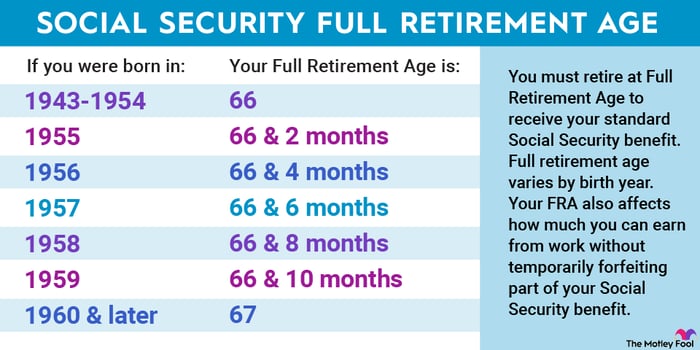
Image source: The Motley Fool.
If you're curious about where you stand, you can check your user account on the Social Security Administration website (create an account if you don't have one). There, you can find estimates of your monthly benefit based on your claiming age.
The $23,760 Social Security bonus most retirees completely overlook
If you're like most Americans, you're a few years (or more) behind on your retirement savings. But a handful of little-known "Social Security secrets" could help ensure a boost in your retirement income.
One easy trick could pay you as much as $23,760 more... each year! Once you learn how to maximize your Social Security benefits, we think you could retire confidently with the peace of mind we're all after. Join Stock Advisor to learn more about these strategies.
View the "Social Security secrets" »
The Motley Fool has a disclosure policy.
Recommended Articles


