

History Says a Turning Point Is Likely Coming for the S&P 500 in 2026
Key Points
The S&P 500 is currently trading at a very high CAPE ratio.
Only once in history has the index traded at a higher CAPE ratio -- during the dot-com bubble.
Now more than ever, deliberation and caution matter when picking stocks.
- 10 stocks we like better than S&P 500 Index ›
Every year around this time, my newsfeed is flooded with predictions of how the stock market will go in the new year. While obviously clickbait, some of these articles are well-reasoned, and others are little more than a guess -- and they're almost never right.
Let me preface my prediction with an honest caveat -- one that, for the seasoned investor out there, is likely unneeded: Markets aren't predetermined, and no one, not even the most skilled digital scryer, can tell you with absolute certainty what will happen in the new year.
Where to invest $1,000 right now? Our analyst team just revealed what they believe are the 10 best stocks to buy right now, when you join Stock Advisor. See the stocks »
But people can guess what's likely to happen or what, in the history of the market, has happened under similar circumstances. If the outcome of one particular valuation metric holds true (as it has historically), 2026 will either be another hot year -- or one in which a greater downward trend finally asserts itself.

Image source: Getty images.
The market is doing something it's only done once in the last 155 years
Over the last decade, the S&P 500 (SNPINDEX: ^GSPC) has had a magnificent run. As of Dec. 30, the S&P 500 has gained roughly 230% over the past 10 years, which works out to a compound annual growth rate (CAGR) of about 12.6%.
Not only is that higher than its roughly 10% long-term CAGR over the last 97 years, but it's also the kind of above-trend decade that can turn an initial lump sum of $100,000 into a nest egg north of $330,000.
The S&P 500 has had its ups and downs throughout the last 10 years. But one red flag hidden in its overall upward climb might be sending a warning: Today's market looks pricy, even when you smooth out the good years and the bad.
I'm talking, of course, about the cyclically-adjusted price-to-earnings ratio (CAPE ratio), or Shiller price-to-earnings ratio (P/E). This market heuristic is designed to smooth out volatility, like recessions and short-term profit spikes, by averaging inflation-adjusted earnings over the prior 10 years. It gives investors a clearer sense of whether the market is truly expensive or distorted by a business cycle.
Simply put, the S&P 500 trades at a historically high CAPE ratio. How historic? Try this: It has happened only once before 2025 since data was recorded in 1871. By historical standards, the S&P 500's CAPE is in territory traversed by the dot-com bubble.
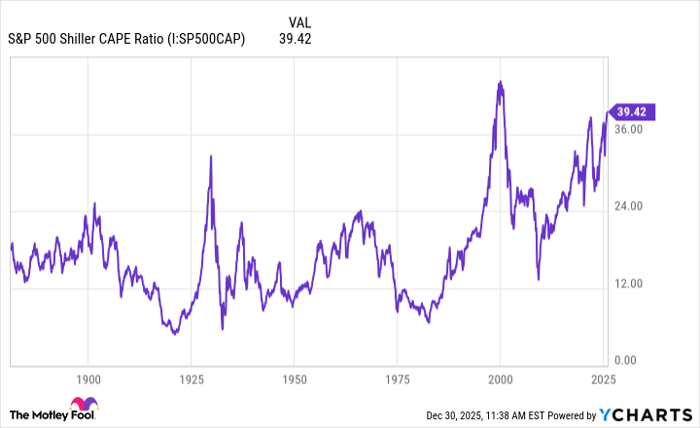
S&P 500 Shiller CAPE Ratio data by YCharts.
Today's CAPE ratio has been hovering in the 39-40 range recently (and closed 2025 slightly above 40). That's only the second time in the history of the market that this valuation gauge has surpassed 40. When the Shiller P/E runs anywhere near this hot, it has typically been followed by a sharp reversal, as seen in the chart above, though the timing of that reversal has varied widely.
Could the market crash in 2026?
Of course, a record-high Shiller P/E doesn't mean that 2026 will be the next dot-com bust (or another Great Depression), and comparing Shiller P/Es across decades isn't exactly apples-to-apples. Today's mega-cap companies, especially those dominating the tech landscape, differ meaningfully from the companies that populated earlier versions of the index. Artificial intelligence (AI) remains a powerful secular trend, and the infrastructure needed to build it -- energy, industrials, and materials -- could sustain elevated growth in 2026 and beyond.
At the same time, it would be unwise to ignore valuation altogether. The stock market is historically expensive, and expectations of perpetual growth could lure investors into overpaying for stocks that are supported by little more than promise and hype.
Now more than ever, caution and deliberation matter. Investors who have been in this territory before -- even as recent as the "everything bubble" of 2021 -- know the importance of picking companies with durability that extends beyond short-term exuberance.
In sum, I'm not predicting a 1929-style crash in 2026 and can't say with certainty that the market will continue to grow from here. Next year, I'd hold on to your high-quality stocks, regardless of market direction, and measure every investing decision with discipline, rather than emotion.
Should you buy stock in S&P 500 Index right now?
Before you buy stock in S&P 500 Index, consider this:
The Motley Fool Stock Advisor analyst team just identified what they believe are the 10 best stocks for investors to buy now… and S&P 500 Index wasn’t one of them. The 10 stocks that made the cut could produce monster returns in the coming years.
Consider when Netflix made this list on December 17, 2004... if you invested $1,000 at the time of our recommendation, you’d have $505,749!* Or when Nvidia made this list on April 15, 2005... if you invested $1,000 at the time of our recommendation, you’d have $1,149,658!*
Now, it’s worth noting Stock Advisor’s total average return is 979% — a market-crushing outperformance compared to 195% for the S&P 500. Don't miss the latest top 10 list, available with Stock Advisor, and join an investing community built by individual investors for individual investors.
See the 10 stocks »
*Stock Advisor returns as of January 1, 2026.
Steven Porrello has no position in any of the stocks mentioned. The Motley Fool has no position in any of the stocks mentioned. The Motley Fool has a disclosure policy.
Recommended Articles


