

Semiconductor Spending Is Set to Hit $1 Trillion in 2026: 2 Top Stocks to Buy Before That Happens, According to a Wall Street Analyst
Key Points
The jump in AI infrastructure spending in 2026 is going to be a catalyst for the semiconductor industry.
Let's look at a couple of names that are not just attractively valued, but growing at a healthy clip.
- 10 stocks we like better than Lam Research ›
The semiconductor industry witnessed another year of solid growth in 2025, with sales rising by 22.5% to just over $772 billion, according to World Semiconductor Trade Statistics (WSTS). The good news is that the industry is poised for stronger growth in the new year.
WSTS predicts a 26% jump in semiconductor sales in 2026 to $975 billion. However, Bank of America analyst Vivek Arya anticipates an even stronger jump of 30% in the industry's revenue, to just over $1 trillion. Arya says that the artificial intelligence (AI) boom, which has been the driving force behind the surge in semiconductor sales, is going to get bigger.
Where to invest $1,000 right now? Our analyst team just revealed what they believe are the 10 best stocks to buy right now. Continue »
Arya estimates that the AI data center market could grow to an enormous $1.2 trillion by 2030, clocking an annual growth rate of 38%. AI accelerator chips, such as graphics processing units (GPUs) and custom processors, are likely to hit a whopping $900 billion in sales. The BofA analyst has handpicked a few names that will help investors capitalize on the lucrative semiconductor market, both in 2026 and in the long run.
Let's take a closer look at two of them and check why they are worth buying right now.
Image source: Nvidia.
A no-brainer way to play the AI chip boom
BofA says that Nvidia (NASDAQ: NVDA) is leading the AI revolution. That's not surprising, as it remains the dominant player in AI chips.
Nvidia is the biggest player in the data center GPU market, with an estimated share of more than 90%. Its chips have played a critical role in the proliferation of AI, helping train popular large language models (LLMs) and inference applications in the past three years. While companies such as Advanced Micro Devices and Broadcom have been trying to cut Nvidia's lead, the technological head start that it enjoys over rivals is likely to ensure years of terrific growth.
Arya points out that Nvidia's AI processors are a generation ahead of the competition. The company reportedly has the potential to clock at least $500 billion in revenue in calendar years 2025 and 2026, as per BofA. That's in line with consensus expectations.
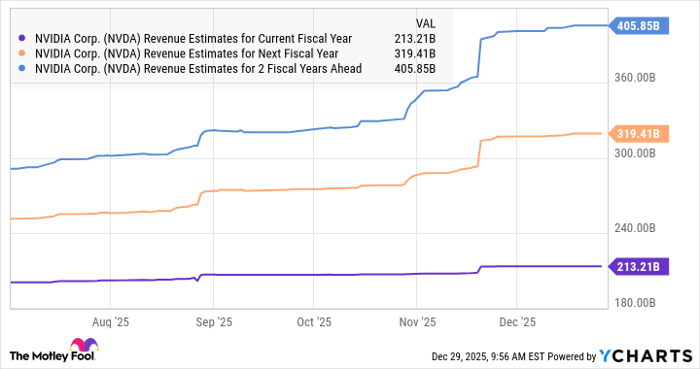
NVDA Revenue Estimates for Current Fiscal Year data by YCharts.
Analysts are forecasting a 50% increase in Nvidia's sales in the next fiscal year (which will begin next month). Importantly, the revenue expectations have moved higher of late. That's not surprising, as Nvidia's lead in AI chips puts it in a solid position to capitalize on the fast-growing AI accelerator market. The solid jump in Nvidia's sales is likely to filter down to the bottom line as well, with analysts predicting a 50% jump in earnings in the next fiscal year to $7.55 per share.
With Nvidia trading at just 25 times forward earnings right now, a discount to the tech-laden Nasdaq-100 index's earnings multiple of 32, now is a good time to buy this AI stock before the spending on AI chips surges higher in 2026.
This high-flying semiconductor name can keep soaring in 2026
Shares of Lam Research (NASDAQ: LRCX), a semiconductor equipment maker, shot up an impressive 140% in the past year. BofA has named Lam as one of its top semiconductor picks for 2026, and it is easy to see why that's the case.
Lam's valuation and growth potential suggest that the stock isn't done climbing yet. It is trading at 36 times forward earnings, which isn't very expensive when compared to the Nasdaq-100 index's average. The company's revenue in the last reported quarter (ended on Sept. 28) increased by 28% from the year-ago period to $5.32 billion. Its earnings jumped by a stronger pace of 46% year over year to $1.26 per share.
This solid growth is being driven by the healthy demand for Lam's chipmaking equipment. The company gets a third of its revenue from memory manufacturing equipment, and this business is in fine form thanks to the favorable market dynamics. The demand for memory chips is exceeding supply, as AI chip designers have been packing huge amounts of high-bandwidth memory (HBM) into their data center accelerators.
As a result, memory manufacturers such as Micron Technology and others have been ramping up their capital spending to bring more capacity online. Micron has a capital expenditure budget of $20 billion for the current fiscal year, which would be a 45% increase from its spending in the previous year. It is worth noting that Micron has increased its capex guidance by $2 billion for the current year from its original guidance.
Given that the memory market is expected to witness shortages beyond 2026, the likes of Micron could continue to spend more money on buying chipmaking equipment so that they can fulfill the robust demand they are experiencing. This should put Lam in a solid position to sustain its outstanding growth in the new year, resulting in more upside for investors.
Investors looking to buy a semiconductor stock that isn't too expensive and has favorable prospects can consider adding Lam to their portfolios before it jumps higher.
Should you buy stock in Lam Research right now?
Before you buy stock in Lam Research, consider this:
The Motley Fool Stock Advisor analyst team just identified what they believe are the 10 best stocks for investors to buy now… and Lam Research wasn’t one of them. The 10 stocks that made the cut could produce monster returns in the coming years.
Consider when Netflix made this list on December 17, 2004... if you invested $1,000 at the time of our recommendation, you’d have $505,749!* Or when Nvidia made this list on April 15, 2005... if you invested $1,000 at the time of our recommendation, you’d have $1,149,658!*
Now, it’s worth noting Stock Advisor’s total average return is 979% — a market-crushing outperformance compared to 195% for the S&P 500. Don't miss the latest top 10 list, available with Stock Advisor, and join an investing community built by individual investors for individual investors.
See the 10 stocks »
*Stock Advisor returns as of December 31, 2025.
Bank of America is an advertising partner of Motley Fool Money. Harsh Chauhan has no position in any of the stocks mentioned. The Motley Fool has positions in and recommends Advanced Micro Devices, Lam Research, and Nvidia. The Motley Fool recommends Broadcom. The Motley Fool has a disclosure policy.
Recommended Articles


