




Is Navitas Semiconductor Stock a Buy Now?
Key Points
Navitas is transitioning away from its core business with China to pursue markets such as AI.
The company's stock has more than doubled in 2025 as it makes steps toward its transformation.
Navitas is unprofitable, and revenue plunged over 40% in 2025 compared to the previous year.
- 10 stocks we like better than Navitas Semiconductor ›
The advent of artificial intelligence (AI) has boosted the fortunes of many companies in the semiconductor industry. This includes Navitas Semiconductor (NASDAQ: NVTS), which saw its shares soar over 100% in 2025 through the week ended Dec. 19.
The rise of Navitas stock has been astounding. It began 2025 under $4 per share, but as the year progressed, it eventually hit a 52-week high of $17.79 in October. The share price has fallen since then to around $7.50.
Where to invest $1,000 right now? Our analyst team just revealed what they believe are the 10 best stocks to buy right now, when you join Stock Advisor. See the stocks »
Could this sharp price drop signal a buy opportunity? Or do reasons exist to hold off at this time? Let's dive into the company to find out.

Image source: Getty Images.
Navitas Semiconductor's bold transition
Navitas focuses on semiconductors used in devices for power conversion and charging, such as laptops, mobile phones, electric vehicles, and data centers. It was a pioneer in gallium nitride power-integrated circuits, which helps it differentiate from the competition through faster charging, higher power density, and greater energy savings compared to silicon-based power systems.
The rise of electric vehicles, renewable energy sources, and artificial intelligence have created opportunities for revenue growth, given the anticipated power demand in these sectors. To capitalize on the trends, Navitas decided to make fundamental changes to its business.
The company is shifting its focus away from the mobile and consumer markets in China, which accounted for a substantial 60% of product revenue in 2024, and toward what it considers high-growth markets, such as data centers designed for AI.
Because of this transition, Navitas took a revenue hit in 2025 as it allowed existing inventory to sell down. Through the first three quarters of the year, sales were $38.6 million compared to $65.3 million in 2024, representing a whopping 41% drop. In that time, operating expenses were $77.8 million, which means the company isn't profitable, with an operating loss of $66.4 million.
That's not all. Navitas expects sales to continue falling in Q4, forecasting revenue of $7 million compared to $18 million in 2024. Moreover, Navitas founder and CEO Gene Sheridan stepped down in August, with Chris Allexandre taking over as CEO.
Factors driving the rise in Navitas stock
Considering the downturn in revenue and departure of Navitas' founder and CEO, why did its stock surge this year? The company's strategic pivot to the hot AI market is one component contributing to share price gains.
But the main driver is the partnership Navitas is touting with AI heavyweight Nvidia. In October, Navitas' stock skyrocketed after the company announced progress in developing the advanced power devices required by Nvidia.
The company's potential for success with its new strategy was bolstered by its Q3 balance sheet, which sported $150.6 million in cash and equivalents with no debt. Its cash position was further strengthened in November by a private equity offering that was expected to generate $100 million in gross proceeds.
Management believes its downward sales spiral will bottom out in Q4, with revenue growth expected in 2026. The company plans to cut operating expenses next year as well.
To buy or not to buy Navitas shares
If the new direction Navitas is pursuing leads to outsized sales growth, its stock may be a worthwhile investment for the long run. But that requires a leap of faith for investors at this time. There are also a few other factors to consider before deciding to buy.
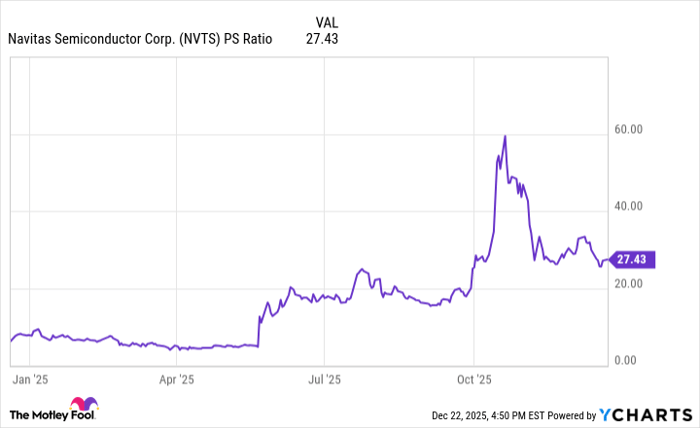
First, its share price valuation has risen substantially over the past year. This can be seen in the stock's price-to-sales ratio (P/S), which indicates how much investors are paying for each dollar of revenue generated over the past 12 months.
Data by YCharts.
As the chart shows, the company's P/S multiple was more reasonable at the start of 2025, but shares look expensive despite the drop from its price spike in October.
Another consideration is that notable insider sales have taken place. For example, in December, Navitas Board of Directors members Ranbir Singh and Gary Kent Wunderlich sold 179,354 shares and 128,300 shares, respectively. The sales are understandable, given the price appreciation and elevated P/S ratio of Navitas stock, but they underscore that now isn't the best time to buy.
The prudent approach is to put Navitas on your watch list, and wait until at least the company's Q1 financial results to see if its prediction of a 2026 revenue rebound becomes reality.
Should you buy stock in Navitas Semiconductor right now?
Before you buy stock in Navitas Semiconductor, consider this:
The Motley Fool Stock Advisor analyst team just identified what they believe are the 10 best stocks for investors to buy now… and Navitas Semiconductor wasn’t one of them. The 10 stocks that made the cut could produce monster returns in the coming years.
Consider when Netflix made this list on December 17, 2004... if you invested $1,000 at the time of our recommendation, you’d have $509,470!* Or when Nvidia made this list on April 15, 2005... if you invested $1,000 at the time of our recommendation, you’d have $1,167,988!*
Now, it’s worth noting Stock Advisor’s total average return is 991% — a market-crushing outperformance compared to 196% for the S&P 500. Don't miss the latest top 10 list, available with Stock Advisor, and join an investing community built by individual investors for individual investors.
See the 10 stocks »
*Stock Advisor returns as of December 27, 2025.
Robert Izquierdo has positions in Nvidia. The Motley Fool has positions in and recommends Nvidia. The Motley Fool has a disclosure policy.
Recommended Articles


