

Why 2026 Will Be the Year of the Tesla Robotaxi
Key Points
Tesla plans to begin Cybercab production in 2026, but it still needs key regulatory approvals for the vehicles to operate.
The case for robotaxis is strong, but Tesla's autonomous vehicles may take longer than expected to get regulatory clearance.
The company also plans to begin production of the Tesla Semi and Optimus robot in 2026.
- These 10 stocks could mint the next wave of millionaires ›
At Tesla's (NASDAQ: TSLA) recent annual general meeting, CEO Elon Musk said the company is gearing up to start production of three new products in 2026: the Tesla Semi, a class 8 semi-trailer truck; the Optimus robot; and its dedicated robotaxi, the Cybercab. So it's set to be an exciting year for the company all around, but by far the most crucial development will be its robotaxi service, which will be built around the Cybercab. That business has the most significant prospects for positively impacting the stock price in the coming year.
Tesla's plans for 2026
Musk has said publicly that he believes that in the future, 80% of the company's value could come from Optimus. He has also asserted that the Tesla Semi could revolutionize the heavy-duty truck market if it achieves on a wider scale the kind of efficiency gains and cost reductions it did in the trial of the vehicle conducted by PepsiCo.
Where to invest $1,000 right now? Our analyst team just revealed what they believe are the 10 best stocks to buy right now. Continue »
Yet as exciting as they are, Optimus and the Tesla Semi are likely to have far less dramatic near-term impacts than Tesla's robotaxi ambitions.
Tesla's robotaxi: risk and reward
One of the market's most prominent Tesla bulls, Cathie Wood of Ark Invest, says that her firm expects that 88% of Tesla's enterprise value will derive from robotaxis in 2029, compared to just 9% from electric vehicles (EVs). That's unlikely, not least because Ark's median case expectation calls for the robotaxi service to roll out in late 2025, and Tesla has yet to operate its robotaxis commercially without safety drivers as backups. Nor has it started manufacturing Cybercabs -- the vehicles currently being used for the service are Model Y's. Still, it indicates the massive potential for a recurring stream of ride-hailing revenue to drive value for the business.
However, to get there, Tesla will need to start mass-producing Cybercabs, and also convince Tesla owners to convert their vehicles into part-time robotaxis using unsupervised full self-driving (FSD) software. Tesla plans to begin Cybercab production in April and continue developing its FSD solutions. It also hopes to earn regulatory approvals for supervised FSD in Europe in 2026 – hopefully as early as February. That would help it raise consumer awareness of FSD and support a potential robotaxi deployment in the future.
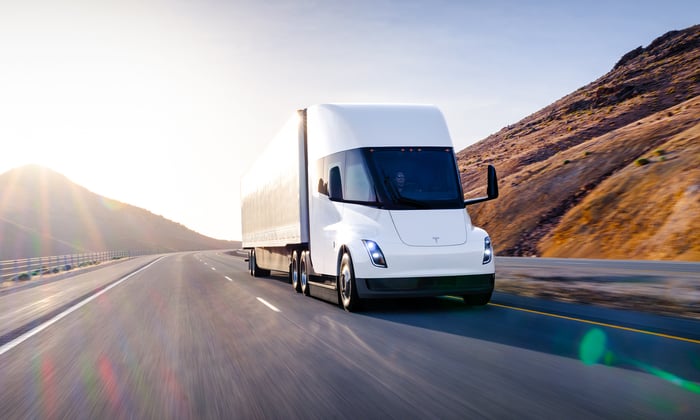
Image source: Tesla.
That said, there are two potential flies in the ointment here:
- Tesla's vehicles have not been approved for unsupervised FSD yet, so Tesla owners who want to earn money by allowing their vehicles to participate in the robotaxi service aren't able to do so.
- Tesla's plan to aggressively ramp up Cybercab production won't make sense if it doesn't receive unsupervised robotaxi approval. Cybercabs don't have steering wheels or pedals. Hence, having a safety driver on board as a backup is not an option.
Consequently, while the potential of the robotaxi service is rising, so is the risk that Tesla will ramp up Cybercab production and capital expenditures without having the necessary regulatory approvals, or at least, enough approvals to justify the ramp.
What management said on the matter
Musk was asked about the potential for a mismatch between Cybercab production and regulatory approvals at the recent annual general meeting. He responded that "the rate at which we receive regulatory approval will roughly match the rate of Cybercab production."
He went on to say that "the regulators will have just fewer and fewer reasons to say no," based on favorable accident statistics. He also pointed to the deployment of rival Waymo's robotaxis as a development that is helping pave the way for social acceptance of autonomous vehicles.
Image source: Tesla.
Musk is right that Waymo's deployment and Tesla's robotaxi rollout in Austin are increasing the chances of wider approval for autonomous vehicles. However, what's more questionable is the assumption that the early approvals for Tesla's vehicles to operate as unsupervised robotaxis (if there are any) will cover large enough populations and areas to justify the mass production of Cybercabs starting in April.
The year of the robotaxi
As such, investors should be skeptical of the idea that Cybercabs will be a common sight on U.S. streets in the second half of 2026. That said, Tesla is making progress with its robotaxi rollout, and driverless robotaxis are already being tested (without passengers) in Austin.
Image source: Getty Images.
Moreover, while critics argue that Tesla has hardly any robotaxi safety data available, because it wasn't until recently that it had any robotaxis in service without safety drivers, the reality is that Tesla has 6.9 billion miles of data from Teslas driven with supervised FSD that indicate those systems achieve substantially better safety performance than human drivers.
All told, 2026 will be the year of Tesla's robotaxi, but don't be surprised if developments don't unfold linearly throughout the year. Tesla shareholders have good reason to be optimistic about 2026, but they will need to be patient.
Don’t miss this second chance at a potentially lucrative opportunity
Ever feel like you missed the boat in buying the most successful stocks? Then you’ll want to hear this.
On rare occasions, our expert team of analysts issues a “Double Down” stock recommendation for companies that they think are about to pop. If you’re worried you’ve already missed your chance to invest, now is the best time to buy before it’s too late. And the numbers speak for themselves:
- Nvidia: if you invested $1,000 when we doubled down in 2009, you’d have $490,759!*
- Apple: if you invested $1,000 when we doubled down in 2008, you’d have $51,814!*
- Netflix: if you invested $1,000 when we doubled down in 2004, you’d have $504,239!*
Right now, we’re issuing “Double Down” alerts for three incredible companies, available when you join Stock Advisor, and there may not be another chance like this anytime soon.
See the 3 stocks »
*Stock Advisor returns as of December 25, 2025.
Lee Samaha has no position in any of the stocks mentioned. The Motley Fool has positions in and recommends Tesla. The Motley Fool has a disclosure policy.
Recommended Articles


