

This Is the 2nd Priciest Stock Market in 155 Years, Which Makes This High-Yield ETF a Genius Buy for 2026
Key Points
The Dow Jones Industrial Average, S&P 500, and Nasdaq Composite have outperformed in 2025, with respective year-to-date gains ranging from 13% to 18%.
The stock market has only been pricier during a bull market one other time over the last 155 years -- and that's bad news for investors, based on what history has to say.
A superb high-yield ETF that's packed with more than 100 time-tested, brand-name companies makes for a smart buy in the new year.
- 10 stocks we like better than Schwab U.S. Dividend Equity ETF ›
Although it's been a volatile year for Wall Street, it appears as if it'll be a highly profitable one for investors who've stayed the course. As of the closing bell on Dec. 17, the ageless Dow Jones Industrial Average (DJINDICES: ^DJI), benchmark S&P 500 (SNPINDEX: ^GSPC), and growth stock-dependent Nasdaq Composite (NASDAQINDEX: ^IXIC) have, respectively, gained 13%, 14%, and 18% year-to-date.
The artificial intelligence revolution, coupled with the Federal Reserve lowering interest rates, has investors excited about the future -- but perhaps a bit too excited.
Where to invest $1,000 right now? Our analyst team just revealed what they believe are the 10 best stocks to buy right now, when you join Stock Advisor. See the stocks »
As things stand now, we're set to enter 2026 with the second priciest stock market in history. Should things go south on Wall Street in the new year, as history has foreshadowed, one exchange-traded fund (ETF) stands out as a truly genius buy for 2026.

Image source: Getty Images.
The stock market is in rarified territory
To preface this discussion, "value" is a somewhat subjective term. Every investor has their unique blueprint for evaluating securities, which means what you find to be pricey might be viewed as a bargain by another individual. This subjectivity is one of the primary reasons the stock market is so unpredictable over short periods.
Most investors turn to the time-tested price-to-earnings (P/E) ratio when evaluating businesses for investment purposes. The P/E ratio is calculated by dividing a company's share price by its trailing 12-month earnings per share (EPS). While this valuation tool works wonders for profitable, mature businesses, it's not particularly useful for growth stocks and loses virtually all of its utility during recessions when EPS can turn negative.
The valuation metric that demonstrates just how expensive the stock market is right now is the S&P 500's Shiller P/E Ratio, which you'll also find referred to as the cyclically adjusted P/E Ratio, or CAPE Ratio.
Instead of looking at 12 months of EPS data, the Shiller P/E is based on average inflation-adjusted EPS over the previous 10 years. This helps minimize the ebbs and flows of economic cycles, maintaining the usefulness of this valuation measure even during recessions.
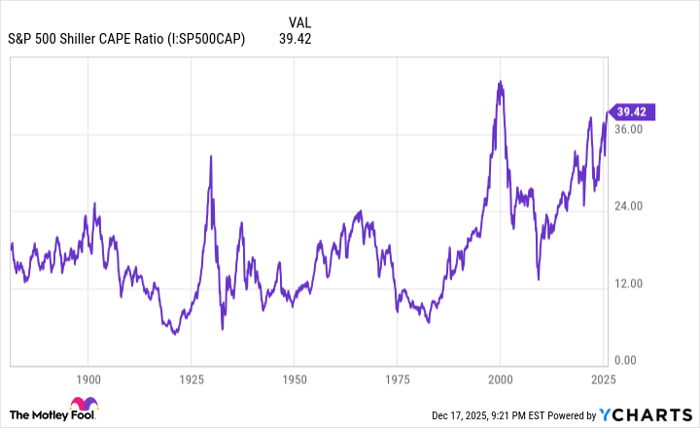
S&P 500 Shiller CAPE Ratio data by YCharts.
When back-tested to January 1871, the S&P 500's Shiller P/E has averaged a multiple of 17.32. As of the closing bell on Dec. 17, it chimed in at a multiple of 39.59, which is 129% above its 155-year average. It's also within a stone's throw of the 41.20 peak achieved during the current bull market.
The only time the stock market has been pricier than it is now is in the months leading up to the bursting of the dot-com bubble. In December 1999, the Shiller P/E hit an all-time high of 44.19.
Over 155 years, there have only been six occurrences of the S&P 500's Shiller P/E topping 30 and maintaining this premium for at least two months. Excluding the present instance, the five prior occurrences were all, eventually, followed by declines in the Dow Jones Industrial Average, S&P 500, and/or Nasdaq Composite of at least 20%.
In other words, the Shiller P/E has been a historically flawless foreshadower of significant downside in equities. Although it's in no way a timing tool, it serves as a stark reminder that premium valuations aren't sustainable over a long period.
With several catalysts potentially poised to pull the rug out from beneath Wall Street in 2026, investors are going to have to be mindful of where they put their money to work.

Image source: Getty Images.
This high-yield ETF checks all the right boxes for investors
If a stock market correction, bear market, or even a short-lived elevator-down move were to take place in the new year, the genius, high-yield ETF that can help investors navigate this turbulence is the Schwab U.S. Dividend Equity ETF (NYSEMKT: SCHD).
Though there is a laundry list of effective investment strategies on Wall Street, few have been as consistently successful as buying and holding high-quality dividend stocks.
In "The Power of Dividends: Past, Present, and Future," the analysts at Hartford Funds, in collaboration with Ned Davis Research, compared the performance of dividend-paying companies to non-payers over the course of 51 years (1973-2024). Researchers found that dividend stocks more than doubled the average annual return of non-payers (9.2% vs. 4.31%). What's more, the income stocks were notably less volatile than the benchmark S&P 500 and the non-payers.
The Schwab U.S. Dividend Equity ETF aims to mirror the total returns, including dividends, of the Dow Jones U.S. Dividend 100 Index, before fees and expenses. Schwab's ETF is packed with 103 predominantly time-tested, brand-name companies.
For example, drugmakers Merck, Amgen, Bristol Myers Squibb, and AbbVie are four of the top five holdings. Since we can't control when we become ill or what ailment(s) we develop, demand for novel therapies remains steady in any economic climate. Other top 10 holdings include consumer goods giants Coca-Cola and PepsiCo, as well as communication services titan Verizon Communications. These are all businesses that generate abundant and predictable operating cash flow.
Additionally, the Schwab U.S. Dividend Equity ETF is crushing the broad-based S&P 500 in terms of yield. Whereas Wall Street's broad-based stock index is yielding a measly 1.12%, as of Dec. 12, courtesy of data from The Wall Street Journal, the Schwab U.S. Dividend Equity ETF had a yield of approximately 3.8%!
Amazingly, the luxury of instant diversification comes at a very low cost. Since turnover in the Dow Jones U.S. Dividend 100 Index is minimal, the net expenses ratio -- i.e., the management fees and expenses investors pay -- is a mere 0.06%. This means only $0.60 of every $1,000 invested annually is going toward various fees and expenses. For comparison, the average passive ETF has a net expense ratio of 0.16%.
Best of all, the Schwab U.S. Dividend Equity ETF offers investors value amid a historically pricey stock market. As of Dec. 12, WSJ listed the S&P 500 as having a trailing 12-month P/E ratio of 25.63. But as of the end of November, the average trailing 12-month P/E ratio for the 103 companies that comprise the Schwab U.S. Dividend Equity ETF was just 17.18.
Even though growth rates for these mature businesses will be relatively tame, this genius ETF provides a high floor and steady appreciation potential for income- and value-seeking investors.
Should you buy stock in Schwab U.S. Dividend Equity ETF right now?
Before you buy stock in Schwab U.S. Dividend Equity ETF, consider this:
The Motley Fool Stock Advisor analyst team just identified what they believe are the 10 best stocks for investors to buy now… and Schwab U.S. Dividend Equity ETF wasn’t one of them. The 10 stocks that made the cut could produce monster returns in the coming years.
Consider when Netflix made this list on December 17, 2004... if you invested $1,000 at the time of our recommendation, you’d have $511,196!* Or when Nvidia made this list on April 15, 2005... if you invested $1,000 at the time of our recommendation, you’d have $1,047,897!*
Now, it’s worth noting Stock Advisor’s total average return is 951% — a market-crushing outperformance compared to 192% for the S&P 500. Don't miss the latest top 10 list, available with Stock Advisor, and join an investing community built by individual investors for individual investors.
See the 10 stocks »
*Stock Advisor returns as of December 19, 2025.
Sean Williams has no position in any of the stocks mentioned. The Motley Fool has positions in and recommends AbbVie, Amgen, Bristol Myers Squibb, and Merck. The Motley Fool recommends Verizon Communications. The Motley Fool has a disclosure policy.
Recommended Articles


