

Better Dividend Stock: Annaly Capital vs. Realty Income
Key Points
Annaly Capital boasts a massive dividend yield that demands investor attention.
Realty Income's dividend yield is smaller, but it pays out monthly and is growing.
- The $23,760 Social Security bonus most retirees completely overlook ›
When you're considering what kind of dividend stocks you want to buy, you really need to decide what kind of investor you are. Do you want a set-it-and-forget-it stock? Are you seeking a substantial yield and willing to accept some volatility? Are you looking for your dividend payments to grow over time? And how do you plan to use your dividend -- as monthly or quarterly income, or will you reinvest into your portfolio?
Where to invest $1,000 right now? Our analyst team just revealed what they believe are the 10 best stocks to buy right now, when you join Stock Advisor. See the stocks »
In the world of dividend stocks, there are literally hundreds from which to choose -- blue chip names, growth stocks, high-yield stocks, and real estate investment trusts. Some stocks that find a way to grow their dividend for at least 50 consecutive years earn the distinction of Dividend King. Even among those buckets of dividend stocks, you'll find companies that are vastly different.
For instance, Annaly Capital Management (NYSE: NLY) and Realty Income (NYSE: O) are both REITs, which means they are required to pay out 90% of income in the form of dividends. REITs are popular dividend stocks, but Annaly Capital and Realty Income couldn't be more different. Let's take a closer look at these two and choose which is the superior real estate dividend stock.

Image source: Getty Images.
About Annaly Capital
Annaly Capital, which is based in New York, is one of the largest mortgage-backed REITs. Rather than dealing specifically with property, Annaly owns and manages real estate-related investment securities, including mortgage pass-through certificates and collateralized mortgage obligations.
Its largest segment is Annaly Agency Group, which has $87.3 billion in assets and works in the mortgage-backed securities (MBS) market. Through this segment, Annaly invests in residential and commercial mortgages that are guaranteed by the Federal National Mortgage Association (Fannie Mae) and the Federal Home Loan Mortgage Corporation (Freddie Mac), or through the U.S. Department of Housing and Urban Development's Ginnie Mae program.
It also has a mortgage servicing program that provides complementary cash flow to Annaly's MBS work, and a residential credit division that provides direct financing to residential homeowners. Overall, the company has financed more than 1 million homes.
Its third-quarter earnings report showed that the company's portfolio has a $97.8 billion investment portfolio, with a book value per share of $19.25. Earnings per share came to $1.20, versus just $0.05 per share a year ago.
The company offers a quarterly dividend of $0.70 per share, which equates to a massive dividend yield of 12.6%.
About Realty Income
Unlike Annaly Capital, Realty Income is in the property business. It has a portfolio of more than 15,500 properties stretching in every U.S. state, plus the United Kingdom and seven other European countries. The company's holdings are commercial, not residential, but they are diversified across multiple sectors. Its customers include Dollar General, Wynn Resorts, AMC Entertainment, CVS Health, and Walmart.
|
Top Industries |
Percentage of Reality Income Portfolio |
|---|---|
|
Grocery stores |
10.8% |
|
Convenience stores |
9.7% |
|
Home improvement stores |
6.4% |
|
Dollar stores |
6.2% |
|
Quick-service restaurants |
4.8% |
Data source: Realty Income.
The company reported revenue of $1.47 billion in the third quarter, up from $1.33 billion. Adjusted funds from operations were $922 million and $1.08 per share, up from $915.6 million and $1.05 per share a year ago.
Realty Income's dividend yield is smaller than Annaly's, but it's still a very respectable 5.6%. Reality Income pays its dividend on a monthly basis, rather than quarterly, which makes it easier for investors seeking a steady revenue stream.
Which dividend stock is better?
There are two major factors separating these two REITs. The first is dividend growth. Annaly has a consistent dividend in that it pays out every quarter, but it's also been forced to cut the dividend in recent years -- a 26% cut in 2023, and a 12% cut in 2020.
Meanwhile, Reality Income is famous for its history of dividend increases. The company has paid a monthly dividend for 666 consecutive months as of this writing and has recently announced its 133rd consecutive monthly increase.
All that adds up over time. When you look at the two companies in the last five years, Realty Income has increased its dividend by 46%, while Annaly Capital cut its dividend by nearly 42%.
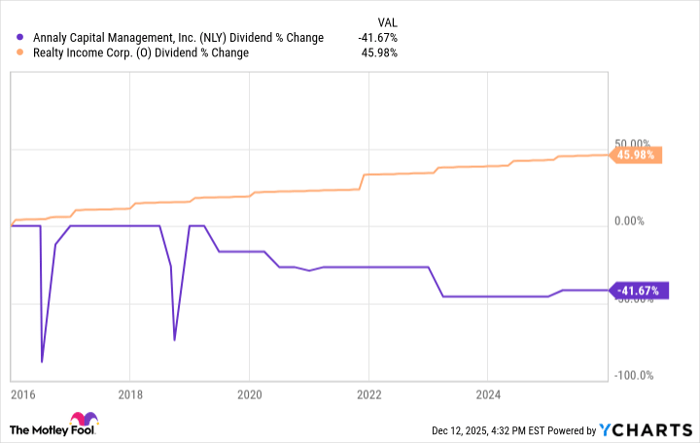
NLY Dividend data by YCharts
The second factor for me is the payout schedule. I will always prefer a dividend stock that pays me monthly because the sooner I receive the money, the sooner I can put it to work for me. I would much rather get a payment every month than have to wait 90 days for the next payout -- knowing that money is working for the company, not its investors.
So, despite the massive yield provided by Annaly Capital, my choice in this head-to-head battle of REITs is Realty Income. The payout schedule and dividend growth are massive advantages that the mortgage REIT can't overcome.
The $23,760 Social Security bonus most retirees completely overlook
If you're like most Americans, you're a few years (or more) behind on your retirement savings. But a handful of little-known "Social Security secrets" could help ensure a boost in your retirement income.
One easy trick could pay you as much as $23,760 more... each year! Once you learn how to maximize your Social Security benefits, we think you could retire confidently with the peace of mind we're all after. Join Stock Advisor to learn more about these strategies.
View the "Social Security secrets" »
Patrick Sanders has no position in any of the stocks mentioned. The Motley Fool has positions in and recommends Realty Income and Walmart. The Motley Fool recommends CVS Health. The Motley Fool has a disclosure policy.
Recommended Articles


