




Gold blasts above $4,330 as US jobs data and Venezuela flare-up spark haven rush
- Gold rises above $4,340 as mixed payrolls lift unemployment above Fed projections.
- Safe-haven demand strengthens after Trump orders blockade of Venezuelan oil tankers.
- Fed’s Waller says rates remain above neutral, sees no urgency for immediate cuts.
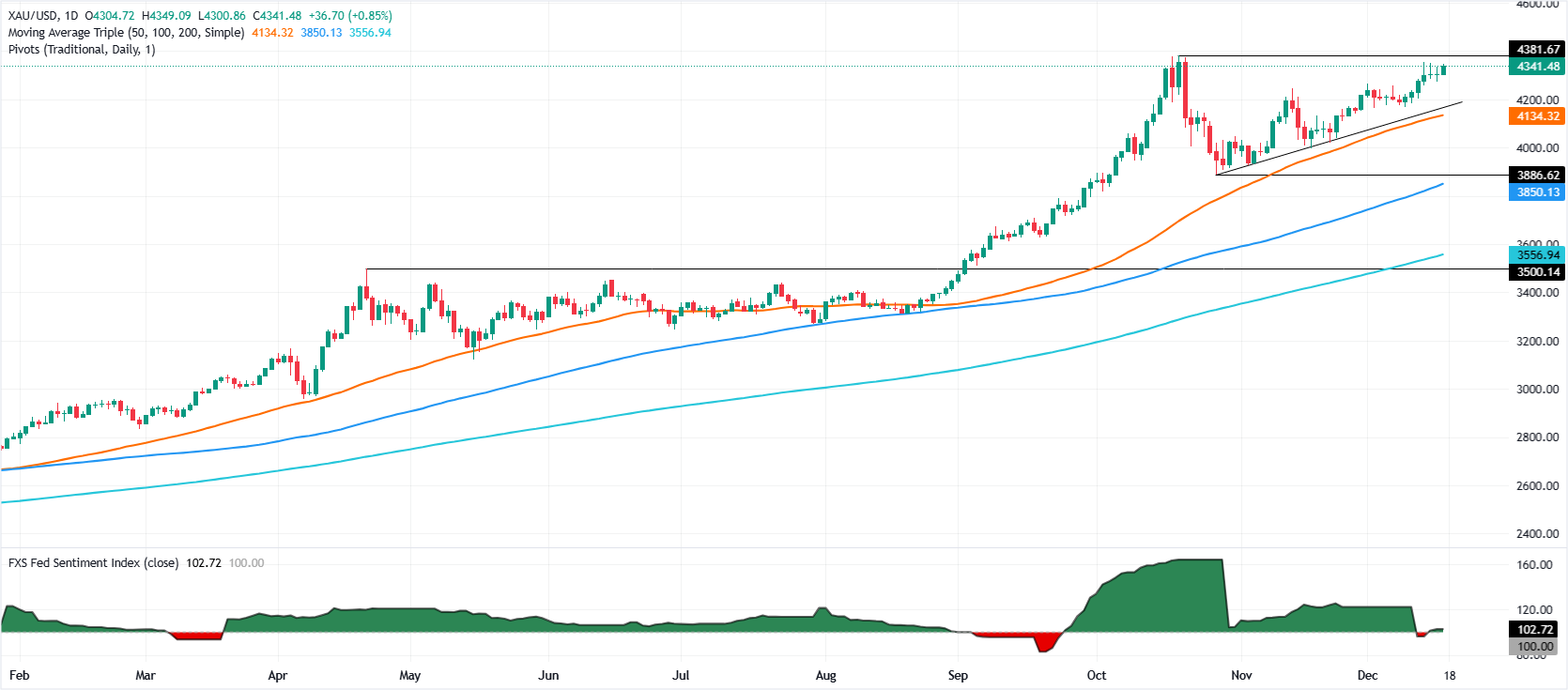
Gold (XAU/USD) rallies on Wednesday, edging up 0.87% following a mixed US jobs report on Tuesday, along with rising tensions of the US-Venezuela conflict and comments by Federal Reserve (Fed) Governor Christopher Waller. At the time of writing, XAU/USD trades at $4,338 after bouncing off daily highs of $4,349.
Bullion rallies nearly 1% on rising geopolitical risks, expectations of prolonged Fed easing
On Tuesday, the latest Nonfarm Payrolls prints were mixed. October’s data showed that the economy slashed 105K people from the workforce, but November’s figures showed a creation of 64K job posts. Therefore, the Unemployment Rate shot up, from 4.4% to 4.6%, exceeding the Fed’s officials’ 4.5% projections for the end of the year.
Despite this, expectations for a rate cut in January remained unchanged, at around 24%, according to Capital Edge data.
Geopolitics is also driving the yellow metal higher after the US President Donald Trump ordered a blockade of sanctioned oil tankers going into or leaving Venezuela.
Earlier, Fed Governor Christopher Waller crossed the wires. He said that rate cuts have positively impacted the employment sector, while adding that rates are 50 to 100 bps above neutral levels. Nevertheless, he said that there’s no rush to continue reducing the Fed funds rate and that inflation “is unlikely to pick up again.”
Ahead, the US docket will feature inflation figures and Initial Jobless Claims for the week ending December 13.
Daily digest market movers: Gold prices underpinned by Trump’s action on Venezuela
- In his Truth Social network, US President Donald Trump posted, “Venezuela is completely surrounded by the largest Armada ever assembled in the History of South America.” He demands that Venezuela return to the US “all of the Oil, Land, and other Assets that they previously stole from us. The illegitimate Maduro Regime is using Oil from these stolen Oil Fields to finance themselves, Drug Terrorism, Human Trafficking, Murder, and Kidnapping.” He also designated the Venezuelan regime as a foreign terrorist organization.
- Trump’s action pushed Crude Oil higher, along with Gold, due to heightened geopolitical risks.
- Further US economic data showed that American consumers remain resilient following the latest Retail Sales report. US Retail Sales were flat in October, easing from September’s 0.1% gain and missing forecasts for a 0.1% increase. In contrast, control-group sales —used to calculate the consumer spending component of GDP— rebounded sharply, rising 0.8% after a 0.1% contraction , the US Census Bureau reported.
- US Treasury yields are falling, with the 10-year benchmark note rate little changed, rising one basis point to 4.159%. US real yields, which correlate inversely with Gold prices, rose nearly two basis points to 1.929%.
- The US Dollar Index (DXY), which tracks the Greenbacks’ performance against a basket of six peers, is up 0.13% at 98.33.
Technical Analysis: Gold’s uptrend intact is above $4,300
Gold’s broader uptrend remains intact, but it seems that buyers are lacking the strength to clear $4,350. Bullish momentum accelerated, as shown by the Relative Strength Index (RSI), an indication that XAU/USD could hit its all-time high of $4,381. In that outcome, this clears the path to challenge key resistance targets at $4,400, $4,450, and $4,500.
Conversely, Gold’s slide below $4,300, the December 11 high turned support, is up next at $4,285, with further support at $4,250 ahead of a deeper pullback toward $4,200.
Gold FAQs
Gold has played a key role in human’s history as it has been widely used as a store of value and medium of exchange. Currently, apart from its shine and usage for jewelry, the precious metal is widely seen as a safe-haven asset, meaning that it is considered a good investment during turbulent times. Gold is also widely seen as a hedge against inflation and against depreciating currencies as it doesn’t rely on any specific issuer or government.
Central banks are the biggest Gold holders. In their aim to support their currencies in turbulent times, central banks tend to diversify their reserves and buy Gold to improve the perceived strength of the economy and the currency. High Gold reserves can be a source of trust for a country’s solvency. Central banks added 1,136 tonnes of Gold worth around $70 billion to their reserves in 2022, according to data from the World Gold Council. This is the highest yearly purchase since records began. Central banks from emerging economies such as China, India and Turkey are quickly increasing their Gold reserves.
Gold has an inverse correlation with the US Dollar and US Treasuries, which are both major reserve and safe-haven assets. When the Dollar depreciates, Gold tends to rise, enabling investors and central banks to diversify their assets in turbulent times. Gold is also inversely correlated with risk assets. A rally in the stock market tends to weaken Gold price, while sell-offs in riskier markets tend to favor the precious metal.
The price can move due to a wide range of factors. Geopolitical instability or fears of a deep recession can quickly make Gold price escalate due to its safe-haven status. As a yield-less asset, Gold tends to rise with lower interest rates, while higher cost of money usually weighs down on the yellow metal. Still, most moves depend on how the US Dollar (USD) behaves as the asset is priced in dollars (XAU/USD). A strong Dollar tends to keep the price of Gold controlled, whereas a weaker Dollar is likely to push Gold prices up.
Recommended Articles


