

Taiwan Semiconductor Manufacturing vs. ASML: Which Stock Will Outperform in 2026?
Key Points
TSMC and ASML are critical companies in the semiconductor industry with strong long-term outlooks.
TSMC is the leader in chip manufacturing, and has a strong runway of growth ahead.
ASML has a monopoly on the machines needed to make advanced chips.
- 10 stocks we like better than Taiwan Semiconductor Manufacturing ›
While chip designers like Nvidia tend to grab the most investor attention, they are not the only important players in the semiconductor space. Taiwan Semiconductor Manufacturing (NYSE: TSM) and ASML (NASDAQ: ASML) play very different but equally important roles in the semiconductor value chain.
With demand for chips booming due to the artificial intelligence (AI) data center buildout, both stocks are well-positioned heading into 2026. The question, though, is which one will outperform next year.
Where to invest $1,000 right now? Our analyst team just revealed what they believe are the 10 best stocks to buy right now. Continue »
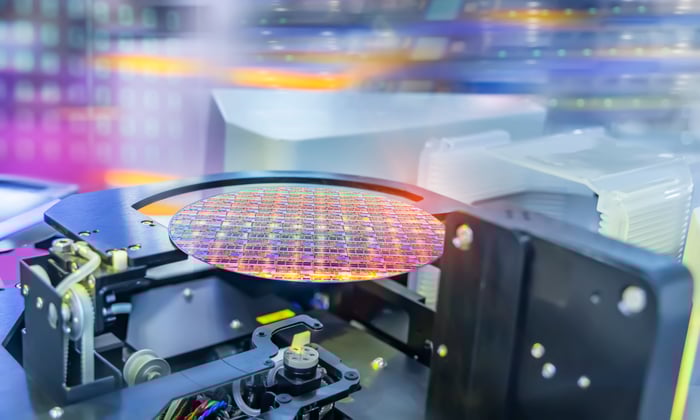
Image source: Getty Images.
The case for Taiwan Semiconductor Manufacturing
Taiwan Semiconductor Manufacturing, or TSMC for short, is the world's leading semiconductor contract manufacturer. The company is one of only three chip manufacturers, along with Intel and Samsung, that make advanced chips at small node sizes.
Nodes refer to a chip's current generation and correspond to an increase in transistor density, which provides increased power while being more energy efficient.
With both Intel and Samsung struggling with yield issues (defective chips per wafer) for advanced nodes, TSMC has become the only company that can manufacture advanced chips at scale. As such, it has become one of the most important cogs in the semiconductor supply chain and one of the biggest beneficiaries of the current AI infrastructure buildout.
The struggles of its competitors have also given TSMC strong pricing power, with it expected to increase prices by 3% to 10% next year.
TSMC is working closely with customers like Nvidia to help meet future demand, giving it strong visibility. It projects demand for AI chips, such as graphics processing units (GPUs) to grow at a 40% compound annual growth (CAGR) over the next few years.
Meanwhile, TSMC is also cheaper than ASML, trading at a forward price-to-earnings (P/E) ratio of under 23.5 times based on analysts' 2026 estimates compared to more than 36.5 times for ASML.
The case for ASML
While TSMC is a virtual monopoly at the moment, given the struggles of its competitors, ASML is an actual full-blown monopoly. There are no competitive alternatives to the extreme ultraviolet lithography (EUV) machines it makes that are needed to manufacture advanced chips.
So as TSMC expands, and Intel and Samsung try to catch up, they need to buy ASML's EUV machines.
With the demand for AI chips booming, ASML finds itself in a strong position. TSMC has to build new fabs (chip manufacturing facilities) to increase capacity to keep up with demand, while Intel has also been aggressively expanding its footprint, backed by government loans from the CHIPS Act. Meanwhile, Micron is currently making a huge push to build DRAM memory fabs in the U.S. that will likely use both EUV and DUV machines, which should be a tailwind for ASML in later years.
The company has also developed its next-generation technology, called High-NA EUV (high numerical aperture extreme ultraviolet lithography), that will shrink node sizes even more. These new machines cost around $400 million apiece, a significant increase compared to the $220 million of its EUV machines, and all three leading foundries have already taken orders to test them out.
The one negative for the company moving into next year is that it has seen a pull forward in demand from China for its older DUV (deep ultraviolet) machines over the last few years. This could lead to fewer sales of these machines, which are used to make less complex chips, in 2026.
The verdict
I think TSMC and ASML will both be long-term semiconductor winners, as both will benefit from the increased proliferation of advanced chips. AI is leading the way now, but you also have potential drivers in robotaxis and quantum computing down the road as well.
However, for 2026, I think TSMC's stock is better positioned to outperform. The stock is cheaper, and it has a strong AI tailwind, while ASML's 2026 could be a bit rockier, given the earlier pull-forward in demand with China. Meanwhile, the mass adoption of TSMC's new High-NA EUV is still years down the road, and the bulk of the Micron buildout is still a few years away.
Should you invest $1,000 in Taiwan Semiconductor Manufacturing right now?
Before you buy stock in Taiwan Semiconductor Manufacturing, consider this:
The Motley Fool Stock Advisor analyst team just identified what they believe are the 10 best stocks for investors to buy now… and Taiwan Semiconductor Manufacturing wasn’t one of them. The 10 stocks that made the cut could produce monster returns in the coming years.
Consider when Netflix made this list on December 17, 2004... if you invested $1,000 at the time of our recommendation, you’d have $556,658!* Or when Nvidia made this list on April 15, 2005... if you invested $1,000 at the time of our recommendation, you’d have $1,124,157!*
Now, it’s worth noting Stock Advisor’s total average return is 1,001% — a market-crushing outperformance compared to 194% for the S&P 500. Don’t miss out on the latest top 10 list, available when you join Stock Advisor.
See the 10 stocks »
*Stock Advisor returns as of December 1, 2025
Geoffrey Seiler has no position in any of the stocks mentioned. The Motley Fool has positions in and recommends ASML, Intel, Nvidia, and Taiwan Semiconductor Manufacturing. The Motley Fool has a disclosure policy.
Recommended Articles


