




Warren Buffett Called This Asset "Unproductive," But Now It's Crushing the S&P 500, the Nasdaq, and even Nvidia
Key Points
Warren Buffett has served as the CEO of Berkshire Hathaway since 1965, where he oversees several fully owned subsidiaries and a $304 billion portfolio of stocks.
Buffett has shunned gold during his career, calling it an "unproductive" asset because it doesn't produce any revenue or earnings.
However, gold is having a spectacular year in 2025 as political instability and government spending take center stage.
- 10 stocks we like better than SPDR Gold Trust ›
Warren Buffett is one of the world's greatest investors, having steered the Berkshire Hathaway holding company to a compound annual return of 19.9% since he became its CEO in 1965. In dollar terms, a $1,000 investment in Berkshire stock back then would have been worth a whopping $44.7 million at the end of 2024, whereas the same investment in the S&P 500 (SNPINDEX: ^GSPC) would have grown to just $342,906.
Buffett invests in companies with steady growth, reliable profits, and strong management teams. He especially likes companies that return money to shareholders through dividends and stock buybacks, because they compound his returns much faster. In other words, he's a big fan of assets that produce income.
Where to invest $1,000 right now? Our analyst team just revealed what they believe are the 10 best stocks to buy right now, when you join Stock Advisor. See the stocks »
That's why Buffett isn't a fan of gold. In his 2011 letter to Berkshire's shareholders, he actually referred to it as an unproductive asset because it doesn't generate any revenue or earnings. However, the shiny yellow metal has delivered an eye-popping 62% return this year, crushing the S&P 500, the Nasdaq-100, and even artificial intelligence (AI) powerhouse Nvidia, which have gained between 13% and 32%.
Image source: The Motley Fool.
Why investors are flocking to gold this year
Warren Buffett was right when he called gold unproductive. Not only does it generate zero income, but it also has very little utility in industrial settings. Small traces of the yellow metal can be found in semiconductors because of its electrical conductivity, and it remains a staple of the jewelry industry, but its primary source of demand comes from investors who speculate it will continue to rise in value.
History supports their theory, because gold has been a widely accepted store of value for thousands of years because of its scarcity relative to other commodities. Many countries -- including the U.S. -- even used to peg their domestic currencies to the yellow metal.
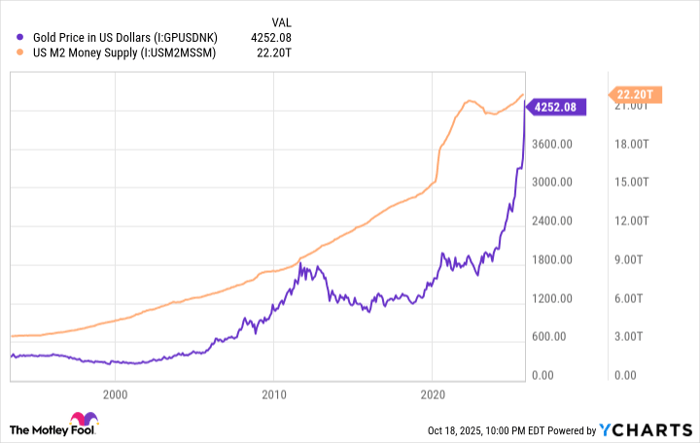
The gold standard required countries to back their currencies with physical bullion, which limited how much money they could "print." This kept a lid on money supply and therefore inflation. But the U.S. abandoned the gold standard in 1971, which eliminated that restriction. Unsurprisingly, money supply has since exploded, eroding almost 90% of the U.S. dollar's purchasing power.
Gold has trended higher ever since, and investors sense a potential acceleration in the growth of money supply given the U.S. government's enormous budget deficits. According to the Committee for a Responsible Federal Budget (CBO), the government is forecast to spend a staggering $22.7 trillion more than it will take in over the next decade, which could see the current national debt of $37.9 trillion balloon to around $60 trillion.
Investors are betting the only solution to this concerning fiscal situation is to devalue the U.S. dollar even further by aggressively expanding the money supply. As a result, they are flocking to gold, which is the one asset that has consistently maintained value throughout all of human history.
Gold Price in US Dollars data by YCharts
Buying gold has never been simpler
Exchange-traded funds (ETFs) that directly track gold's performance are widely available. These funds can be bought and sold instantly through any investing platform, so they are much easier to move than actual gold bars.
Most ETFs charge an annual fee, but since they eliminate the storage and insurance costs associated with owning physical gold, most investors still come out ahead. Below are three popular funds and their expense ratios (the proportion of each fund deducted annually to cover management costs):
|
ETF |
Expense Ratio |
|---|---|
|
SPDR Gold Trust (NYSEMKT: GLD) |
0.40% |
|
Abrdn Physical Gold Shares ETF (NYSEMKT: SGOL) |
0.17% |
|
VanEck Merk Gold ETF (NYSEMKT: OUNZ) |
0.25% |
Data source: State Street, Aberdeen Investments, and VanEck.
The SPDR Gold Trust is the largest of the three by far, with $142 billion in assets under management. That figure is fully backed by physical gold reserves, although investors aren't entitled to take delivery of any bullion. It has the highest expense ratio of the three funds listed above, but it could be the right choice for investors who transact in large volumes, because it offers the most liquidity.
For investors who simply want to prioritize cost, the Abrdn Physical Gold Shares ETF might be the way to go. It offers exactly the same exposure to gold as the SPDR Gold Trust, but with a much lower annual fee.
Should you buy gold right now?
Warren Buffett's comments about gold might seem silly right now in light of its recent performance, as its return this year certainly isn't typical. In fact, the value of gold has grown at a more modest compound annual rate of 7.96% over the last 30 years, trailing the S&P 500, which has grown by 10.67% per year over the same period.
That annual difference of 2.6 percentage-points made a staggering impact on returns in dollar terms:
|
Starting Balance 30 Years Ago |
Compound Annual Return |
Balance Today |
|---|---|---|
|
$50,000 |
7.96% (Gold) |
$497,572 |
|
$50,000 |
10.67% (S&P 500) |
$1,046,808 |
Calculations by author.
Simply put, Buffett's decision to focus on productive assets rather than gold has paid off in the long run. But that doesn't mean investors should ignore the yellow metal entirely, because holding a small portfolio allocation of around 10% will yield benefits in years like 2025 when political instability and reckless government spending take center stage.
Should you invest $1,000 in SPDR Gold Trust right now?
Before you buy stock in SPDR Gold Trust, consider this:
The Motley Fool Stock Advisor analyst team just identified what they believe are the 10 best stocks for investors to buy now… and SPDR Gold Trust wasn’t one of them. The 10 stocks that made the cut could produce monster returns in the coming years.
Consider when Netflix made this list on December 17, 2004... if you invested $1,000 at the time of our recommendation, you’d have $667,945!* Or when Nvidia made this list on April 15, 2005... if you invested $1,000 at the time of our recommendation, you’d have $1,119,558!*
Now, it’s worth noting Stock Advisor’s total average return is 1,073% — a market-crushing outperformance compared to 191% for the S&P 500. Don’t miss out on the latest top 10 list, available when you join Stock Advisor.
See the 10 stocks »
*Stock Advisor returns as of October 20, 2025
Anthony Di Pizio has no position in any of the stocks mentioned. The Motley Fool has positions in and recommends Berkshire Hathaway and Nvidia. The Motley Fool has a disclosure policy.
Recommended Articles


